
On March 25, six plainclothes DHS agents “arrested” Rümeysa Öztürk, a 30-year Tufts University PhD student in child psychology and development. Öztürk, a Turkish national, earned a master’s in developmental psychology from Columbia University where she attended on a Fulbright scholarship, and she continued her study at Tufts on a F-1 student visa. The agents grabbed Öztürk as she left her home to meet up with some friends for an iftar dinner during Ramadan. Agents did not tell Öztürk why they “arrested” her, and they moved her from detention center to detention center, eventually taking her to a center in Louisiana. On May 9, Öztürk was released, while the legal case over her detention continues.
Öztürk spent 45 days in the Louisiana center, and she wrote about her experience in a piece for Vanity Fair where she described her abduction, the conditions at the center, and the bonds she made with other detainees. The piece, entitled “‘Even God Cannot Hear Us Here’: What I Witnessed Inside an ICE Women’s Prison,” highlights the ways that the for-profit prison system, ginned up with fear mongering rhetoric, functions as a space of dehumanization, not rehabilitation or care. We know this story, and Öztürk lays it bare. However, while Öztürk shows us the atrocious conditions, she also illuminates the humanity of individuals and the importance of community in resistance.
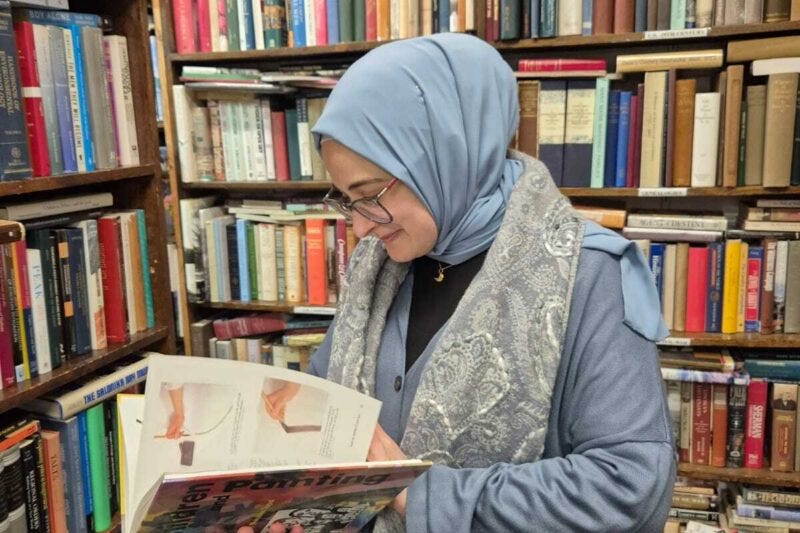
Öztürk reiterates, throughout her article, that the center, along with countless others, including the one in Florida, and prisons, strip the humanity away from individuals, making them nonexistent because the state views them as persona non grata and unworthy of existence. Öztürk, understandably, found it difficult to celebrate Eid al-Fitr at the end of Ramadan, ten days after her kidnapping. In her struggle, a “Catholic friend” told her, “Even God cannot hear us here,” even as she prayed to God, hoping for an ear. Continuing, Öztürk asked the woman, “if it was God would could not hear us, or if it was people like me before this experience, who either know nothing about the immigration detention system or prefer to ignore or forget about it.” In her question, Öztürk points out the role of centers like the one in Louisiana, the societal death of individuals.
This societal death removes the individual from those they love and those that love them, from those who support them, from those who hold them up. “All we wanted,” Öztürk writes, “was to be seen as human again. We felt invisible, stripped of our identity as breathing and living human beings.” When the agents grabbed Öztürk, she was on the phone with her mother, and her mom heard her scream, not knowing where her daughter went. In the center, Öztürk formed a community with mothers, “a singer with almost a million followers, a talented violinist, a Pilates instructor, a visual arts teacher,” and others. The women helped one another in times of crisis. They shared food with one another. They prayed with one another. They told stories together.
The women wanted the world to hear their stories, to let the world know they exist. An Armenian woman who Öztürk considered an aunt to her, told her, “Rümeysa, please write about us. Please let the world hear our story.” The woman has three kids and struggles to get by. “Many women,” Öztürk continues, “wept day and night, longing for their families. My friends showed me letters from their young children, accompanied by sweet photos of them and mischievous pictures of their pets.” These women are people, not shadows. They are individuals with families, with loved ones, with hobbies, with lives.
Amidst all of this, the women in the center created a space of beauty and love. Öztürk found herself “immersed daily in the love, beauty, resilience, and compoassion of these women” as they turned the cell and center “into a therapy space, a beauty salon, a hairstyling center, a Pilates studio, a medical center, a massage room, an interfaith temple, and an art studio all at once — without any tools or resources.” Their story, their existence, reminds me of Mary Berg and the Warsaw Ghetto, of a community continuing, seeing beauty even while others strive to dehumanize them. It reminds me of Solomon Northup, enslaved in Louisiana, who did the same. It reminds me of communities in Gaza in that, even amidst genocide, embrace beauty.
While in Palestine, Ta-Nehisi Coates spent time with artists Sahar Qawasmi and Nida Sinnokrot. One night, a group of settlers attacked their property, seeking to enstil fear in them drive them off of their land. When Coates asked how they could live under such threats, Nida responded, “It is a precarious life. At the same time, there is a strong will to stay and keep working. There are communities whose villages are destroyed eighty times and they come back. It becomes part of how you live. It’s a mode of survival. This is how you live on the land. We will keep going back, building the things they keep destroying.” Even amidst all of this, life goes on. Coates sees the couple birth two kids, guiding the goat through the birth, and , Sahar and Nida offer artists residencies, providing a community, a space to create.
Artists have power, through words, image, or sound, to create beauty and to make change. Coates tells his students this when he says a writer’s “task is nothing less than doing their part to save the world.” Saving the world involves creation, it involves beauty, it involves, as Coates puts it elsewhere, “drawing out a common humanity.” This drawing out of our common humanity leads us forward, it “is indispensable for our future, if only because what must be cultivated and cared for must be seen.” When we do not see, we do not care. When we do not cultivate, nothing grows.
Öztürk points this out continually in her piece, especially when discusses her role as a writer. For Öztürk, “Writing is a form of listening, a process of thinking . . . [and] the heart of freedom of expression.” Writing is power. When Öztürk was finally able to get a book from the detention center’s library, she “discovered handwritten notes scattered throughout the book, dated and written by various detainees over time.” The notes, written by other detainees, consisted of “reminders of hope, strength, and assurance that this, too, shall pass.” The words brought comfort and solace for the future, for what comes next, for what lies beyond the moment where humanity has been stripped away. Öztürk wept reading the messages, and she thought the ways that “human beings can find ways to uplift each other, transcending time, space, and borders if they wan to and if they choose to,” connecting across these spaces to offer resistance, hope, and comfort.
Öztürk work focuses on children, specifically the ways that children interact with social media and how to help children become kind and compassionate members of society. She quotes James Baldwin who wrote, The children are always ours, every single one of them, all over the globe.” Then, she relates the suffering of children acorss the globe from the 50,000 Palestinian children killed since October 2023, the 537,000 Yemeni children suffering malnutrition, and the 6.5 million Sudanese children who have endured displacement. If we claim to care about children, how can we allow this to happen? How can we turn a blind eye? How can we make individuals suffer, separating them from their children? Tearing away their humanity?
Öztürk, through her words, gives the women she communed with their humanity back, in some form. Öztürk tells us about them. Öztürk shares their stories with us, telling us not to look away. We have been warned, again and again and again and again the dangers of looking away when individuals lose their humanity in the eyes of society, when they become invisible, hidden in swamps, in sweltering cages, on islands. We know where this leads. We’ve seen it over and over again, and again I ask the question, “Where will you stand? Whose humanity matters to you?”
I want to leave you with John Oliver’s segment from earlier this year about ICE Detention and the conditions in center’s like the one where Öztürk and other women were held. What are your thoughts? As always, let me know in the comments below. Make sure to follow me on Bluesky @silaslapham.
 Interminable Rambling