
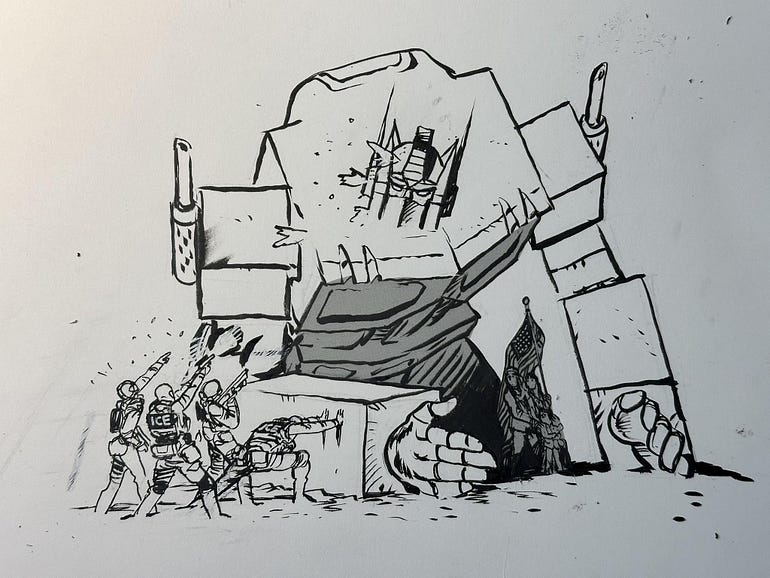
Over the past couple of weeks, starting with the news of Rachel Nicole Good’s murder and continuing to the current protests against ICE and the ruling of medical examiner in Texas that ruled that Gerald Lunas Campos, detained at an ICE facility in Texas, was murdered by a guard who performed a chokehold on him, I’ve been listening, on repeat, songs such as the Idles’ “Danny Nedelko,” System of a Down’s “Sad Statue,” Oddisee’s “You Grew Up,”and The Muslims’ “Illegals.” Each of these songs speaks to the current moment, even though each appeared during different recent histroical moments. Along with these songs, I’ve been reading, for my Early American Literature course, some of the documents produced during the Revolutionary period from Thomas Paine’s Common Sense to The Federalist Papers. All of these things, and more, speak to me in this moment.
The Idles “Danny Nedelko” came out in 2018, during the European Migrant Crisis that brought individuals from various locales to Europe seeking refuge and a better life. Written about the band’s friend, Danny Nedelko, the singer of the Ukrainian band Heavy Lungs, the song calls out blind patriotism and virulent nationalism while celebrating the diversity of humanity. Joe Talbot runs through a litany of immigrants to England and Europe from celebrities such as Freddie Mercury to a Nigerian mother of three. In the chorus, Talbot points out the progression from fear to hate. He sings,
fear leads to panic
panic leads to pain
panic leads to anger
anger leads to hate
We know the ways these things operate. When those in power stoke fear, causing individuals to fear for their livelihood or even their lives, it leads the populace to panic because, acting irrationally to a fabricated threat, and that panic then causes them to become angry at those who the powerful taught them to fear, leading them to hate. Hate makes it easy to dehumanize and enact violence against individuals because they do not exist in the mind of the enactor of violence.
This playbook is old as time. I could cite numerous examples, but I want to focus on the ways that DHS and Kristie Noem labeled Rachel Nicole Good following her murder. In official statements, they called Good a “domestic terrorist.” That language about a woman who, from video of the scene, turns her vehicle away from the agents and even smiles as she tells them, “I’m not mad at you,” right before Jonathan Ross shoots her. The use of “domestic terrorist” presents Good as someone who is incompatible with the administration’s vision of the nation and wants to change it through political vioelnce. A terrorist is someone who, through the use of political violence, seeks to stoke fear in a populace and enact physical and psychological harm. No matter what else we know of Good, does the video show this? No. However, the rhetoric presents her in this manner, stoking fear amongst people who are not even close, geographically or through their networks of friends and acquaintances, to Minneapolis.
Until people experience fascist violence firsthand, instead of just seeing it beamed across their screens, then they will pontificate on whether or not it is, in fact, fascism. Some will vehemently condone it because it harms those whom they have been taught, through fear, to hate, and when it finally comes from them, they will ask, “What did I do?” Distance makes it easy to play off what happens and to ignore it. In Common Sense, Thomas Paine points out this out explicitly when writing about why the colonies should fight for their independence. He asks the reader of they have had their home burned or had their family turned out into the street or faced physical violence. If they haven’t expericned these things, he tells them, “If you have not, then are you not a judge of those who have.” When we see communities terrorized (and I use that word purposefully), it is not our position to judge how they respond because we do not, directly, experience it.
Paine continues by pointing out, as well, that if one has experienced these acts of violence and still seeks to reconcile with Britain, then they are nothing more than a bootlicker. He writes, “But if you have, and can still shake hands with the murderers, then are you unworthy the name of husband, father, friend, or lover, and whatever may be your rank or title in life, you have the heart of a coward, and the spirit of a sycophant.” He calls individuals who saw, firsthand, Britain’s actions and still called for reconciliation cowards and sycophants, pointed out that they seek to maintain their position even in the face of violence against their neighbors or even themselves. We can read these lines in relation to the Revolution, but we can also read them in relation to Nazi Germany, and we can read them in relation to today. What does it say about us if we condone and celebrate violence, enacted by the state, on our neighbors? Who are our neighbors? Everyone. As Jesus said in John 15: 12–13, “This is my commandment, that you love one another as I have loved you. No one has greater love than this, to lay down one’s life for one’s friends.”
Likewise, in The Federalist #1, Alexander Hamilton, as he argues for states to support the constitution, points out the dangers of demagogues rising to power, even within a democratic republic. He notes that individuals, in order to get into power, will pay a”an obsequious court to the people,” leading to “demagogues.” James Madison, in The Federalist #10, points out the same thing. When discussing the differences between a democracy and a rpublic, Madison writes, “Men of factious tempers, of local prejudices, or of sinister designs, may, by intrigue, by corruption, or by other means, first obtain the suffrages, and then betray the interests, of the people.” We see these in politicians all of the time, yes, but we see it most admittedly in the current administration and polls that show that the majority of individuals disagree with their position and actions on immigration and other issues.
All of this serves as a reminder that what we encounter today has historical threads. Individuals have, over the course of history, faced similar moments and responded. The question in front of us, as we know, is will be cowards and sycophants or will we resist, pushing for a better community for all? Will we choose to ignore what happens elsewhere because it doesn’t impact us directly or will we speak out? What will we do? These are the questions I’ve asked countless times, and they are the questions we need to answer, every day.
As well, I want us to think about who is an “American”? Looking back at the period when Paine and Madison wrote, that question was one that they tried to answer, working to formulate a national identity. Paine wasn’t American, only coming to the colonies right before the Revolution. Madion’s’ family had been here a while. Yet, we consider Paine an important American from that period, even though he was not, “technically,” and American. These debates are as old as the nation itself, and we must remember that when Thoas Jefferson and others wrote “all men are created equal,” they did not mean “all men,” and they did not mean women, as the correspondence between Abigail Adams and her husband John Adams shows.
Finally, Rachel Nicole Good was not the first person killed by ICE in the past year. She was the first white citizen murdered, which in and of itself we need to remember. It brings to mind the murder of Jimmie Lee Jackson in 1965 leading to the Selma to Montgomery marches, but then James Reeb’s murder, a white minister, giving the marches broader national attention.
I have more to say, but I will leave it here. If you would like more, check out the latest episode of This Ain’t It where Melissa and I talk about all of this and more. What are your thoughts? Have you done unessay projects in class? Are you thinking about it? As usual, let me know in the comments below. Make sure to follow me on Bluesky @silaslapham.bsky.social.
 Interminable Rambling