
One of the things I love about graphic narratives, as I’ve pointed out numerous times, is how they engage the reader in construction of the story, specifically through the use of the gutter, that space in between panels where the reader must fill in the gaps of movement from one moment to another. The gutter, as well, serves as a visual marker that severs panels as well, providing multiple perspectives of an illustration that carries within it multiple meanings. Both of these aspects of the gutter appear through Saladin Ahmed and Sami Kivelä’s series Abbott, and today I want to briefly look at a few of these moments, highlighting the ways that the gutter functions within the series.
Gutters call upon readers to engage in the act of closure, filling in the absent spaces on the page in our own mind, thus creating a flowing image within ourselves. Gutters provide transitions between panels, allowing us, as readers, to move from one moment to another, sometimes through action, other times through time itself, and at other times between perspectives. Scott McCloud provides us with six different types of transitions that the gutter implements: moment-to-moment; action-to-action; subject-to-subject; scene-to-scene; aspect-to-aspect; and non-sequitur.
Ahmed and Kivelä utilize most of these transitions in Abbott. They highlight moment-to-moment in scenes where we see Eleanor Abbott at a typewriter and insert panels of her ashtray. As we move down the page, more and more cigarette butts fill the ashtray, showing her smoking them over time, and we see two larger panels of Abbott at the typewriter, one of her facing us and another zoomed in on her typing, highlighting aspect-to-aspect. The final large horizontal panel shows Abbott standing up at the typewriter contemplating her article, thus returning us to a moment-to-moment transition between panels. While Ahmed and Kivelä fill Abbott with these types of transitions, the ones that stand out the most, for me, use a hard gutter (white space) to separate moments while maintaining an overall image of the setting.
An example of this occurs when Abbott walks into Chee’s bar and encounters Amelia for the first time in the series. After Amelia’s brother Lincoln tells Abbott that his sister is there, we get a three horizontal panel sequence with four small panel inserts, sometimes over the gutter, showing Abbott’s movement from the bar to Amelia’s table. This scene incorporates movement-to-movement and subject-to-subject transitions while also maintaining a static image, a top-down view of the bar from the ceiling, with the rafters crisscrossing the scene. The only character that moves, from panel to panel, is Abbott. The other patrons of the bar, including Amelia, who sits in the booth in the final panel, remain static.

Over this sequence, we see Abbott move, in the top panel, from the bar at the top left of the image, to the middle of the room in the second panel of the image, to Amelia’s booth in the final panel. She walks from the top left to the bottom right, and each panel calls upon us as readers to trace her movement, create within our minds her walking the floor towards Amelia. The inserted panels give us more to fill in as we see what Abbott does as she traverses the scene. As she leaves the bar, in the large panel, we see Abbott reaching into her coat pocket, and in the insert, we see a closeup of her face as she lights a cigarette. In the next insert, which is between the first and second large panels, we see her flick something off of her shoulder, and in the final insert, over the second and third large panels, we see her fix her neckerchief as she gets closer to Amelia. Like Abbott in the larger panels, these inserts cause us to move down the page from the top left to the bottom right, and while the large panels highlight moment-to-moment transitions, these inserts showcase subject-to-subject transitions as we see Abbott’s actions during her movement.
The combined panel ends with an insert of Abbott in between the gutter of the final horizontal panel and an image of Amelia in the booth. We see Abbott’s face as she reaches for her cigarette and stares at Amelia. This insert ends the movement, the transitions of the scene, and links us to what comes next, Abbott’s conversation with Amelia in the booth, a sequence where Ahmed and Kivelä again take full advantage of the gutter to call our attention to certain moments and to engage us as readers. We see this at the outset of the conversation where Kivelä has a borderless image of Amelia and Abbott sitting at the table, as we look from above, and on each side, at the top, we have two bordered panels of Amelia’s and Abbott’s faces as they speak to one another.
I don’t want to focus on the above example; instead, I want to look at another moment from the conversation, one that highlights, for me, what I would call a perception-to-perception transition. With this type of transition, the gutter bisects the panel, creating a disconnect in the scene, and these disconnects relay different information to the reader. They serve to draw the reader’s attention to small things that the reader may miss, moments that cue the reader in to the action, backstory, and more. Kivelä incorporates this type of transition when we see a sideways type view of Abbott and Amelia talking with the image bisected at the bottom by the gutter.
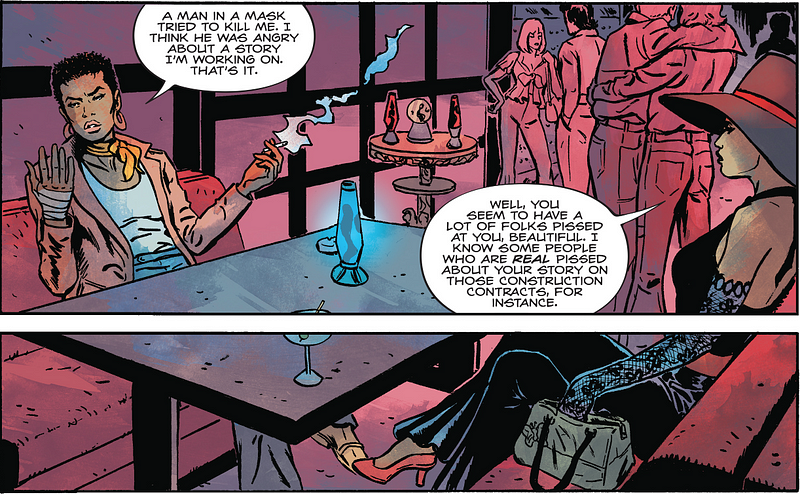
In this panel, Abbott tells Amelia about the man who tried to kill her, and Amelia responds, “Well, you seem to have a lot of folks pissed at you, beautiful. I know some people who are real pissed about your story on the construction contracts for instance.” Paying close attention to Amelia’s words, we notice that she calls Abbott “beautiful.” This could just be a rhetorical ploy, a condescending comment to a reporter who has “pissed” off some people connected with Amelia. However, in the bottom panel, the one where the gutter bisects the image, we see Abbott’s and Amelia’s feet touching in an intimate manner, a familiarity that suggests a past relationship. The words appear in the surface, for the public around them, but the intimacy is underneath the table, for them and us as readers. This tension, the intimacy between the two and the outward animosity, runs throughout the book. The gutter serves to show us this disconnect, these different aspects of their relationship.
Ahmed and Kivelä’s Abbott contains so many more of these moments, and that is what makes it such a great series. What are your thoughts? As usual, let me know in the comments below. Make sure to follow me on Twitter @silaslapham.
 Interminable Rambling