
In her posthumously published memoir Family of Earth: A Southern Mountain Childhood, Wilma Dykeman asks us to think about the ways that we process reality and the stories we hear and share. Dykeman wrote the manuscript in her twenties in the early 1940s. Early on, she details learning to walk and learning to speak, moments that most people do not remember at all. I know, for myself, that I have no recollection of these milestones, yet I still have images in my head of them. Dykeman proclaims that each of these acts served as the beginnings of her life: “Now, indeed, I had begun life. By one act, I had established my independence and solitary nature; by the other I had woven an invisible thread of contact and sociability between myself and other people.” These moments are monumental in everyone’s life, but we don’t remember the “reality” of these milestones.
Even though we do not recall the moments when we learned to do certain things, we retain, on some level, and image of the event, of the moment. It resides in our minds, not as a continuous film moving from frame to frame in rapid succession but as a series of still images that feel more akin to snapshots. In some ways, we feel a disconnect from the memory. I have memoires of myself as a toddler, doing different things. However, these memories are not my own. These memories arise from the stories my parents and others told me about the events, the moments that make up the image in my head. With these images, I stand outside myself, looking upon the scene, detached from my body. I am an actor in the memory, not the participant.
The images I carry within myself come from others; they arise from the experiences of others. Yet, they are also part of me, arising from myself. Does that mean that the images contained within my head are not “reality”? Does that mean that they do not exist? No, they do exist. I bring the memories into existence and they become part of my “reality,” a “reality” that is not necessarily “factual” or “what actually happened,” but a “reality” that, nonetheless, exists. Dykeman’s father, talking with her about the difference between reading books and actually touching grass, brings this issue up. He tells his daughter that he has no problem with her reading, yet he points outside the window and tells her, “This is reality. . . . The books are only how someone else has seen the things. But you’ve got to go out and see them for yourself.”
Dykeman’s father tells her she needs to experience the world herself, make her own impressions of “reality,” but I would argue that even in the act of reading Dykeman forms “reality,” a “reality” of her own experiences and imagination. The stories we tell, the imagination we use in the telling of those stories, forms “reality.” During elementary school, Dykeman recalls a teacher showing students a picture of a vase with flowers. Then, she would remove the images, and ask students to close their eyes and imagine the image in their “mind’s eye.” Dykeman always had issues with this exercise because, as she argues, it removes one’s imagination from the equation.
Dykeman compares the exercise to the differences between a photograph and painting. She writes,
It stressed the photographic reproduction of an object, not the imagined and adorned. I thought that all our teacher sought after was a likeness, which was true, and that any significance or interpretation I might bring to bear on that matter was due to a fault on the part of my mind’s eye. It was the difference between the photographer and the painter. The former takes the object as it is and can never change or alter it from its actuality — even remembering the wonders which his angle-shots and filters may achieve; but the painter paints a part of himself into the reproduction which he makes; he brings his hand and eye and spirit to the task.
Dykeman points out that if we recall the vase and flowers as they “actually” existed in front of us, we do nothing more than reproduce the image, essentially turning it into nothing more than a photograph. While we can frame a photograph, thus adding our individuality and imagination to the reproduced image, it still, nevertheless, depicts, with some variation, “reality.” However, a painting adds the painter to the work, the painter’s imagination and being to the finished image that resides on the canvas.

Vincent Van Gogh’s Tournesols
During his time in Arles, France, Vincent Van Gogh completed a second set of sunflower paintings. He completed the first in 1887 in Paris, depicting sunflowers on the ground. In 1888, he depicted sunflowers in vases, essentially doing what Dykeman’s teacher asked her to do in teh third grade. Van Gogh’s sunflower paintings are iconic and memorable because when we see them we see part of Van Gogh in them. We see the brushstrokes, the way he views the world, and more. We do not get an actual reproduction of “reality,” whatever that may be. We get Van Gogh’s perception of “reality,” imbued with “his hand and eye and spirit.”
During his time in the south of France, Paul Gauguin produced Le Peintre de Tournesols depicting Van Gogh painting a still-life of the sunflowers. Again, instead of having a photographic representation, a black and white still image of Van Gogh sitting at his easel looking at a vase of sunflowers, Gauguin paints the image, adding himself into the composition. These moments of depiction cause us to thing about reality and existence in different ways. Gauguin’s imagination, Gauguin’s spirit, enters into the equation. Our imagination, our spirit, enters as well.
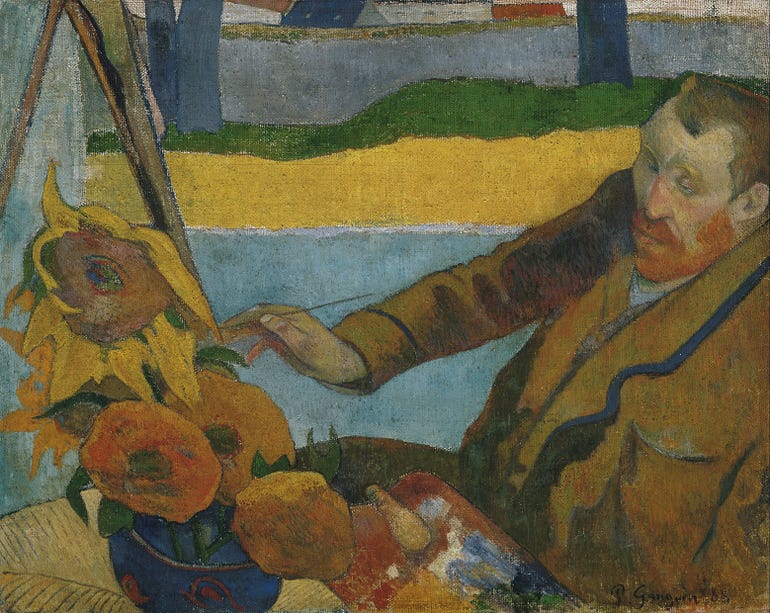
Now, I would move this discussion forward even more by asking, “Are Van Gogh’s and Gauguin’s paintings reality?” I would say yes because they are a reality. They depict Van Gogh’s and Gauguin’s view of the world, their views of what they see. They are the books that Dykeman reads about the landscape when her father tells her to go outside and form her own impressions, thus melding what she gathers from the books and what she gathers through her own senses into the work she ultimately creates. The same can be said of any artist. Dykeman points out that we need imagination and that as we get older, as we move more into “reality,” whatever that entails, we lose imagination and the ability to see the world and “reality” in different ways. We lose our ability to stop in our tracks and imagine.
When I walk, I pay attention to the world around me. I see the caterpillar scurrying across the asphalt in a parking lot. I see a leaf, dangling from a spider’s thread, twirling in the wind. I see leaves descending to the ground, spinning in the air. I hear music in my steps, patting the wall as I make beats with my feet. I stare at a pattern on the wall and see faces and objects. My imagination allows me to see the world in way that imbues it with my spirit. As I walk through the world, I think about Ralph Waldo Emerson’s exhortation in Nature when he writes, “Turn the eyes upside down, by looking at the landscape through your legs, and how agreeable is the picture, though you have seen it any time these twenty years!” Our imagination impacts the way we view the world and the way we interact with it. It helps us view the world both inside and outside of oursleves.
In the next post, I’m going to continue this discussion some by looking at the importance of sharing stories with others. Until then, what are your thoughts? As usual, let me know in the comments below. Make sure to follow me on Bluesky @silaslapham.
 Interminable Rambling