
A few days ago, as I am wont to do on occasion, I walked through the stacks at my local library, immediately making a line towards the French literature section. I did this, partly, because I had just read Michael Rothberg’s Multidirectional Memory: Remembering the Holocaust in the Age of Decolonization and wanted to see if I could find some of the works by Didier Daeninckx, André Schwarz-Bart, and other that he examines in the book. Unfortunately, I didn’t find any of these authors, but I did come across Ágota Kristóf’s The Notebook Trilogy and her slim memoir L’Analphabète (The Illiterate). I picked up the latter because of its length, a mere forty-four pages, and I devoured it in one sitting. Kristóf’s sparse memoir, as Gabriel Josipovici writes, is “pared down and precise,” and it is a “story of exile and loss, of how, for the refugee, the country in which she eventually settles . . . will always be a poor inadequate substitute for the country of one’s’ birth.”
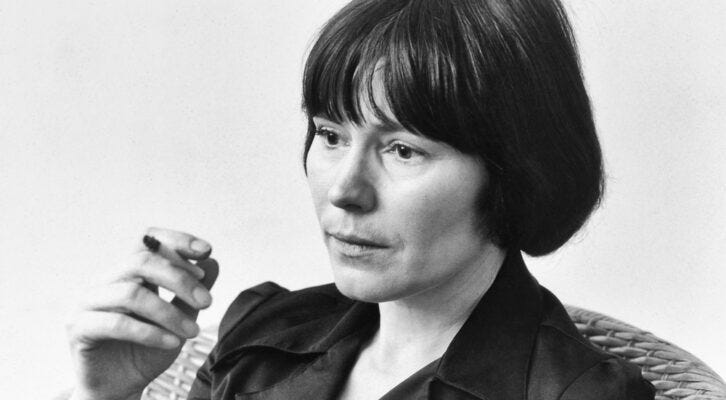
Born in Hungary in 1935, Kristóf lived through World War II and the German invasion of Hungary. She attends boarding school in Austria, and during the communist rule in Hungary, she flees, at the age of twenty-one, to Zürich and and eventually to Neuchâtel, near Swiss border with France. Over the course of L’Analphabète Kristóf traces her life, from Hungary to Switzerland, and the ways that writing grounds her serving as Josipovici puts it, “an account of the extraordinary resilience of human beings.” This resilience finds its source in writing, in words and text. Kristóf begins by detailing her introduction to reading. She writes, “I read. It is like a disease. I read everything that comes to hand, everything that meets my glance. . . . Everything in print.” She does that at the age of four, at the start of the war.
Kristóf reads and writes in Hungarian, but when she flees, following the anti-communist rebellion, she becomes, as she says, “illiterate.” Kristóf does not mean that she could not read or write in Hungarian. She means that within the community and milieu where she resides, she cannot do those things. On the ways that language, whether through the forced use of Russian in Hungary under Communist rule or the German of Austria or Switzerland or French in Neuchâtel, constructs identity and marginalizes individuals, Kristóf terms these languages “enemy languages.” She uses this term because “[i]n the beginning,” for her, “there was only one language”: Hungarian. Now, she must navigate and learn other languages in order to survive and communicate. Ultimately, though, she refers to them as “enemy languages” because they are, as she puts it, actively “killing my mother tongue” and culture.
When Kristóf arrives in Switzerland at the age of twenty-one, she frames her engagement with French in a confrontational manner, in a way that positions French as a threat to herself and her identity. She writes, “I arrive in a city where French is spoken, I confront a language that is totally unkown to me. It is here that my battle to conquer this language begins, a long and arduous battle that will last my entire life.” Kristóf’s use of “confront,” “arduous battle,” and “conquer” all position her in relation to the French language, as a combatant who must stave off the threat of the language stripping her of her identity and as a task that she must accomplish in order to become part of the language and the community. There is a tension at work here within the framing, a tension that expresses both fear of loss and one that acknowledges the hardship ahead in learning French in order to function in Neuchâtel.
Even after speaking French for thirty years and writing French for twenty years, Kristóf notes that she didn’t know it. She could not “speak it without mistakes” and she had to “write it with the help of dictionaries.” After decades, she still felt inadequate with French. She felt this way because French, coupled with the imposition of Russian on her in Hungary, and other factors, highlighted for her how these moments killed her own Hungarian language and culture, thus killed her in the process. The loss of herself, of her mother tongue, and of her culture permeates Kristóf’s memoir, culminating in the final vigenette in the book, “The illiterate.”
Kristóf begins the final vigenette by relating a conversation she had with a neighbor. The interlocutor tells Kristóf about seeing a program that talked about “foreign women workers” in factories and elsewhere. Kristóf tells the neighbor that those women were her, that she did the same things when she arrived, working in a factory. The woman then proclaims, “And they don’t even know French.” Again, Kristóf tells her that she was the same, not knowing the language. The woman becomes upset because she doesn’t view Kristóf in the same way she views the “foreign women,” and this realization makes her frustrated.
At the factory, Kristóf would pick up French words and phrases here and there. When she went home and spoke to her daughter, she would speak in Hungarian. However, her daughter grows up speaking French elsewhere. “One time,” Kristóf states, “[her daughter] begins to cry because I don’t understand her; another time, because she doesn’t understand me.” The language barrier causes separation, and this inability to communicate creates a rift. As well, Kristóf’s daughter loses, before she even realize it, her mother’s tongue, replacing it with the “enemy language.”
Even after five years in Neuchâtel, Kristóf can only speak French, not read it. When her daughter starts school, Kristóf goes back as well, enrolling in the university so she can learn how to read French. At the university, she takes the entrance exam and gets placed in the beginners class, but in that class, her teacher notices she can speak French well and asks her about it. She tells the instructor, “I don’t know how to read or write. I’m illiterate.” Kristóf’s illiteracy is connected to much more than her inability to read or write. It connects to her very being and her sense of self. She has read since the age of four, and when she cannot read French, since that is what surrounds her, it impacts her immensely. On top of this, having to learn French threatens her identity and connection to Hungary and her mother tongue.
As a refugee, as a migrant, as an immigrant, Kristóf must learn a new language. She had no choice in the matter; rather, as she writes, “It was imposed on me by fate, by chance, by circumstance.” This imposing, not matter the cause, impacts Kristóf because it makes her feel inadequate, it makes her feel lost, it makes her, as she says, “illiterate.” At its core, L’Analphabète doesn’t deal with language. It deals with immigration, migration, and being a refugee, fleeing oppression and violence only to come face to face with feelings of being displaced, specifically through language. Kristóf does not shy away from what the impact of these chances of fate did to her. She lays bare that the place where she resides and the language, even though it is a “beautiful country,” exists as noting more that “a desert” for her and other refugees that they must cross in order to assimilate. That process, of course, causes loss of one’s self.
Kristóf’s L’Analphabète is sparse, but it contains so much that we need to think about when we think about immigrants, refugees, and others who enter into a new space to seek refuge and opportunites for a better future. That move, no matter the circumstances, does not come easy. There are physical things, yes, but we must also think about the psychological and emotional tolls that these moves have on individuals. L’Analphabète showcases this through Kristóf’s langauge but also through the fact that she did not write her published work in Hungarian. She wrote it in French.
What are your thoughts? As usual, let me know in the comments below. Make sure to follow me on Bluesky @silaslapham.bsky.social.
 Interminable Rambling