
Constructing my syllabus for “Who Watches Superheroes?”, I knew I wanted to include early turns in the superhero genre towards self-reflection by including two seminal works from the mid-1980s: Alan Moore and Dave Gibbons’ Watchmen and Frank Miller and Klaus Janson’s The Dark Knight Returns. It has been a while since I read each of these books, and looking at articles and discussions about The Dark Knight Returns, I came across an interview where Alan Moore called Miller’s work, specifically The Dark Knight Returns, “sub-fascist,” comparing it to D.W. Griffin’s Birth of A Nation. As I’ve reread The Dark Knight Returns for class, I’ve really been thinking about Moore’s comments, and I want to explore them some, specifically in relation to Miller and Janson’s book, not anything beyond that.
If you’ve read me over the past few years, you know that I have been reading and writing a lot about fascism in various contexts. I don’t think that The Dark Knight Returns is overtly fascist or that Batman is overtly fascist. However, I do think there are some undercurrents of fascism at work within the series, especially if we consider the end where Batman organizes a group of Sons of Batman as a sort of vigilante army to “protect” Gotham or of Superman’s role in the narrative. The Dark Knight Returns doesn’t meet every aspect of Umberto Eco’s, Robert Paxton’s, or Jason Stanley’s definitions of fascism, but it does contain various aspects from the use of violence and control of the media to the idea that, as Eco puts it, “everybody is educated to become a hero” to “protect” society. Eco calls this the “cult of heroism [that] is strictly linked to the cult of death.”
Miller uses “fascist,” in varying contexts, throughout The Dark Knight Returns, sometimes referring to Batman himself and sometimes to other individuals. This makes it unclear who is fascist and who isn’t. This uncertainty comes from the fact that The Dark Knight Returns uses news reports, debates, and interviews to move the story forward, thus having individuals on every side use the term fascist. If we take fascism, at its core, to be the embodiment of fear and supposed decline of a nation and “traditional” values, then The Dark Knight Returns contains fascism through the narrative of Gotham being overrun by crime, fueled in part by the media, without any real move towards alleviating it except through vigilante justice. The people feel they must become the “hero.”
I do agree with Moore on the fact that Batman’s raising of a vigilante army is fascism because, as Paxton points out, “It may be that the earliest phenomenon that be functionally related to fascism is American: the Ku Klux Klan.” Now, I do not think that Batman’s “army” is equivalent to the Klan; however, I do think that the “army” is fascist. Here is why. If we think about the Klan, Mussolini’s Black Shirts, the Nazi’s Brown Shirts, The Christian Front’s Silver Shirts, or other gorups, they arise as vigilante groups to take the laws into their own hands, enacting violence on others in the furthering of their own political ideals. Batman’s “army” is constructed under the guise of “protecting” Gotham from crime, but the group consists of everyday people who have bought into the “cult of heroism.” We see some of them act honorably before joining Batman and others act violently.
Where does this “army” lead us at the end of the series? We don’t see that. However, we may have a clue early on when the news interviews two men about Batman’s return to Gotham. The first man tells the reporter, “Batman? Yeah, I think he’s a-okay! He’s kicking just the right butts — butts the cops ain’t kicking, that’s for sure. Hope he goes after the homos next.” This man’s response contains a lot. Who are “the right butts”? Is it just the criminals? Probably not. He ends by saying that he hopes Batman “goes after the homos next.” This, of course, is the escalation, the movement from one group to the next before the complete takeover. The most marginalized get oppressed and attacked first then others.
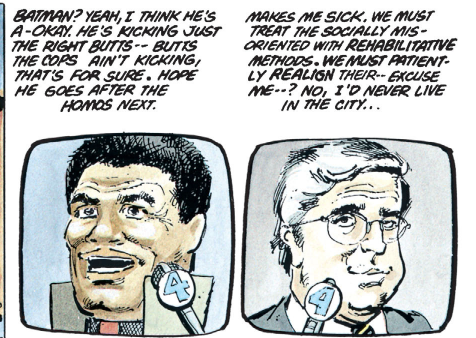
The next man tells the reporter, “Makes me sick. We must treat the socially misoriented with rehabilitative methods. We my patiently realing their — excuse me — ? No, I’d never live in the city.” This man’s response starts off looking for solutions and providing ways to assit people; however, when it comes to him actually moving from the suburbs into the city, he declines, saying he’d never live in the city. While the other man is overtly homophobic and bigoted, this man covers his bigotry with liberalism, thus fueling the desire for fascist street violence.
Instead of fixing issues that cause Margaret Corcoran to live in poverty or even General Nathan Briggs to stress over medical care for his wife, the political establishment and media perpetuate fear by allowing crime to happen without addressing the underlying issues what drives the individuals to commit acts of violence. The media plays into this because they placate the masses, telling them about the latest celbrity gossip amidst the violence in the city, treating each as if it is the same, moving from one to the next and back again in seamless transition.
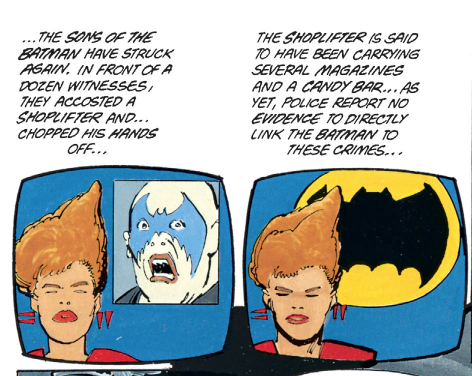
The media’s role in role in relation to fascism appears when we learn that a media blackout occurs whenever Superman does something sanctioned by the president at the governemnt but any act committed by Batman gets reported. This control of the media, this use of the media to push a certain narrative, pitting one side against the other, is a fascist tool. As well, the use of Superman in service to the government is, in and of itself, fascistic. This is where the conundrum comes in when looking at The Dark Knight Returns. Which character represents facsim? Does either character? I’d say it’s a mixture because Batman’s organizing and rallying of the Sons of Batman reeks of fascism, and Superman’s role as an agent of the governemnt reeks of fascism. Add on top of all of this the role of the media and The Dark Knight Returns becomes a convoluted mess.
I have some issues with The Dark Knight Returns but the discussion of fascism within the text isn’t necessarily one of the ones that turns me off to the narrative. If anything, the exploration of fascism engages me because it leads me to think about aspects of fascism in relation to different perspectives. I can always see Batman’s perspective, but I also always see where his modus operandi goes directly against the law and civil rights. I understand Superman’s selfless nature, but his acquiescence to serving the government, even in conflicts with other nations, diminishes his moral standing.
There is so much more to discuss, but I will leave it there. I’m still wrestling with all of this, and I may write some more about it in the future. Until then, what are your thoughts? As usual, let me know in the comments below, and make sure to follow me on Twitter at @silaslapham.
 Interminable Rambling