
When I chose to add Alan Moore and Dave Gibbons’ Watchmen to my “Who Watches Superheroes?” course, I hadn’t read it for a few years. So, while I knew many of the overall plot points and themes, I always thought about the graphic novel as a work that solely deals with the height fears during the Cold War of mass nuclear destruction and with the commentary on the roles of “superheroes” in our cultural imagination. However, as I reread Watchmen this semester with my students, I became struck by the fact that these themes are merely the window dressing for the true core of Watchmen, an emotional examination of our humanity and our needs for intimacy and connection in a chaotic, out-of-control world.
We see this focus on human connections throughout Watchmen, with almost all of the characters in the series, including the newspaper vendor and the boy reading Tales of the Black Freighter. We even see it with the narrator of the Tales of the Black Freighter and he works to get back to Davidstown to save his wife and kids from the impending freighter. Dr. Manhattan drives this theme home while talking with Laurie on Mars when he says, “[T]he world is so full of people, so crowded with these miracles that they become commonplace and we forget.” We forget human connection; we forget our shared humanity; we forget to connect with one another. Rorschach is an example of failed connections, and we see this during Dr. Malcolm Long’s interrogation of him following his arrest.
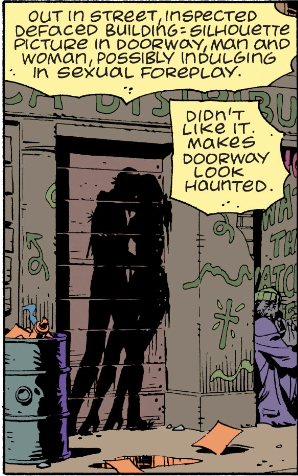
Before his arrest, Rorschach leaves his apartment and comes across a graffitied silhouette of two individuals embracing on the wall outside of his apartment. He looks at it and writes in his journal, “Out in the street, inspected defaced building: silhouette picture in doorway, man and woman, possibly indulging in sexual foreplay.” Rorschach sees the image as morally reprehensible, not as an image of intimacy and connection. His view comes to forefront during his sessions with Malcolm when Rorschach relates his past and his mother’s work as a sex worker.
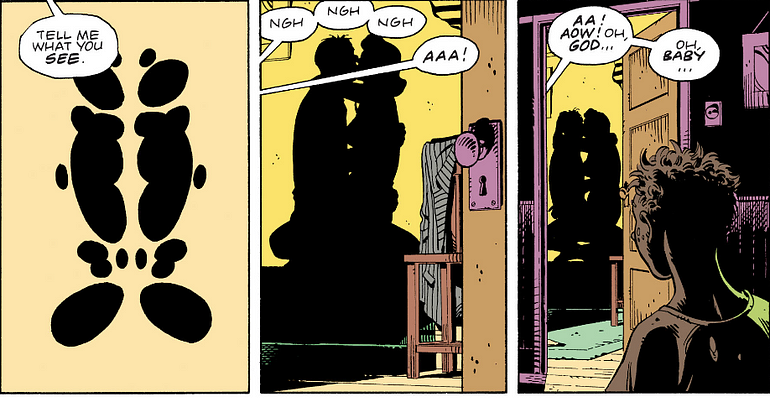
When Malcolm shows Rorschach ink-blot tests, one makes Rorschach think about walking in on his mother with a client. The move backwards begins with an image that looks like the shilouette on the side of the building; however, the silhouette of his mother and the man that Rorschach sees shows them in the act of intercourse. Rorschach walks in on them, the man gets freaked out, and he leaves, resulting in Rorschach’s mother beating him. The flashback sequence ends with another silhouette, this time Rorschach’s mother grabbing and slapping him before we return to a full panel of the ink-blot that Malcolm holds in front of Rorschach.
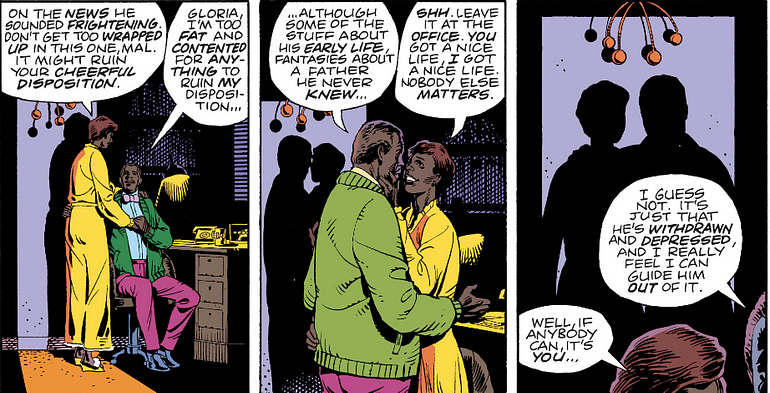
Rorschach comes to see sexual intimacy as depraved and leading to violence, but Malcolm, on the other hand, sees it as a way to connect with his wife Gloria. When he returns home after his session, Malcolm works in his office and Gloria enters to tell him he needs to stop working so hard and spend time with her. In this section, we again see silhouettes on the wall, but instead of the sexual act, we see silhouettes of Gloria and Malcolm embracing and, as they leave the room, a large silhouette of them with their arms around one another, an image of intimacy and connection.
After another session, though, Gloria again asks Malcolm to stop working and spend time with her, but this time he keeps on working. Here, we don’t see Gloria, we only see Malcolm, and in one panel she stands at the door, and we see her silhouette behind Malcolm, with her arms on her hips in anger. She leaves, and the two go their separate ways for the night. The next day, on his way home, Malcolm sees a graffitted silhouette on a building, a piece similar to the one Rorschach sees earlier. Instead of seeing the silhouette as degenerate and morally reprehensible, Malcolm stares at it and thinks about “the people disintegrated at Hiroshima, leaving only their shadows.” The next panel shows Gloria and Malcolm in bed, facing away from each other, still separated in anger.
The more Malcolm becomes engaged with Rorschach, the more he becomes distance from Gloria because Rorschach’s case envelops him, it swallows him whole and he begins to think about his own past. He dives so deep that he expresses amazement when Rorschach tells Malcolm about partnering up with Daniel Dreiberg and their firendship. After this recollection, Maclom looks across the table at Rorschach and asks, “You have friends?” The framing in this panel is interesting because instead of seeing either Rorschach or Malcolm head on, Gibbons places us outside the penitentiary, looking in, through a barred window, at the pair sitting across from one another. This framing highlights the loss of intimacy and connection that both men endure, placing Malcolm alongside Rorschach in this lack of human connection.
Heading home for the dinner party with another couple that Gloria arranged, Malcolm stops by the newstand and picks up a paper, reading about what people should do with dead family members in case of a nuclear attack. As he thinks about this, we see another panel with the graffitted silhoutte of the two individuals embracing with a trashcan in the foreground and a figure, walking off panel, throwing a candy wrapper into the bin. Over this image, Malcolm writes, “It says that any dead family member should be wrapped in plastic garbage sacks and placed outside for collection. On 7th Avenue, the Hiroshima lovers were still trying inadequately to console one another.”
This panel juxtaposes the reality of the threat of nuclear war as well as Malcolm’s growing distance from Gloria, a distance that will appear throughout the rest of Watchmen when he shows up. Malcolm’s comment about the lovers “trying inadequately to console one another” and not being able to fully embrace one another serves as a commentary on the ways that Malcolm and Gloria, other couples in the series such as Laurie and Daniel or Edward Blake and Sally, struggle to connect with one another in an intimate manner.
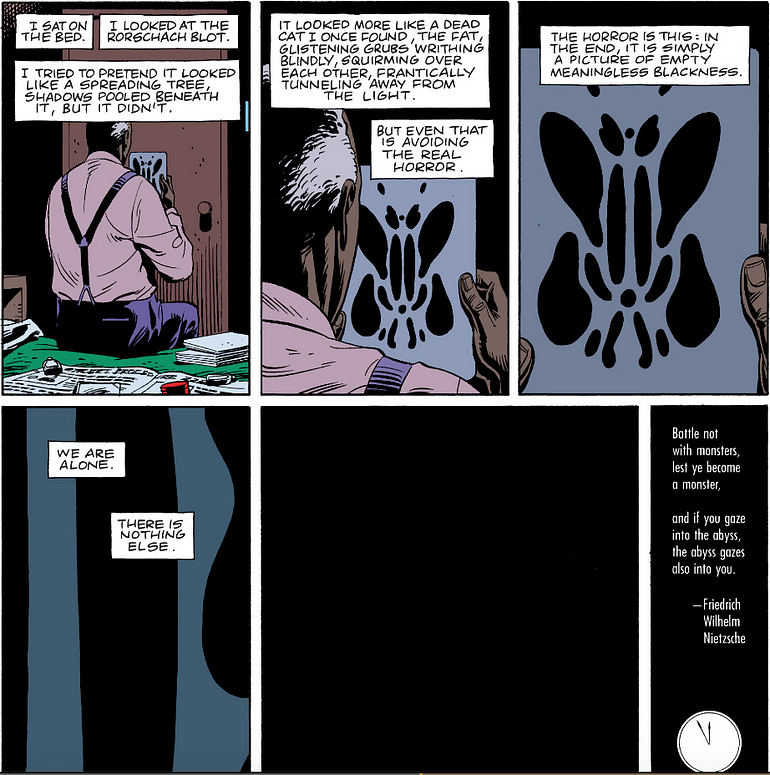
At the dinner party, one of the guests asks Malcolm about working with Rorschach, and Malcolm tells them about Rorschach killing the man who abducted a six-year-old girl. This scares the couple, and they leave. After the couple leaves, Gloria leaves Malcolm, and the issue ends with Malcolm looking at the ink-blot test that makes Rorscach recall the bashed brain of the dog he killed and while Malcolm wants the image to look like a tree, he thinks it looks like a dead cat he once saw. The last three panels zoom in, at various stages, to the ink-blot image, and the last panel is all black. Over these, Malcolm writes, “The horror is this: in the end, it is simply a picture of meaningless blackness. We are alone. There is nothing else.” Malcolm’s connection with Gloria evaporates, and he must, as he does later in the series, rekindle that connection, but without those human connections, we are, as Malcolm says, “alone.”
Malcolm and Gloria’s relationship provides a key narrative of the theme on the importance of intimacy and human connection in Watchmen. In the next post, I’ll continue this discussion by looking at some other examples in the series. Until then, what are your thoughts? As always, let me know in the comments below. Make sure to follow me on Twitter @silaslapham.
 Interminable Rambling