
Over the past few posts, I have been looking at various themes in Alan Moore and Dave Gibbons’ Watchmen. Today, I want to continue the examination of how Watchmen interrogates our relationships with another, calling upon us to build bridges and to connect with others intimately so that we don’t remain alone and can face the trials and tribulations of the world, whether personal, national, or global, together, providing solace and comfort amongst the turmoil. Last post, I looked at the ways that Dr. Malcolm Long and his wife Gloria serve as a grounding for examining our need for intimacy and connection and how fragile that connection truly is, especially when we fail to nurture it. In Watchmen, this failure led to Gloria leaving Malcolm because he became obsessed with Rorschach’s case and the cases of others, bringing his work home to Gloria.
Chapter XI brings all of the relational subplots together on the street in New York next to Bernhard’s newsstand, the Institute for Extraspatial Studies, and the Promethean Cab Company. The chapter moves back and forth from this setting in New York to Adrian Veidt in his Antarctic base unleashing his false-flag, alien invasion to bring about world peace. What makes this chapter important is the ways that numerous plot points intersect, including Bernie who sits at the newsstand reading The Tales of the Black Freighter. The story, even within that fictional comic, correlates to this moment. (I don’t have the space to discuss that here, but I may in the future.)

Early in the chapter, Aline, Joey’s partner, comes looking for at the newsstand. She wants to talk to Joey about their relationship, and Bernhard tells her he hasn’t seen Joey. Aline then decides to meet Joey outside of the cab company where she works. There, they meet and start to walk down the street together. Alin begins to break up with Joey, and Joey starts to get angry, responding that she put up the political poster Aline wanted her to, and Aline simply responds, “Sure, same place you buy Hustler.”
In the next panel, we see Joey and Aline on a street corner, and in the foreground, we see the graffiti silhouette of the couple embracing one another. Joey begins to cry, and when Aline comments on it, Joey says she’s not crying. This image, with the illusion of intimacy, the idealized intimacy of the two individuals embracing, even though they never actually fully embrace one another as Malcolm see it, becomes juxtaposed against reality, the reality of what it takes to make a relationship, any relationship, work. After this panel, Aline gives Joey a book on relationships, and Joey begins to rip it up, telling Aline she wants to “be straight” and “dead.”
As Joey and Aline argue on the street corner, Gloria comes up to the newsstand asking if Bernhard has seen her husband. Bernhard doesn’t know Malcolm by name, and he assumes it is the Black man selling watches on the street. Even though Malcolm buys his paper from Bernhard almost every day, they have never formed a connection and bridge. They merely pass one another, absently going their own way. Gloria sees Malcolm across the street and goes up to him, telling him that even though she isn’t ready to come home she wants to work on their relationship.
In the background of the panel where Gloria says this to Malcolm, we see Joey becoming angrier, and in the next panel, while Gloria and Malcolm talk in the background, we see Joey attack Aline. Malcolm sees this, and when he turns towards the couple, Joey pushes Aline to the ground. Gloria tells him not get involved and that he allows himself to “get drawn towards another heap of somebody else’s grief” she won’t see him ever again. Malcom simply tells her, “Gloria, I’m sorry. It’s the world. I can’t run from it.”
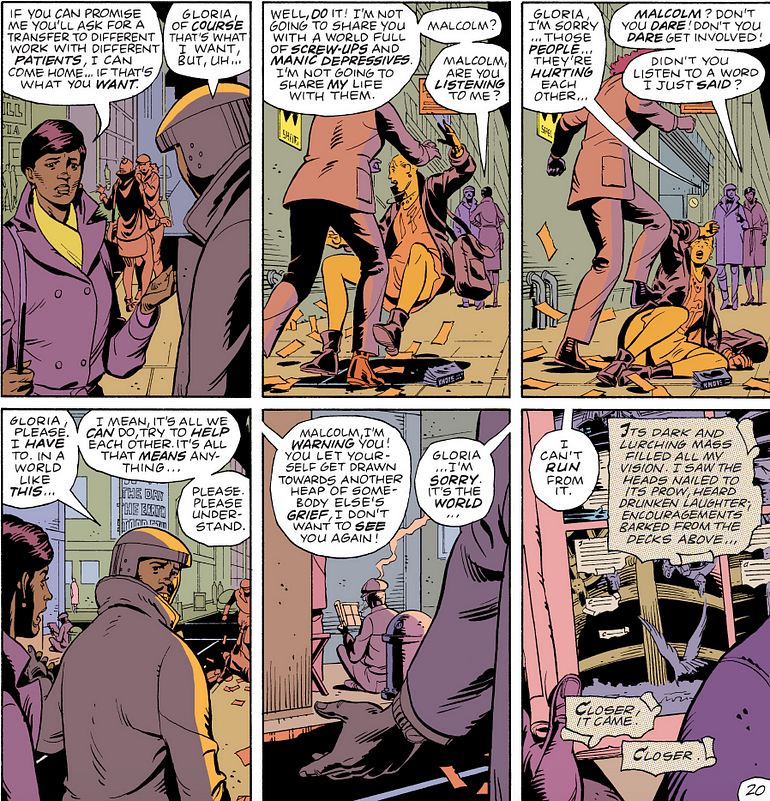
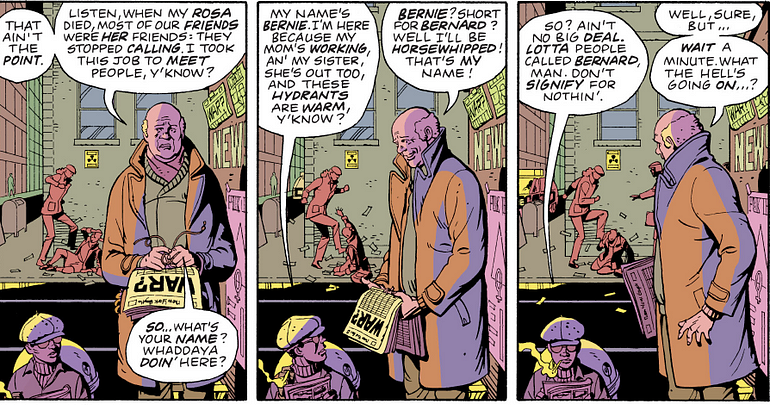
Malcolm sees individuals hurting one another and, unlike Dr. Manhattan throughout Watchmen, decides to step in and try to help. He cannot look away. He refuses to look away. At the same time that Malcolm and Gloria talk, the scenes shit to Bernhard at the newsstand talking about the impending nuclear war and his wife Rosa who passed years ago. Again, we see Joey beating Aline in the background of this five-panel section. In the first four panels, Bernhard talks to Bernie, introducing himself. He tells Bernie that all of his friends were Rosa’s friends and after she passed they stopped calling, so he “took this jon to meet new people, y’know.” When Bernie tells Bernhard his name, Bernhard becomes excited because they share a name, and when Bernie says it “ain’t no big deal,” Bernhard notices Joey beating Aline and begins moving that way. Here, we see Malcolm approaching the couple too.
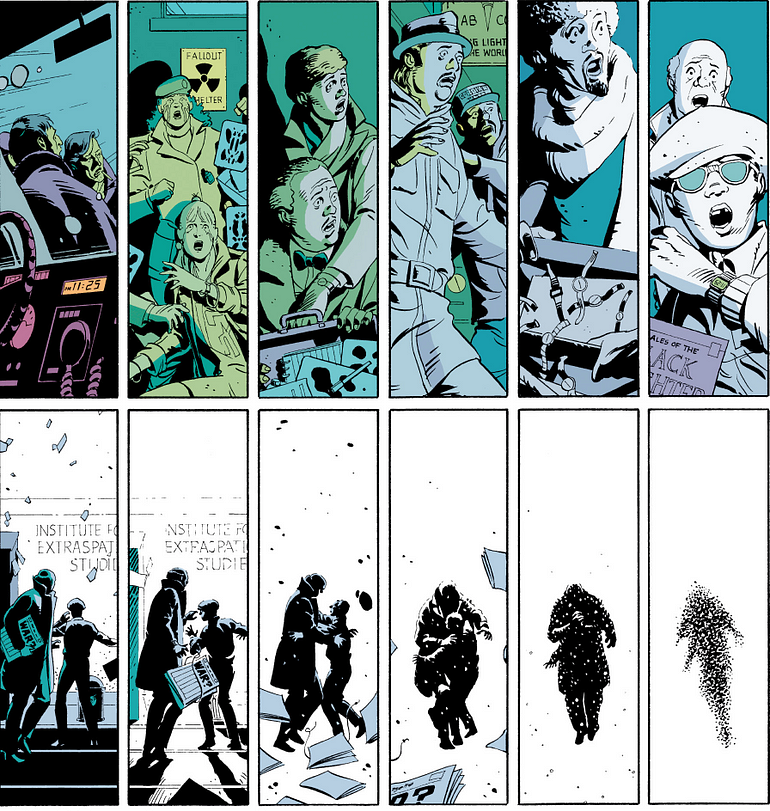
Others, who appear in the background of the series, start to see the commotion and move towards Joey and Aline. They intercede, before the police arrive. Over all of this, we see Veidt telling Rorschach and Daniel his plan, telling them how he killed Edward Blake and why his plan will bring world peace. The chapter ends with the event, and the final page contains thirteen panels. The first six show individuals such as Joey and Aline and Gloria and Malcolm. The last of these panels shows Bernie in front of Bernhard as both look at the glowing light. The next six panels show Bernhard moving towards Bernie, trying to protect him, before they get vaporized, leaving a silhouette on the ground. The final panel appears white.
The final chapter opens with six pages detailing the destrcution caused by Veidt’s false flag. One page shows the tentacle of the constructed alien piercing a building as Joey sits holding a dead Aline and Malcolm holds a dead Gloria. On the left of the page, right behind Joey and Aline, we see the graffitti silhouette of the embracing lovers. Blood rises to the right of them. Here, we see three couples. One the illusion and two reality. We see them together, even in death and devastation. We see them connected. No matter the arguments, Joey and Malcolm love Aline and Gloria. They stare in shock as the bodies of their loved ones reside in their laps.
These couples found one another. They did not pass one another by, even though they fought and did not always agree. They were the “miracles” that Dr. Manhattan talks about with Laurie on Mars. But unlike the “miracles that. . . become commonplace and we forget,” they are the “miracles” that bring us together. Bernhard forgot. He started the job to meet people, to connect, but he didn’t know his customers. He had no clue who Malcolm actually was, and once Gloria calls him out on this fact he introduces himself to Bernie, the young man who has been sitting at his newsstand through the series reading The Tales of the Black Freighter as Bernhard talks about current events with customers and vendors. It’s not until the end of the series that he realizes he has not connected with anyone and he seeks to rectify that.
The impending destruction of the world and the cultural idea of superheroes lies on the surface of Watchmen, but it is so much more than a superhero narrative. It is, as I will finish showing in the next post, a narrative that addresses what it means to be human and the importance of the connections we make with one another and how those connections sustain us or how our lack of those connections damage us. Until then, what are your thoughts? As usual, let me know in the comments below, and make sure to follow me on Twitter at @silaslapham.
 Interminable Rambling