
Every semester I debate what types of assignments I want to incorporate into my courses. Over the years, I have moved away from strictly written essays, choosing instead to provide students with a space to use their talents and passion in the creation of projects to convey an argument. This usually takes the form of an Unessay Project where students create anything based on the texts and themes we cover in class. Along with this, they must write a craft essay, or an Unessay Paper, where they describe their thoughts and rationale for creating the product that they created. This paper includes scholarly research and serves to drive home the ways that everything we learn and take in comes out in the work that we produce.
This semester, for my “Who Watches Superheroes?” course, I decided to have students complete an Unessay Project and Unessay Paper. My exeprience has shown me that this assignment is hit or miss, with some students embracing the freedom and others not totally understanding the project’s purpose. This semester, I had students who wrote songs, did podcasts, made Tik Tok videos, wrote legislation, devised workout regimens for superheroes, and more. Today, I want to discuss one project from a student who created a short comic about the dangers of book bans.
The student chose, for a previous essay, to look at book bans and book challenges, specifically focusing of Alan Moore and Dave Gibbons’ Watchmen, which according to the Comic Book League Defense Fund (CBLDF) has faced at least two challenges over the years. The student chose this topic because they took an English course in high school where they read and talked about bans and challenges to books such as Harper Lee’s To Kill and Mockingbird and other works. This previous course inspired the student to look at bans and challenges to graphic texts, leading them to create a flyer detailing the dangers of denying readers access to texts.

As we talked about the student’s project, I shared Nate Powell’s work, specifically his poster “Comics Are Reading” which he did for the Booklist Guide to Graphic Novels in Libraries. On the poster, Powell points out the ways that comics engage with reader “on multiple levels,” notably “offering a more immersive, engaging reading experience than any other medium” because of the interplay between the visual and elements, along with the ways that the reader fills in blanks between panels. He also notes how “comics are the most democratic mass storytelling medium” due to their costs and existence as “low-risk creative platforms.”
The democratic aspect of the medium, coupled with the use of images, make comics and graphic novels “easy targets to those averse to ideas, empathy, and uncomforotable history.” Thus, they become one of the first targets from individuals who seek to suppress information and knowledge through book challenges and bans. Powell write, in a panel with an angry grandfather and mother covering the eyes of a young girl that “comics are the canary in the coal mine” when it comes to attempts to oppress a populace.
The confluence of book bans and Powell’s work led the student to create their own informational poster about the dangers of book bans. The student, an art major, had not created comics before, but they did an excellent job taking what we learned in class and incoporprating it into their own project. They found a comics’ page layout online and went to work, initially creating the poster on a tablet before realizing they couldn’t achieve everything they wanted to achieve through the tablet and thus moved to pen and ink.
In “Are Books Really A Threat?”, the student begins with a panel where the speaker rhetorically responds to the title with another question: “A threat to who exactly? Adolescents?” This method of addressing the reader with specific questions continues in the next panel where the speaker pushes forward inquiring whether or not individuals who seek to ban books do so to limit students’ ability to access knowledge about “specific topics.” Following this, the poster has four small panels, each presenting one of the topics that arise in discussions of book bans: violence, explicit content, racism, and political views. These panels stand out because the student uses one panel each for each topic, providing visiual cues that amplify the words, such as a skull with a knife, a diverse image of individuals, and a politician at a podium.
Next, the poster moves to the speaker conceding that “it’s understandable why a parent of an adolescent may forbid them from reading books/comics with sensitive topics,” hinting at the ways that parents have the right to monitor what their children at home. However, at home is different from school or the library, public places accessed by various individuals. Ultimately, the speaker argues that texts “educate readers” on a myriad of topics that everyone experiences or encounters. Being exposed to these topics “helps adolescents expand their minds . . . brodening [sic] perspectives, critical thinking skills, real-world relevance, and empathy development.”
In the two panels where the speaker lists the benefits of reading texts that may challenge readers, they present the text in such a manner that causes the reader to progress through the panel in a “Z” pattern, moving from the top left in the first panel to the top right of the second panel then down to the bottom left of the second panel. This pattern constantly appears in comics, drawing the reader’s eyes across the page. The student’s incorporation of this method, over the course of two panels, really stands out stylistically in the poster.
The poster, ends with a panel showing the speaker reading a book, wide-eyed as they engage with the material. The speaker asks, “Why silence someone’s voice? Why prevent someone’s own personal beliefs and choices?” The speaker leaves these questions unanswered here, calling upon the audience to answer them for themselves. Through this ending, the poster engages us as readers, bringing us into the conversation and interrogating us in the process, asking us, “Where do you stand on this?”
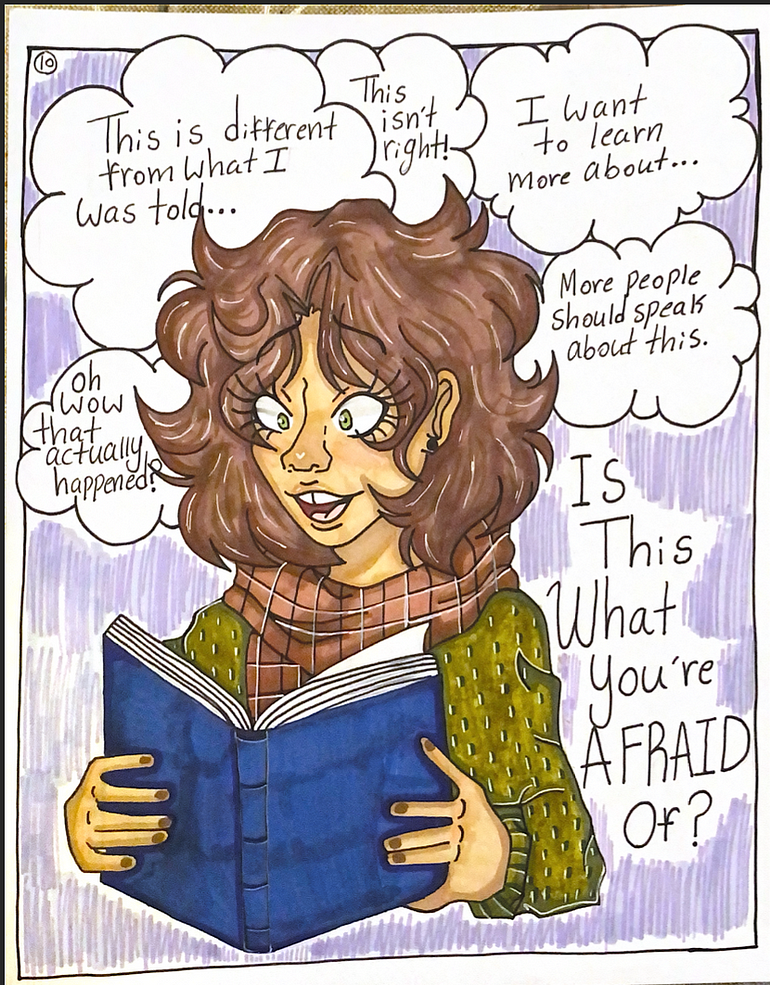
When the student finished the poster, they realized they wanted one more inage, so they drew a splash page that shows the speaker, again, excitedly reading a book. The speaker thinks about how the book challenges their beliefs, educates them on historical events, and motivates them to learn more, thus reinforcing Powell’s assertion at the end of his poster when he writes that comics are “an effective format for cultivating habits and curiosity, making reading part of the fabric of everyday life.” Again, the student ends this page with a rhetorical question interrogating the audience. The speaker asks, “Is this what you’re afraid of?”
When I assign an Unessay Project I am always nervous about what students will present. Namely, I am nervous about their own apprehension and timidness when it comes to stepping out of their comfort zones, moving against the norms they have experienced in writing classrooms throughout their academic careers. However, this nervousness, for the most part, fades when I start to see students get over that apprehension and dive headfirst into their projects, taking risks and expanding what they thought they were capable of doing in the first place.
The student’s project presented here is just one of the many examples that I could provide. At the end of each semester, I am left in awe of some of the products that students produce because they, like the student here, let their creativity and knowledge shine. As an educator, I view my role, partly, as fostering withing students a desire to become lifelong learners and readers, taking what they learn and incoproating into their own lives and careers. When I see students do that, taking what they learn in a composition course and bringing their major or other courses into their work I get excited and count the project as a success.
What are your thoughts? As always, let me know in the comments below. Make sure to follow me on Bluesky @silaslapham.

 Interminable Rambling