
This semester, I am teaching Kathleen Hanna’s Rebel Girl and Carrie Brownstein’s Hunger Makes Me A Modern Girl. Since I am teaching two memoirs by musicians who came of age and still work within the punk and indie scene, I wanted students to make zines for one of their projects. I have always thought about having students make zines in class; however, I have never had the opportunity to assign the project in a course. Below, you will see my assignment prompt. It consists of two parts: the zine itself and an essay describing why the individual chose to construct the zine the way they did. They can make whatever type of zine they want, from an 8-page mini-zine to a larger 24 page zine.
Seen your pictures in the ‘zines
And you look real good
Pale blank faces-black and white keen
London boys-cigarette lean –The Go-Go’s “London Boys”
Both Kathleen Hanna and Carrie Brownstein write about the role that zines played in the Riot Grrrl movement and how zines served as a way to communicate ideas in both local communities and across other geographical spaces. Zines have been around for decades. In fact, Jerry Siegel and Joe Shuster’s first Superman story, “The Reign of the Superman,” appeared in Science Fiction: The Advance Guard of Future Civilization, a fanzine they created while in high school to print some of their work that publishers rejected. Zines became an integral part of the burgeoning punk scene in the 1970s, and they continue to be important today. If you take a trip to a local record store, bookstore, or comic bookstore, you’ll see zines from individuals and groups in the local communities.
Zines, like any medium, serve as a space for conversation and engagement. Lisa Darms, in The Riot Grrrl Collection (cover image), points out that the Riot Grrrl movement started “as a challenge to the punk movement that, in many scenes, had become increasingly conformist” and that zines provided, along with the music and other avenues, a form of dissent within the larger scene, challenging the “conformist,” sexist, racist, xenophobic, aspects of the punk scene itself (11).
During one of Sleater-Kinney’s tours, Corin Tucker started a zine called Hey Soundguy where she, as Brownstein writes, “took a picture of every house sound person we encountered, told a short story about them, and wrote a review of both their performance and their personality” (142). The zine included only three women. Through the zine, Tucker subverted the narratives of touring musicians and confronted the sexist aspects of the punk and indie scenes, specifically through the retelling of sound people like the one who told the band “that the room was shaped like the inside of a speaker and that [they] should face [their] amps” towards Janet Weiss, the drummer (143).
In Bikini Kill: a color and activity book, Hanna, Tobi Vail and Kathi Wilcox encourage readers to create flyers and zines “around issues that’re important to you,” printing them out and placing them “inside newspapers, library books, leave them on buses, restaurant tables, telephone poles, etc. . . .” They continue by listing topics that readers could create flyers or zines around: “AIDS, healthcare for women, low income housing, domestic violence, your feelings on war, racism, art facism [sic], etc. . .” Zines serve as a way of democratizing knowledge and information, akin to websites such as Wikipedia, forums online, or social media sites.
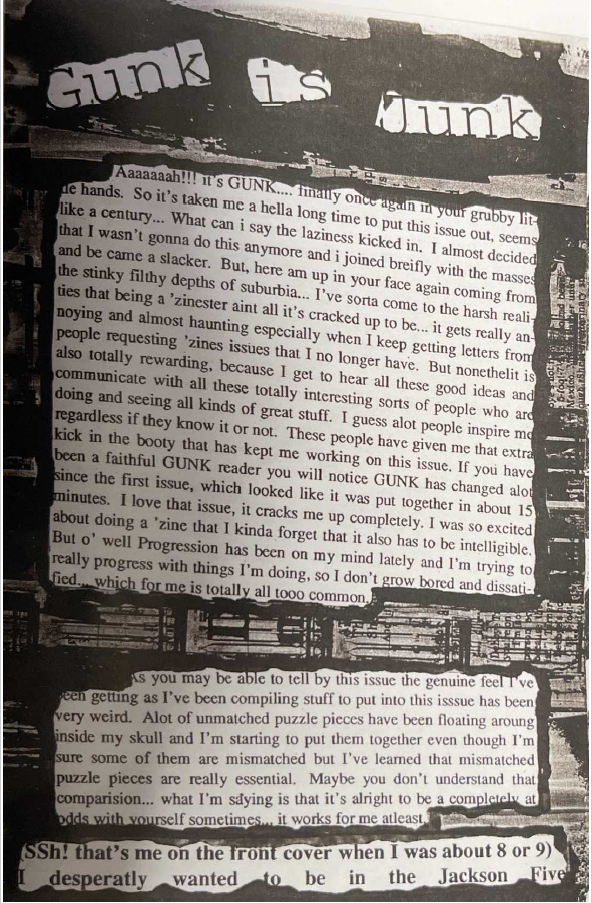
Zines, like all forms of communication, serve as a space for community engagement and the transfer of knowledge. The Riot Grrrl scene was not centralized, and it contained many different viewpoints, as Hanna and Brownstein point out. Hanna notes, again and again, how she worked to understand and confront her own racialized position within the Riot Grrrl scene, writing about how Mimi Thi Nguyen’s work “included a brilliant critique of the way Riot Grrrl was being historicized and whitewashed,” leaving out individuals such as Ramdasha Bikceem who wrote and published Gunk at the age of seventeen (300). In issue #4, Bikceem writes about hanging out with her friends skateboarding and points out that when she goes out with her friends and gets stopped by the police that the police remember her, not her white friends. She writes, “I’ll go out somewhere with my friends who all look equally weird as me, but say we get hassled by the cops for skating or something. That cop is going to remember my face alot clearet [sic] than say one of my white girlfriends.”
For this assignment, you will create a zine of your own and also write an essay where you discuss how you created your zine and why you made the decisions that you made in its construction. You are not limited to any topic or focus. You can choose anything you like, and we will work through possible topics before we start constructing our zines. I will provide examples of zines from the DC Punk Archive and elsewhere. Below, you will see a copy of Bikceem’s Gunk (cited above). As well, I will make a zine and essay alongside you. I will present mine the day before you present your own zines.
Your essay will discuss the process and research you undertook while working on your zine. Keep in mind that all of this adds and contributes to ongoing conversations. Contributing to conversations requires that you have something meaningful to communicate based on your own experiences and research. It also requires, however, that you engage with others on your subject in order to demonstrate, precisely, why you construct your zine the way you choose to construct it.
For the zine itself, keep in mind Darms’ words about the zines collected in The Riot Grrrl Collection. Darms writes, “Reading these zines, flyers, and notes, you’ll see plenty of spelling mistakes, sharpie-marker redactions, gaps, rough edges, and last-minute additions” (12). They are not grammatically or stylistically “correct,” but that is ok. You can have this mistakes in your zine. The purpose of creating the zine is to experiment, to have fun, and to be creative. It is an opportunity to take chances and revel in those chances.
However, your essay must follow MLA format. That means double spaced, one-inch margins, works cited page(s), and correct in text citations, and a works cited page (if you use a source or two). Your font must be Times New Roman 12 pt.
 Interminable Rambling
What a great unit of study – makes me want to write a zine.
LikeLike
I’ve been making a lot of zines lately because of this assignment. Never done them before.
LikeLike
Thanks for incepting the idea. For whatever reason, I’m finding the idea more and more intriguing the more I dwell on it. I don’t know if you’ve seen it but there’s a program electric zine maker https://alienmelon.itch.io/electric-zine-maker that helps you do a zine digitally. Hope this isn’t too much against the DIY analogue/spirit of zines. Also, interestingly linked to on the site is a guardian article about zines and how the journalist used the software during lockdown. It’s here https://www.theguardian.com/games/2021/feb/22/electric-zine-maker-video-game
LikeLike