
Years ago, when I taught in Louisiana, I remember a student walking into the classroom with an “Angola, a gated community” t-shirt. I grew up in Louisiana, I knew about Angola, specifically that it rests on the lands of a former plantation and its long record of humanitarian offenses. I also knew it was the largest maximum-security prisons in the United States. I also knew about the annual Angola Prison Rodeo and The Angolite, the newspaper written and published by individuals incarcerated at Angola. However, I had never seen the t-shirt that celebrated the prison, promoting it with the words surrounding an image of a guard tower and gates. Seeing this shirt, which one can purchase at the prison museum at Angola, I became disgusted that someone would openly promote and celebrate mass incarceration in such a manner.
I thought about this shirt when I started seeing news about “Alligator Alcatraz” in Florida, a detention center in the Everglades that can hold 3,000 detainees. Funded by FEMA funds, the concentration camp, there is no other name for it, came together in a little over a week, situated in a region ravaged by extreme heat, flooding, hurricanes, and more. In fact, flooding has already occurred, and lawmakers who have sought to visit the site have been denied entry. As well, the facility costs $450 million a year to operate, and, CBS Miami points out that the some GOP donors will profit off of the facility through government contracts.
The budget bill adds $29.2 billion for ICE enforcement and deportation operations, which increases the agency’s budget by three fold. Along with that increase, the bill also adds $45 billion to build new immigration detention centers, “a 265 percent annual budget increase to ICE’s current detention budget,” according to the American Immigration Council. This increase is also 62% higher than the budget for the federal prison system. For the border wall, the bill allocates $46.6 billion, which is three times the amount during Trump’s first presidency, and $10 billion to reimburse the Department of Homeland Security for expenditures related to “safeguard[ing] the borders of the United States to protect against the illegal entry of persons or contraband.” All of this brings ICE’s budget to $37.5 billion, which is more than the military budgets for countries such as Italy ($30.9), Israel ($30.5), Netherlands ($27.0), and Brazil ($26.1). In fact, as Representative Alexandria Ocasio-Cortez points out, ICE’s budget is now “bigger than the FBI, US Bureau of Prisons, DEA, & others combined.”
Why? What is the point of making ICE the largest law enforcement agency in the United States? David Hoekema, who has volunteered on the border with the Green Valley-Sahuarita Samaritans, notes that the rhetoric and actions surrounding sites like the one in Florida, specifically socially media posts from the White House, DHS, and others, showing alligators in ICE hats in Florida, serve to stoke and create a false fear. Hoekema points out that “of the government’s deportation requests to immigration court in January and February of 2025, only 1 percent cite criminal acts other than illegal entry.” He also notes that these tactics, as we have seen in Los Angeles and elsewhere, work “to preserve an enormous pool of workers who will accept low wages, unsafe conditions, and job insecurity without complaint, knowing that appealing to a supervisor for fair treatment may trigger dismissal and deportation,” ultimately keeping workers “underpaid, overworked, unrepresented by unions, and living in constant fear of immigration authorities and self-appointed vigilantes.”
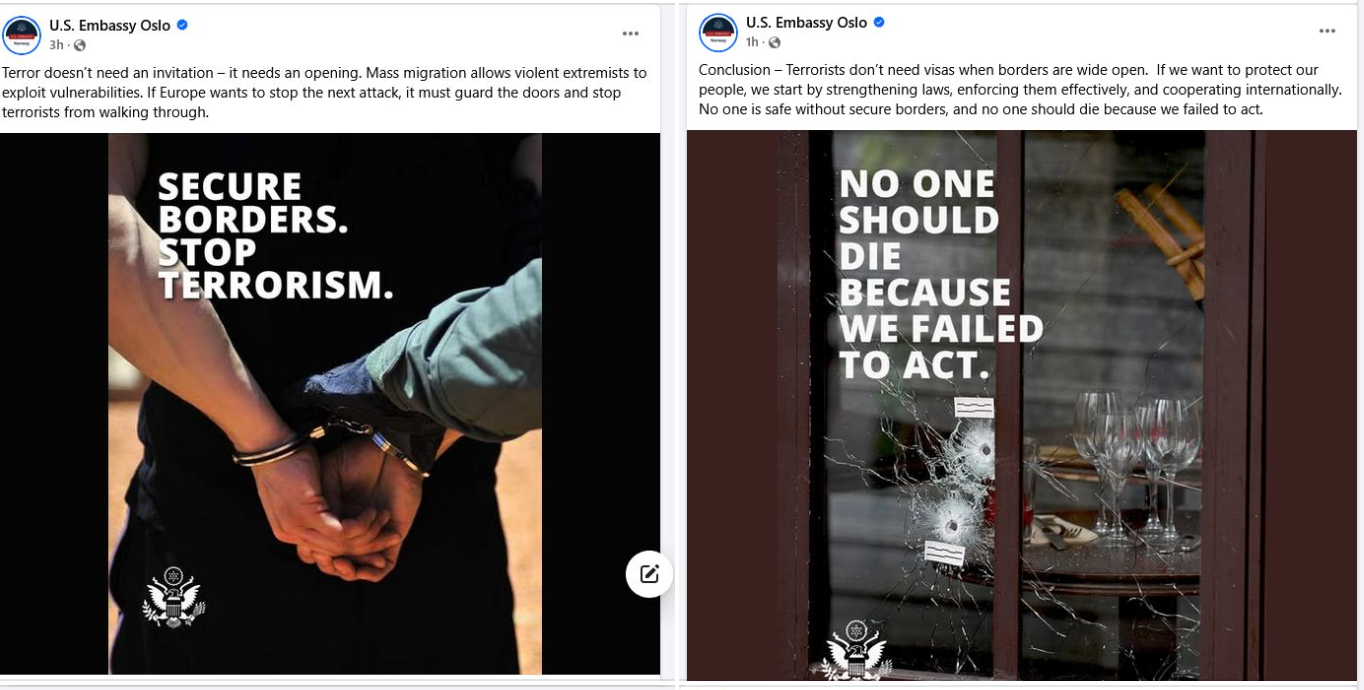
I know this tactic. I’ve seen it countless times. Lillian Smith knew this tactic with the Jim Crow South and demagogues. She wrote, “The Devil knows that if you want to destroy a man, all you need do is fill him with false hopes and false fears. These will blind him to his new direction and he will inevitably turn away from the future and destroy himself and those close to him.” The false fear has been a non-existent invasion of rapists and criminals from Mexico and elsewhere, a fear stoked from Trump’s first utterances when he descended the escalator in 2015. It’s one that continues today, reaching outwards even from the United States to our embassies in places like Norway with posts such as the ones below. What the US Embassy in Oslo doesn’t note, though, is that the deadliest terrorist attack in Norway occurred on July 22, 2011, when avowed white supremacist Anders Breivik murdered 77 and injured 300 people, mostly teenagers at a Workers’ Youth League summer camp. Breivik, in turn, inspired domestic terrorists in the United States such as Adam Lanza who committed the Sandy Hook Elementary School shooting in 2012 and possibly others such as Robert Gregory Bowers who killed 11 and injured 6 people at the Tree of Life Synagogue in Pittsburgh.
All of this is an old playbook, one that we see repeating itself again and again and again. It did not sprout out of thin air. This idea of immigrants crossing the border and committing violent crimes, stealing jobs, and more, has been part and parcel of the rhetroic for decades in the United States. David Horowitz, the conservative commentator who influenced and supported Stephen Miller, the White House Deupty Chief of Staff for Policy, wrote, in reaction to Obama’s use of “hope” in his campaign messaging, “Hope works, but fear is a much stronger and compelling emotion.” Fear sells. The fear of losing ones position in society. The fear of losing ones property. The fear of losing ones job. The fear of losing ones life. Fear motivates us. It keeps us in line and creates an “us” versus “them” mentality, which is a key component of fascist ideology.
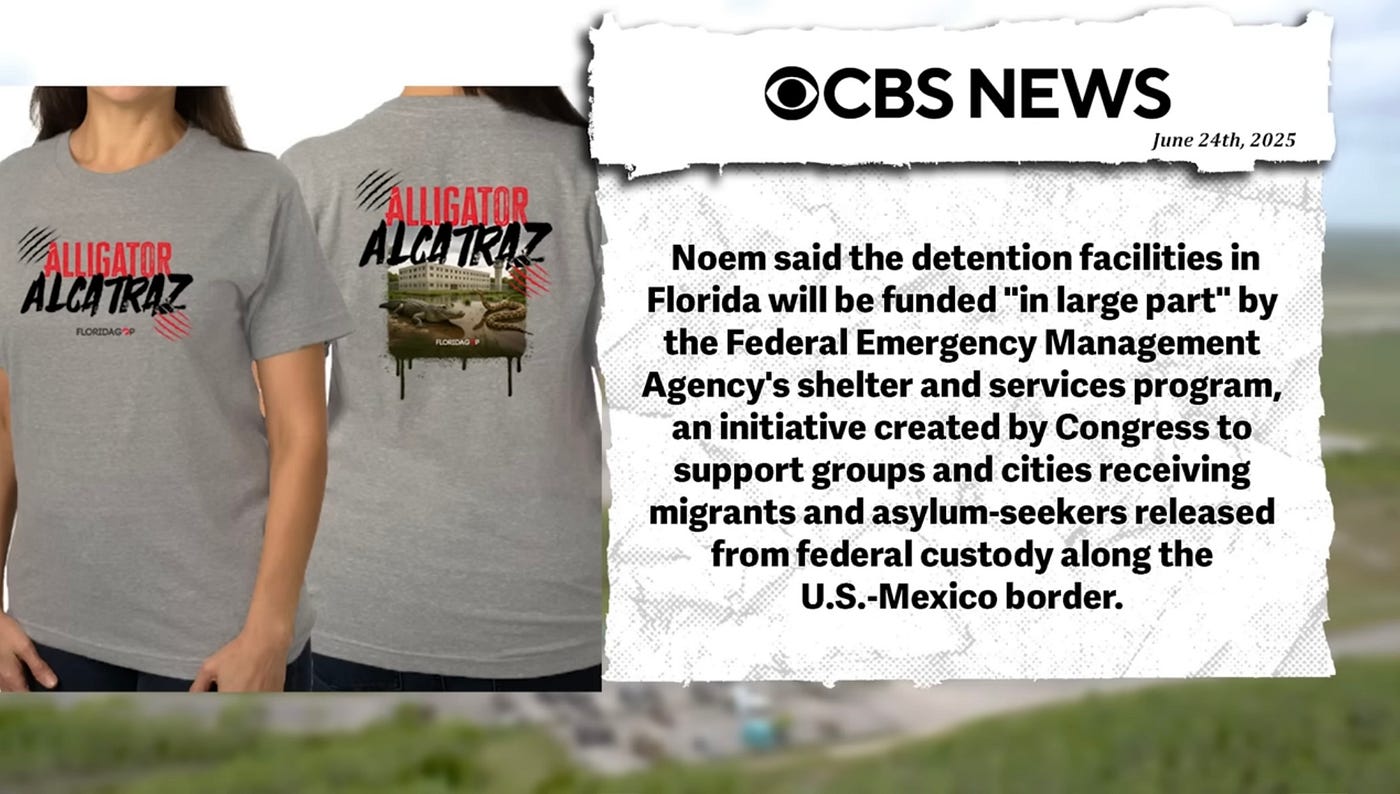
I think about all of this, and then I think back to the student who wore the t-shirt in class that one day. I think about that student because the Florida GOP is selling shirts that say “Alligator Alcatraz” on the front and back with an image of a detention facility and alligators on the back. One can buy t-shirts for $30, hats for $27, and beer cozies for $15. Why? Why does a political party sell merchandise like this? While I disagree with the Angola shirt, it is sold in the prison museum, not by a political party. The act of selling merchandise that profits off of the suffering of others is heinous. It is cruelty for the sake of cruelty above the already cruel and inhumane. It makes me think of Robert Keith Parker who wore a Camp Auschwitz sweatshirt during the January 6 insurrection.
I think about all of this, and I think about the ways we always talk about enslavement, the Holocaust, and the Civil Rights Movement. We say, “I wouldn’t have participated. I would have helped those under attack. I would have denounced fascism. I would have hidden my neighbors.” I’ve heard that so much, and now at this moment, when the administration has been taking people off the street and setting up concentration camps, places where political enemies or members of specific groups like ethnic or religious minorities are confined against their will.
If we just take Florida as an example, around 770,000 undocumented individuals lived there in 2022 and contributed $1.8 billion in taxes. Dr. Alexis Tsoukalas, senior policy analyst at Florida Policy Institute (FPI), points out, “Due in large part to Florida’s upside-down tax code, immigrants without a documented status pay 7.9 percent of their income, on average, to state and local taxes, while the wealthiest 1 percent of state residents pay just 2.7 percent.” The Institute on Taxation and Economic Policy (ITEP) notes, undocumented immigrants pay $96.7 billion in state and federal taxes while not being able to access public services. The ITEP also found that “for every 1 million undocumented immigrants who reside in the country, public services receive $8.9 billion in additional tax revenue. On the flip side, for every 1 million undocumented immigrants who are deported, public services stand to lose $8.9 billion in taxes.”
Again, what is the point? It is cruelty, plain and simple. We know that. To understand all of this, I could recommend a lot of books and essays. However, right now I want to suggest Jean Guerrero’s Hatemonger: Stephen Miller, Donald Trump, and the White Nationalist Agenda (2021) because Guerrero lays out Miller’s move towards white nationalism and hatemongering and his impact on national policy. Miller’s aunt, Patti Glosser, who has broken off contact with Miller and her sister Miriam, tells Guerreo that she has undocumented friends, and she says, “When we were kids, we wondered, ‘Why didn’t people fight back [against Hitler]? How did they convince people to hate like that?’ And now I see exactly how they did it. It’s lies . . . you’re taking people’s Aryan side of them, that prejudice would never come out, and you’ve opened Pandroa’s box. You’ve let it out. And I don’t think we’re going to slam that box shut very fast.” What makes this even more concerning is that Miller’s ancestors survived the pogroms and the Holocaust in Europe.
All of this seeks to normalize the cruelty we see around us. It seeks to numb us to the inhumane treatment of our neighbors, those who Jesus tells us to love. By promoting “Alligator Alcatraz” merchandise, the Florida GOP tells us, “It’s ok. We’re protecting you. You can celebrate this.” Yet, they aren’t really protecting us. They’re tearing apart families and communities. When we see administration officials, lawmakers, pundits and others laughing and exuberant about “Alligator Alcatraz,” we see their cruelty and their disrespect for their neighbor. We see the lies they peddle or that they have imbibed.
When I see all of this, I ask myself, “What will we say in the future?” Most people will look back on this moment and say they had always been against it, even if they participate in it. They will reflect backwards and proclaim, “I helped. I stood up.” Did they? Did you? I ask you, just as I ask myself, “What will you do? What will you say? Will you go along with the cruelty or will you call it out?” There are no take backs when it comes to life and the ways we treat others, our communities, and ourselves. The moment to act is the moment, not the future when everyone condemns it. So, again I ask, “Where will you stand?”
 Interminable Rambling