
Over the years, I have, as many of you have as well, taken countless photos on my phone. I enjoy taking pictures, capturing a moment in time on screen. I do not view photographs as being a direct reality of what happened at that moment; instead, I view them as a staged (framed) moment that depicts a time, a feeling, a mood, not reality. I’ve never really thought of myself as a “photographer,” per se. However, over the years, I have come to appreciate some of the images I have captured, looking back at them through the years and letting the emotions of the image swell over me, bringing me back to specific moments in the past but also allowing me to see the image anew. With that in mind, I want to take some time here to share with you some of my favorite photos that I have taken over the years.
York Minster in York, England
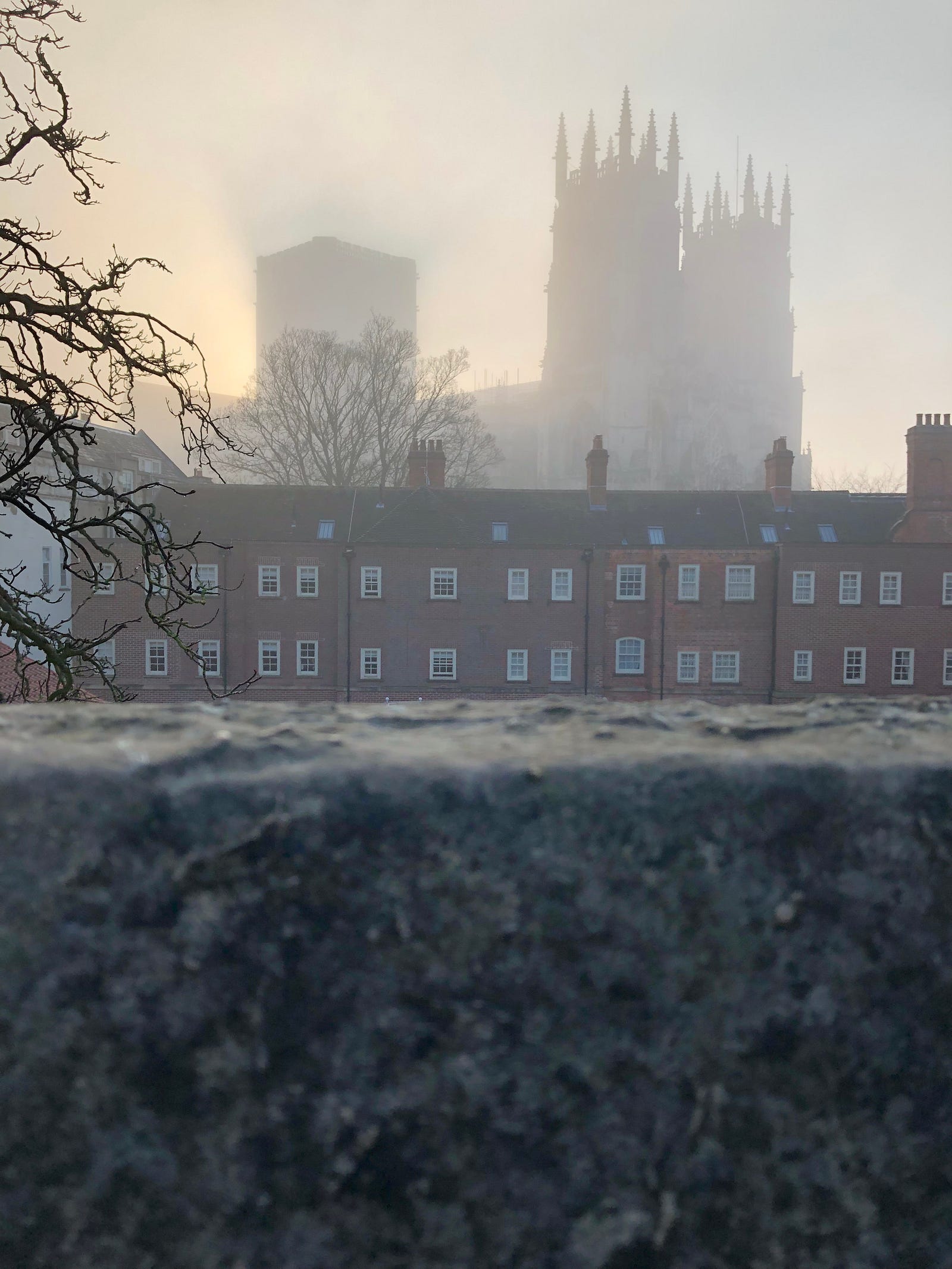
This has to be one of my favorite pictures. During my Fulbright year in Norway, I had the opportunity to travel to York with Norwegian students as they learned about the connections between the the region and their home country. Almost everyday during that two-week trip, if I had the opportunity, I would walk the along the city walls which surround the center of the city and provide views of York Minster. On some days I would have the sun, even capturing a picture with the sun directly above Minster. Other days, though, if I walked early in the morning, fog would greet me. These days had a chill in the air, but I still heard the birds chirping with the near arrival of spring.
It was on one of these foggy mornings that I snapped the picture above. This image remains one of my favorites because of it atmosphere but also because of the framing with the city wall, a building, and the Minster peeking through the fog. It captures, in many ways, the mood of York when I was there, in the waining days of winter and on the cusp of spring. Along with this, the image also carries with a feeling of the gothic, a sort of haunting and foreboding, something that I felt when we went to the Brontë Parsonage in Haworth. There, walking the moors around Haworth, I saw how Emily Brontë could write something like Wuthering Heights. Being in that spot, even being in York with the fog, I understood the ways that the landscape and environment impacted the Brontës and countless others.
Trees and Field in Morgan City, Louisiana

During the summer of 2016, I had accepted a job at Auburn University in Alabama and my family and I started making preparations to move to Alabama from South Louisiana. Before we left, I knew that I wanted to visit the recently opened Whitney Plantation, a site that, unlike Oak Alley or other plantations in the South, centers the experience of the individuals enslaved by the Haydels at the plantation. My daughter, who was nine at the time, and I went to the Whitney Plantation, and on our drive there, I saw this landscape. I pulled over to the side of the road, got out, and took a panoramic picture of the land with my phone.
There are many things that I like about this image. I like that I have the flat land taking up much of the space in the picture with the large tree on the left. I like the dreariness of the image, another picture I took on a foggy morning. I like the fact that this image reminds me of South Louisiana. Foremost, though, I like that this image does not appear as it seems. When I got out of the car and took the picture, I instantly thought that the tree on the left was just that, a tree, one solitary tree with Spanish moss hanging from its limbs. However, when I walked up to it, I discovered it was three or more trees close together, giving off the appearance of a solitary tree in the field. This realization led me to think about this image in relation history and reality.
Since I took it on our way to the Whitney Plantation, I think about this scene in relation to what we know and don’t know, factually, about a space. I do not know who owned this land before this moment. I do not know if enslaved individuals worked it. It looks like that could have been the case. It also makes me think about the ways we think about history and teach it. I think about the distorted narratives of the Lost Cause, which would make us believe a single tree exists there, a single tree that cultivated the land. I think about the reality, a cluster of trees, together, cultivating the land for the singular tree, enslaved by the singular tree.
Franciscan Monk in Jala, Nayarit, Mexico

A few weeks ago, I took a trip to Nayarit, Mexico. While there, I visited Jala, a Pueblo Mágico. During my stay, I was able to catch a callejoneada, a musical experience that leads you around Jala to learn about the history and culture of the town and region. Our guide, playing the guitar and singing, took us to various spots around the town. One of them was the Convent of Limpia y Purísima Concepción de María, built in 1582 by Franciscan monks. A callejoneada includes reenactments by others in the community, and within the convent, someone dressed as a Franciscan monk walked down the aisle and knelt at the altar in the candle light.
Our guide told us the story of some of the indigenous community beheading some of the monks in resistance to colonization. I did not catch everything he said, but that is the just of it. Unfortunately, I cannot find specific information online about it either. However, that does not change the way I see this image. I’m drawn to this photograph, again, for the atmosphere, It is dark and contempative, providing, in some ways, what the convent would have looked like without electricity. The framing of the monk with the candles and the altar invokes a certain feeling for me, one of contemplation and meditation, one of spiritual reflection. Yet, it also brings about feelings of oppression through colonization and resistance. It brings to mind the ways that Christianity served, and still serves, as a tool of colonization and oppression.
Seagull in Nice, France
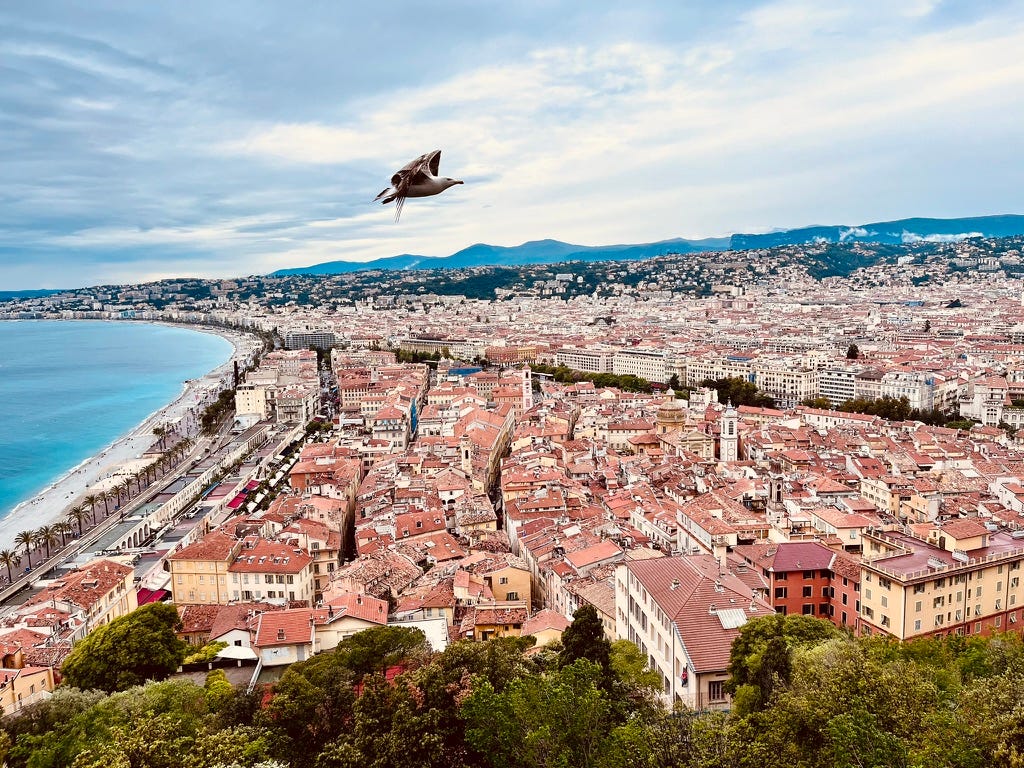
Back in 2023, I had the opportunity to take students on a study travel trip to Southern France where they read Black expatriate writers such as James Baldwin and William Gardner Smith. I had the opportunity to go to St. Paul de Vence, the village where Baldwin spent the last seventeen years of his life, and that experience was spiritual, to say the least. I captured the image above, though, in Nice. On one of our afternoons off, I walked around Nice, eventually working my way up to the Parc de la Colline du Château, I passed by the Jewish section of the Cimetière du Château; however, since it was Shabbat, it was closed. When I reached the Parc de la Colline du Château, I had a panoramic view of the Mediterranean Sea, Nice itself, and the Maritime Alps.
At the top, I took various pictures, including some of two pigeons posing on a wall. Yet, none of those photos compared to the one above. I do not recall if I saw the seagull flying towards me and snapped the picture when it crossed my field of vision or if I inadvertently caught it in the shot. I do know, though, that its presence makes this photograph because seeing it soaring above the cityscape, with the Mediterranean to the left and the Alps in the background, makes me think about that trip, the joys of travel, and even about my visit to St. Paul de Vence. There is a freedom in this image, in this moment, a freedom that encapsulates what it means to travel, to learn new things, to meet new people, to have new experiences. It reminds me of why I like to travel; the inescapable feeling of being a part of something much, much larger than myself. It reminds me of the vastness of the world and existence.
These are not, by any means, all of my favorite pictures from over the years, but they provide a good sampling of images I like to capture. What are some of your favorite pictures that you have taken or just ones that you like? As usual, let me know in the comments below. Make sure to follow me on Bluesky @silaslapham.bsky.social.
 Interminable Rambling
Liked the colour
LikeLike
Thank you.
LikeLike