
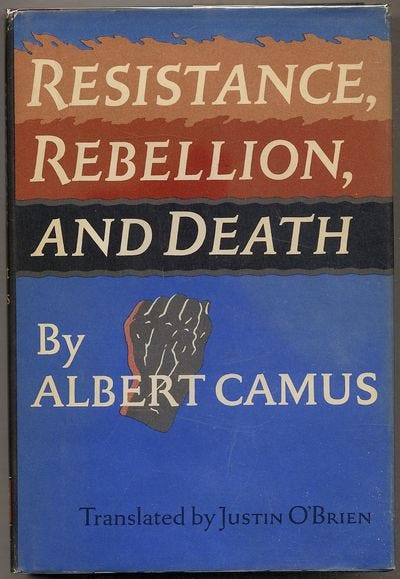
Almost two years ago to the day, I finally read Albert Camus’ The Stranger. I had come across, somewhere, a discussion of the novel’s ending, which I won’t spoil here, and I became intrigued, especially since I was reading texts about the Algerian War and about France’s protectorate control of Morocco. Since then, I have been wanting to read more Camus, especially his 1947 novel The Plague which can be read as an allegory of the French Resistance to Nazi and Vichy control in World War II. I still haven’t read The Plague, but I did pick up his collection of essays, Resistance, Rebellion, and Death. I could spend multiple posts looking at multiple essays in the collection because Camus writes about everything from World War II and the Algerian War to the Communist regime in Hungary and calling for the end to capital punishment.
Instead of looking at multiple pieces, I want to explore what Camus said during his 1957 lecture at the University of Uppsala in Sweden. In “Creating Dangerously,” Camus laid out what he saw as the role of art in modern society. Camus’s opening contains Orientalism, but it sets the stage for what follows. He begins by stating, “An Oriental wise man always used to ask the divinity in his prayers to be so kind as to spare him from living in an interesting era.” He continues by stating that the divine did not spare him or other artists of the period because they existed “in an interesting era.”
I would argue, though, that every era is “an interesting era,” and thus every artist, in every era, must do what artists in “interesting eras” do. They must not sit, solitarily, and create art enjoyed by themselves and a small cadre of their friends. Rather, they must speak out and call out the issues of the era, pointing to the universal nature of humanity. This act, though, as Camus points out, can lead to artists getting “criticized and attacked,” and if they don’t speak up, “they are vociferously blamed for their silence.” Amidst everything, the artist must continue, putting his oar in the water to keep from dying. The artist must “go on living and creating.”
This act, though, does not come easy, especially in the face of authoritarianism and totalitarianism that seek to squash any resistance to their power. Under such pressure, the artist begins to fight within themselves, decided whether or not they will fight against the suppression or capitulate to its desires. Within this battle, the artist must ask themselves what role art plays. They must ask, as Camus puts it, “is art a deceptive luxury?” In other words, does art allow the artist to disconnect from the woes and oppression around them, allowing them to look at the stars, the moon, the horizon? In this manner, the artist uses art as a luxury, as a creative outlet that lets them remove themselves from the current situation, as a luxury.
If art exists as “a deceptive luxury,” then it removes itself from the foundations of its very existence because it “takes shape outside of society and cuts itself off form its living roots.” Art can not simply exist as art for arts sake. It cannot, either, exist as mere propaganda and hate. Camus stresses that works crafted on hate do not sustain. What sustains connects us. What sustains liberates us. What sustains frees up. Art binds us together into cords that strengthen us. It links us to one another across time and space. All of this causes tyrants to attempt to crush art because “tyranny separates” and sees art as “the enemy marked out by every form of oppression.”
The artist must be of their time because when the artist does this they “speak into the void.” Camus, unlike me, does not view artists as prophets because, as he writes, “Judging contemporary man in the name of a man who does not yet exist is a function of prophecy” and unlike religious or political prophets the artist cannot do this because if the artist was a prophet they would “divide reality into good and evil.” I disagree here, though, because no matter who we are, artist or not, we see the world in terms of good and evil, based on our understanding of the world. Artists view the world and reflect it back to us, showing us ourselves in the world and the ways that world impacts us. In this manner, they make statements about good an devil.
I can agree, though, with some of Camus’ reasoning here because he argues that art’s goal “is not to legislate or reign supreme, but rather to understand first of all,” and that the artist and their work cannot be “based on hatred and contempt.” While art divides reality into good and evil, the art that sustains provides nuance, an area in between where good and evil overlap. I think about Toni Morrison’s The Bluest Eye and Cholly whose actions are evil but whom Morrison humanizes, allowing us to see the society that led him to such actions.
Ultimately, Camus argues that artists must speak for those who cannot speak. The artist must provide a voice for the oppressed and those in misery. He states, “[W]e must know that we can never escape the common misery and that our only justification, if indeed there is a justification, is to speak up, insofar as we can, for those who cannot do so. But we must do so for all those who are suffering at this moment, whatever may be the glories, past or future, of the States and parties oppressing them: for the artist there are no privileged torturers.” We must move away from the solitary, individualized “ideal” of art, and we must embrace art as a way to give voice to misery, to give voice to resistance, to give voice to rebellion against those who seek to suppress it. “The time of irresponsible artists,” Camus concludes, “is over.”
When the artist seeks to produce art for their mere comfort and enjoyment, it skirts reality, painting a picture of the world that does not exist, one where misery and suffering exist on the periphery, out of view, and thus relegated to oblivion. The artist’s job is to shift the frame, moving to the edges in order to illuminate the truth. The artist works in tension with society; “there is not other peace for the artist,” Camus proclaims, “than what he finds in the heat of combat.” That combat uses the truth to give voice to the voiceless, to support those who suffer under the boot of oppression, to comfort those enduring misery. That combat puts the artist in relation to the world, eschewing a posture of navelgazing that will produce only pieces for their enjoyment. That combat endures because the world endures, in all its beauty and ugliness, and the artist works, tirelessly, to connect us and to show us the beauty amidst the ugliness, the way things can be if we only have the courage to try to achieve such a future.
Artists, no matter the medium, “create dangerously” by exposing the roots that seep underneath our feet and work tirelessly to pull us under. What are your thoughts? As usual, let me know in the comments below. Make sure to follow me on Bluesky @silaslapham.bsky.social.
 Interminable Rambling
About “the stranger”. I was amazed by the storytelling. Right now i saw that there is a new movie made from the story of this book (already the 3rd movie)
https://m.imdb.com/title/tt36243564/
LikeLike