
In my last post in 2025, I wrote about some of the books I read last year. Today, for the first post of 2026, I want to do a deep dive into my 2025 reading summary, looking, as well, at information about Americans’ reading habits and at what I plan to read during the first part of 2026. Before I get started, I will say that I am a heavy reader, partly due to my job teaching literature but also because, over the past few years, I have found myself increasingly reading instead of doing other things such as playing video games or watching movies. In fact, I can’t even sit for a whole football game without picking up a book during commercial breaks and reading a little. At this point, it has become routine, something I do without even thinking about it and something that, if I miss a day, makes me mad. My students tell me they wish they could read more, and I remind them that they have train themselves to read more, to make it something that do everyday or every other day. With that in mind, let’s dive into my 2025 reading summary.
For the past few years, probably since 2022 or 2023, I have been using The StoryGraph to keep track of what I read, and if you don’t have an app to help you track your reading over the year, I highly recommend The StoryGraph. When I count the number of books I read, I include graphic novels and comics trade paperbacks because they are, in many ways, more difficult to read than prose. I also include plays and the very minuscule amount of poetry collections that I read each year. I do not include single issue comics, which includes numerous issues over the course of the year.
Since 2022, the amount of reading I have done has increased dramatically. In 2022, I read 44 books; in 2023, I read 79 books; in 2024, I read 142 books; and in 2025, I read 185 books. If I removed the comics and graphic novels from my 2025 list, I still read 100 books. As well, I read three graphic novels twice this year, once in the spring and once in the fall because I initially read them in the spring and knew I wanted to teach them in the fall. According to a recent YouGov survey, 40% of Americans did not read any book in 2025 and 27% read between one and four books during the year. That means that 67% of Americans read less that four books all year. Only 10% read more than 20 books and only 4% read more that 50 books over the course of 2025.
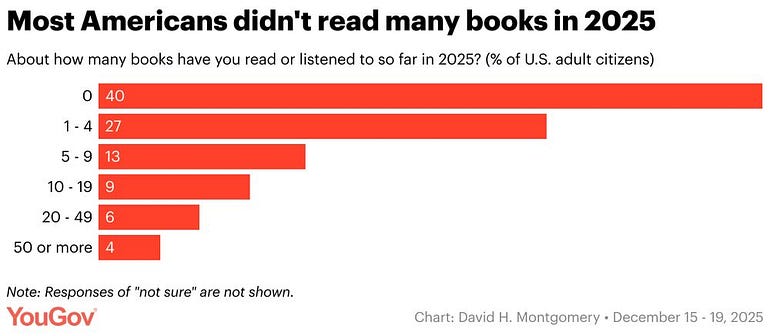
The data continues by breaking down reading habits by education level, with those who have postgraduate degrees reading on average 13.6 books and those with a high school education reading around 4.6 books. Age wise, individuals 65 or older read more than those in other age ranges. With political affiliation, David Montgomery points out, “Democrats read more books on average (10.7) than Republicans (7.7), though this effect is driven more by heavy readers than the reading habits of typical Democrats and Republicans — both parties have a median books read of two. Independents read less than members of either party, both on average (5.9) and as a median.” Finally, individuals who follow public affairs and the government read more than those who do not pay attention to these things.
I am an atypical reader, I know that. I have time to read, because it is part of my job and also because I have the luxury of having time when not working to read for pleasure. Reading, for me, is a political act, an act where I engage with numerous ideas, some of which I agree with and some of which I don’t agree with. It’s a act that allows me to connect with others and to learn about the world around me. It’s an act that helps me to see the world from the perspectives of others, perspectives that differ from my own experiences. With this in mind, I purposefully choose what I read, making sure that I read a diversity of works in different areas and by different writers. I vary up genre, moving from literature, graphic texts, history, and nonfiction. I vary up ethnicity, moving from European, Asian, and African writers to Mexican and United States writers. I vary up gender, trying to maintain a balance between male, female, and non-binary writers. In 2025, I didn’t do as well with this balance, reading 52 books by women and one by an non-binary author with 132 books by male writers.
As well, I find myself getting drawn down rabbit holes, reading books on specific time periods or by specific authors. Over the course of 2025, I read four books by Claude McKay, falling back in love with his writing and his depictions of Marseille and Harlem. I read these for a paper I was writing, and rereading McKay’s work makes me want to teach him again in the near future. In May, I read two of Annie Ernaux’s books, becoming entranced with her memoirs and wanting to read more. I reread come of Chip Zdarsky’s Batman run before finally reading volume 4, Dark Prisons, thoroughly engaged with Zdarsky’s exploration of the Dark Knight’s mentality. I dove down an Irish rabbit hole since I am preparing to do a study travel trip to Belfast. I read Marc Mulholland’s Northern Ireland: A Very Short Introduction, which offers a great overview of Northern Ireland and the Troubles, and followed that up with Louise Kennedy’s Trespasses, an excellent novel that I plan to teach during the study travel trip. I also read two works by Claire Keegan and Sally Rooney’s Normal People. In 2026, I plan to read more to help me prepare for the course.
When I was planning a course, that didn’t make, I thought about doing music as literature in the course, so I read a couple of the 33 1/3 series books: Nick Attfield’s on Dinosaur Jr.’s album You’re Living All Over Me and Michael Stewart Foley’s on Dead Kennedy’s Fresh Fruit for Rotting Vegetables. Attfield epitomizes the beauty of writing about music, and Foley details the historical contexts that gave birth to the Dead Kennedy’s debut album. This thread arose, too, after reading Robert Fitzgerald’s excellent Hardcore Punk in the Age of Reagan, an historical exploration of punk’s response to Reagan’s America, Jean Guerrero’s Hate Monger: Stephen Miller, Donald Trump, and the White Nationalist Agenda, a book tracing Stephen Miller’s life and his agenda, and Kathleen Belew’s Bring the War Home: The White Power Movement and Paramilitary America, a book that traces the white power movement from post-Vietnam America to the Oklahoma City bombing. I read so many other great books from Mary Berg’s diary about surviving the Warsaw Ghetto and Hans Massaquoi’s memoir about growing up as an Afro-German in Nazi Germany to Omar El Akkad’s One Day, Everyone Will Have Always Been Against This, a book calling out our complacency in the face of genocide, to my final book of the year, Seth Wickersham’s American Kings: A Biography of the Quarterback, an extremely engaging exploration of the evolution of the quarterback as a cultural icon and deity in American culture.
I don’t have the space to detail every book that I read in 2025 or every book that I would recommend. As for 2026, I plan to continue reading about Ireland and Northern Ireland specifically. I want to read books such as Fearghus Roulston’s Befast Punk and the Troubles: An Oral History, and I already have a stack of books that I bought over the past couple of the weeks to start the year off right: Mariann Edgar Budde How We Learn to Be Brave: Decisive Moments in life and Faith; John Dominic Crossan and Jonathan L. Reed’s In Search of Paul: How Jesus’s Apostle Opposed Rome’s Empire with God’s Kingdom; Hika Harada’s Dinner at the Night Library; and Helen Oyeyemi’s Mr. Fox. I’m excited to see what I read in 2026, and what I learn. Stay tuned here for posts on some of the books I read. Until then, here are all of the books I read in 2025.
What books are you looking forward to reading in 2026? As usual, let me know in the comments below. Make sure to follow me on Bluesky @silaslapham.bsky.social.

 Interminable Rambling