
As a result of Executive Order 9066, the United States government abducted George Takei and his family, taking them to a concentration camp in Rohwer, Arkansas. They took a train to Arkansas, and during the trip, whenever they entered a town, the soldiers guarding them on board the train would tell them to shut shades so that no one outside the train, walking through the town or on the platforms at the stations, would see the individuals in the cars, under armed guard. Over a three panel sequence in They Called Us Enemy, Takei looks out the window and sees a family, with a young boy in tow, walking along the platform. A soldier immediately comes over and the shuts the shade, and the final panel shows the people on the platform as Takei looks out at them as he peers beneath the shade. Over this sequence, Takei narrates, “Whenever we approached a town, we were forced to draw the shade. We were not to be seen by the townspeople. My brother and I were innocent children, not fully comprehending our situation.”
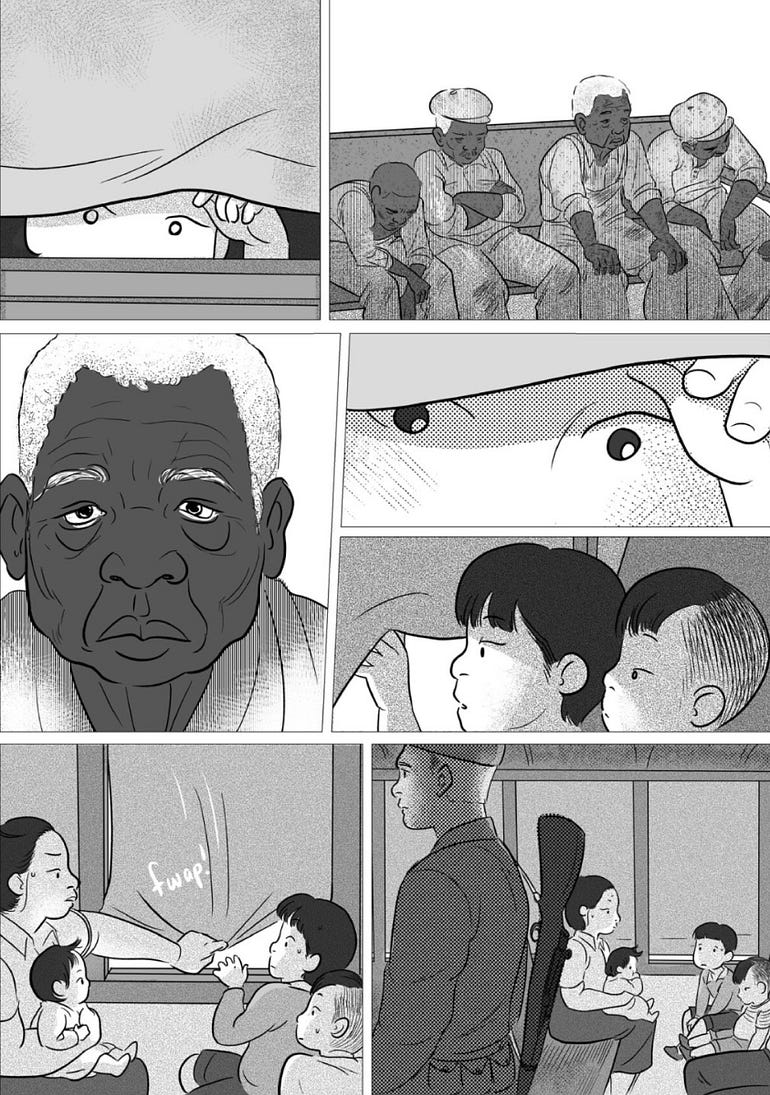
Later, as the train approaches another town, the soldier walks through the train car telling people to shut the shades, and again Takei peers out from underneath the shades to see the people outside. This time, instead of seeing a white family joyfully walking along the train platform he sees a group of older Black men, heads slouched from bearing the weight of oppression. One man looks up at Takei with knowing eyes, and Takei looks back, as if recognizing something within the man’s gaze, recognizing a shared experience that the white family would not recognize.
A similar scene occurs in Julie Otsuka’s’ novel When the Emperor was Divine, a novel that follows a unnamed family through expulsion from their home in Berkeley to the concentration camps during the war to their reunification back in Berkeley after the war. As they pass through Winnemucca, Nevada, the daughter hears church bells ringing and looks out of the window. She sees roads “filled with people in their Sunday clothes walking home from morning service,” going to eat after hearing the word of God procliamed from the pulpit. She sees girls in Sunday dresses and a boy in a suit pull out a slingshot and take aim at three blackbirds. She sees a man and a woman and wonders if they are together. The people do not see the girl or glance at the train. They do not register who the train carries or where. They only focus on themselves.

At this moment, a soldier walks down the aisle and tells everyone to lower the shades so people cannot see inside and those inside cannot see outside. He touches the girl lightly on the shoulder, and she lowers he shade. After everyone lowers their shades, the soldier walks to the back of the car and touches “the gun on his hip, lightly, with his right hand, to make sure it was still there.” The solider feels for his gun the same way he touched the girl, lightly, the distance between consolation and violence being the mere distance between the soldier’s hand and the gun on his hip.
The shade separated the girl and those in the car from the outside world, keeping a distance between them. The narrator describes what a man walking along the train tracks might think if he saw the train with the darkened shades pulled down in the middle of the day. He would probably notice the train then forget about it, thinking instead about what he would have for supper or what he had to do later in the day or the next day. The train would disappear from his memory. Others, though, would know whom the train carried and would attack it, throwing bricks and stones through the window because they bought into the vitriolic propaganda that presented the girl and her family as the enemy, even though they had nothing to do with Japan’s military plans and aspirations.
The novel ends with a “confession” that appears to be from the girl’s father. In it, the man admits to be everything the government’s rhetoric claims him to be, an enemy combatant, a spy, a fifth column, even though he is none of those things. He says that the propaganda has told the truth, that the language used to craft him as a terrorist and enemy is not a lie but factual, and that because of this he deserved what happened to him. We know this is not true, but he does this in order to get released, which does not happen. No matter what he tells them, they will not let him go because the language and the lies have metastasized within the psyche of society, deeming him everything he is not.
I finished reading Otsuka’s novel on Saturday, the day of Alex Pretti’s murder, the seventh person this year, killed by ICE agents. I read the end of Otsuka’s novel as government officials labeled Pretti, as they did with Renee Good and others, a “domestic terrorist,” using language to vilify him as he lost his life protecting others. I read the end of Otsuka’s novel, which details a dark chapter in our nation’s history, as I came across local social media posts about Pretti’s murder filled with countless laughing emojis and arguments justifying his execution. I read the end of Otsuka’s novel and kept getting reminded that what we see is old news in new clothes. I read the end of Otsuka’s novel and thought about the fact that it takes the murder of white individuals to galvanize a critical mass of white rejection of oppression while they countlessly ignored the murders of Geraldo Lunas Campos, Keith Porter, and others.
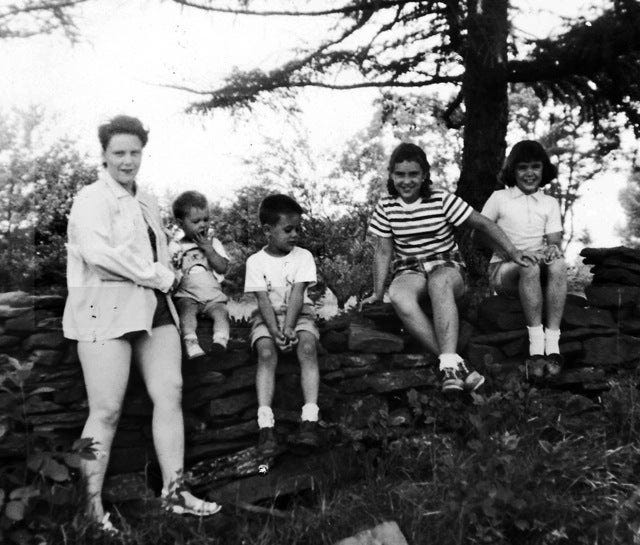
I recall that white perceptions of the Civil Rights Movement changed, not with the murders of Jimmie Lee Jackson but with the murders of James Reeb and Viola Liuzzo. Following Liuzzo’s murder, white supremacists mouth pieces labeled her a “nymphomaniac” and a drug addict who only travelled South to have sex with Black men. From her home in Michigan, she saw the images on television of Alabama and the South, including the murder of James Reeb, and decided to act, to bear witness. They vilified her when they shot her dead as she worked to take activists from Montgomery back to Selma following the marches in 1965.
Ta-Nehisi Coates points all of this out in his latest piece “‘The Homeland’ Is War on America: The Blood-and-Soil Nationalism that Killed Renee Good and Alex Pretti” when he concludes that Liuzzo, Good, Pretti, and others did not become “domestic terrorists” or enemies of the state until they became “woke,” recognizing what lied beneath the shades of the train passing through town and the rhetoric spewed from the pens of those in power. Coates writes,
When Liuzzo acquired this knowledge, when she got woke, she was transfigured into a traitor to her race and a menace to The Homeland. For being a menace, for being woke, she was killed — as was Renee Good. (As was Alex Pretti.) But revelations have their blessings too. In this case, a life, however brief, that is clean and does not depend on the oppression and debasement of others. The revelation of deep human ties, the belief that we are all equally chosen, doomed Liuzzo, Good, and Pretti, as revelation so often does. But it also immortalized them.
We cannot be the man who sees the train, with its shades pulled down, and then forget about it. We cannot let the shades separate us from the truth and blind us from reality. We do not have the privilege to carelessly stroll along as if the train we see isn’t carrying individuals to concentration camps or their deaths. We cannot maintain our existence by keeping the shades pulled down or our heads buried in teh sand. I’ll ask it again and again, “When someone asks, ‘What did you do during that period?’ What will you will say?” That’s the question each of us must answer for ourselves. No one can answer it for us.
 Interminable Rambling