
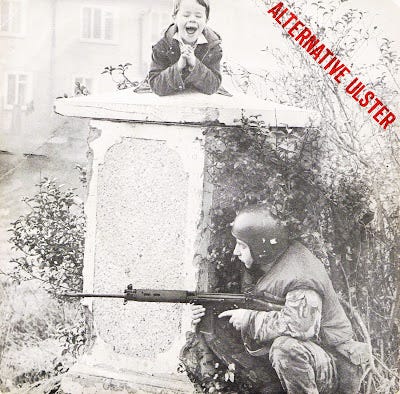
Ever since I discovered punk during my formative years, I have gravitated towards its political and social commentary, specifically the ways that it succinctly yet thoughtfully engages with issues impacting countless individuals. Just as rap served as a political and cultural response to the ways that the government disenfranchised and oppressed Black and Brown and lower class individuals in the urban landscapes of New York and elsewhere, punk arose in much the same manner, giving voice to the disenfranchised working-class white youth on both sides of the Atlantic. As punk exploded in London and New York, it also exploded in Northern Ireland, specifically in Belfast, providing an outlet for the people who lived, daily, amidst a war zone. This lead The Clash’s Joe Strummer to proclaim, “If punk was chaos, Ulster was war zone. Punk was the perfect soundtrack to the ravaged cities.”
Punk has politics at its core, but those politics don’t always align with distinct political ideas and idoelogies. Rather, the politics of a lot of punk music focuses on unity and togtherness, on the creation of a space where individuals can be individuals, specifically disaffected youth in the midst of political and economic violence that they had no hand in formulating and amidst which they exist, through no fault of their own. This thread of punk permeated throughout Belfast and Northern Ireland during the Troubles and beyond, beginning with bands such as Rudi, The Outcasts, The Undertones, and Stiff Little Fingers and the Terri Hooley’s record store and label Good Vibrations.
At the end of the biopic Good Vibrations, during the 1980 concert at Ulster Hall, the crowd chants, “Terri Hooley is our leader!” As they continue to chant, Hooley stands before the crowd and tells them, “No leaders. No gods eithers. . . . When I look out at yous, alls gathered here, it confirms something I’ve always felt. When it comes to punk, New York has the haircuts. London has the trousers. But Belfast has the reason. Good Vibrations isn’t a record shop. It’s not a label. It’s a way of life.” Holley highlights the unifying nature of music and punk, a unifying nature that while maybe not overtly political in some of the band’s lyrics, comes through in the way that they cultivate a scene to push back against the oppressive and violent society they exist within, stuck under the thumb of an occupying governemnt and in between two warring paramilitray factions.
This atmosphere of sectariation and occupying violence even comes through with the name Good Vibrations, which, as Andy Kershaw points out, “was a nod to the aftershocks of the Belfast bombs,” not the Beach Boys’ song. During his interview with Kershaw, Hooley points out that he opened the shop to highlight the people who lived surrounded by violence. He told Andy, “I just wanted to let the world know that there was more going on in Belfast than just bombs and bullets.” He saw the effect of the war on the youth and others, and he sought to so something about it. He told people there would be no sectarian violence in his store, and he brought people together through the music, creating beauty and unity amongst a war zone.
One of the preeminent examples of the strain of unity running through Belfast and Northern Irish punk has to be Stiff Little Finger’s “Alternative Ulster” off of their 1979 debut album Inflammable Material. It is a quintessential punk song that expresses both anger and hope at the same time: anger at the current state of affairs and a hopeful call for something different to come in the future. It’s a song that epitomizes what many came to see as punk in the late 1970s and 1980s, an anthem for youth who felt that they had nowhere to go and nothing to do, a song that could, if it wasn’t for the air of The Troubles hanging over it, been a suburban punk anthem in the United States. As Jake Burns says about the song’s origins, it appeared “in the classic punk mode of having nothing to do,” and it expressed the frustration of youth in Belfast who endured “the sheer tedium of having nowhere to go and nothing to do when [they] got there.”
The song begins with Burns proclaiming, “There’s nothin’ for us in Belfast” because all of the clubs have either become boring and monotonous or exist outside of the city itself. As well, no one cares that the youth have nothing to do. The only thing others care about is the money that the youth spend. This feeling of boredom and loneliness causes Burns to call for, full-throatedly, as “an alternative Ulster” in the chorus where they could alter their “native Ulster” and “native land” to something far removed from the occupying forces bearing down on them.
Burns drives all of this home in the second verse where he points out that the Royal Ulster Constabulary act as a “dog of repression” in the heels of the citizens and the British army occupies the street as people merely try to live and exist. Burns asks the audience, “Is this the kind of place you wanna live?” If not then what should one do to change it? If the government won’t do it, if the sects won’t do it, who will do it? It’s up to the people. They must, as Burns puts it, “grab it and change it.” This is the punk scene. It created a space for those who merely wanted to live their lives and have their voices heard no matter if they were republican or loyalist or Catholic or protestant. It didn’t matter. What mattered was the moment and the here and now and what that could foretell for the future.
The song ends, before a rousing chorus that repeats the title, with propaganda slogans from both sides. Burns sings,
And they say they’re a part of you
And that’s not true, you know
They say they’ve got control of you
And that’s a lie, you know
They say you will never be free
Free
Free
At the end of this sections, Burns conludes by telling the listener that others say they they will never be free, but the section ends not with an acceptance of this assessment. Rather, Burns screams, twice, “Free,” as if in rebuttal to the assertion that they will never be free, then he leads into the final chorus where he proclaims. “Alternative Ulster,” a hopeful call for the future that when people come together, laying down their sides and joining in unity as one.
I could say more, but I wll leave it there for now. In future posts, I may write some more about Stiff Little Fingers and other groups, including Kneecap, the contemporary hip-hop group from Belfast. Until then, what are some of your thoughts? As usual, let me know in the comments below. Make sure to follow me on Bluesky @silaslapham.bsky.social.

