
When my daughter and I were working on Classics and Coffee, we each chose books to discuss. She chose one of her favorite novels at the time, Charlotte Brontë’s Jane Eyre for one of the early episodes. After reading the novel, I came across Jean Rhys’ Wide Sargasso Sea, a postcolonial novel focusing on Edward Rochester’s wife Bertha Mason. The novel presents Bertha as a Creole heiress in Jamaica who Rocherster changes, including her name from Antoinette Cosway to Bertha Mason. While we read Rhys’ novel as an interrogation of Rochester’s patriarchy and what drives Antoinette to become the “madwoman in the attic,” we must also read it as a postcolonial novel that interrogates British colonial rule.
Later, I finally, and yes I do say finally, got around to reading Albert Camus’ L’Étranger. Told from the perspective of Meursault, the novel is an exploration of alienation and existentialism. It has remained popular and influential, and Le Monde ranked it the number one novel of the 20th century. However, the novel hinges, especially the second part, on a murder and Meursault’s reuminations while in prison and during his trial. At the end of the first part, Meursault murders an “Arab” on the beach, shooting the man once, and then, after the man falls, putting four more shots into the man’s body. He tells us, “I knew that I had shattered the harmony of the day, the exceptional silence of a beach, where I’d been happy. Then I fired four more times at the motionless body where the bulletts lodged without leaving a trace.” The man that Meursault murders has not identity apart from the “Arab” or the “body,” and this fact, like the sidelining of Bertha/Antoinette in Jane Eyre, highlights the colonial mindset of othering an individual, treating them as invisible and insignificant in relation to ones self.
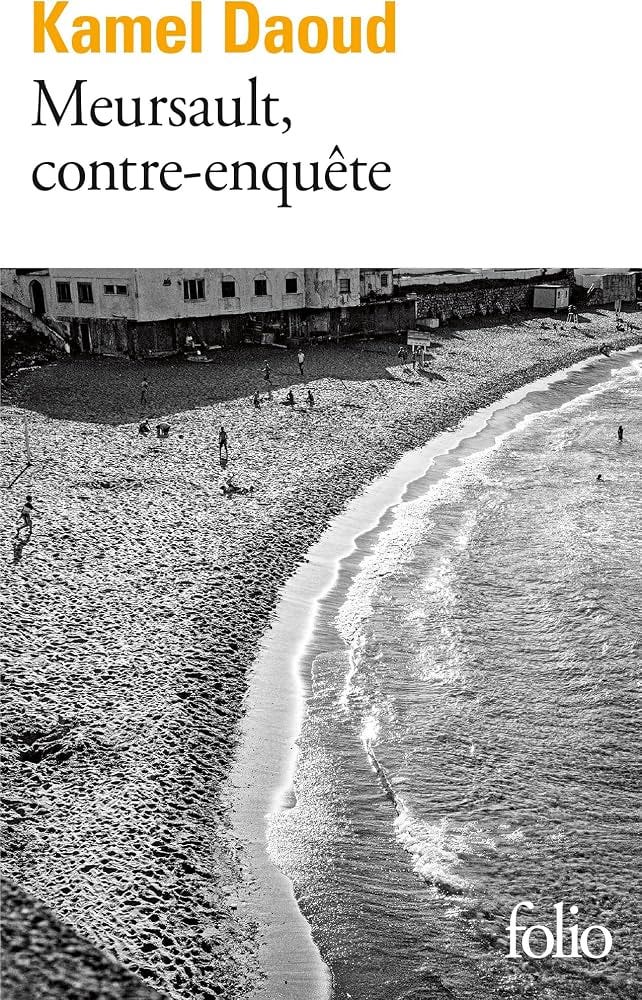
After reading L’Étranger, I discovered Kamel Daoud’s Meursault, contre-enquête, a novel that directly engages with Camus’ novel and, like Rhys’ Wide Saragossa Sea, interrogates it through a postcolonial lens. I finally picked up a copy of Meursault, contre-enquête, and read it immediately after rereading L’Étranger. Reading these novel in such close proximity to one another really affected the way I read Daoud’s novel and I was able, apart from his direct confrontation of Meursault’s dehumanizing of his victim, see the ways that Daoud also presents his narrator, Harun, is like Meursault. Harun relates the story of his brother, Musa, whom Mersault murdered, giving reviving his brother through his words, but what makes this interesting, as well, is that Harun does not write the story himself; rather, he mediates it through an interlocutor, a French student who becomes us and whom he meets at a bar every night, telling his story and the story of his brother, in the hopes that it will one day reach the world just as Mersault’s story did.
I could write a lot about Daoud’s conversation with Camus, but I don’t want to do that today. Instead, I want to focus on a few things from the first chapter of Daoud’s novel and the ways that Harun frames the story he tells us. Most importantly, Harun’s story begins with a rephrasing of Meursault’s opening line. Where Meursault states, “Maman dies today,” Harun begins by telling us, “Mama’s still alive today.” This reversal sets the stage because it lays the foundation for what Harun will do over the course of the narrative, revive his brother’s memory. Harun, early on, asks us, “Good God, how can you kill someone and then taken even his own death away from him?” He asks this because Meursault does not even identify Musa; he merely calls him one of “two Arabs” he encounters on the beach, and even after he shoots Musa, he continues to fire into his body. At Meursault’s trial, the case, while brought because of the murder, hinges on the argument that Meursault has no feeling, with the prosecutor focusing on his reaction to his mother’s passing, not to his murdering Musa.
Harun tells that he learned French so he could “speak in the place of a dead man, so I can finish his sentences.” He also points out that since Meursault published his story in 1942, his brother, whom Meursault never names, has repeatedly died for over seventy years, partly because Meursault’s account has reached such a wide audience. Meursault “was such a good storyteller,” Harun tells us, “he managed to make people forget his crime,” while Musa “was a poor illiterate God created apparently for the sole purpose of taking a bullet and returning to dust — an anonymous person who didn’t even have time to be given a name.” Everyone, so impressed with Meursault’s words, never sought his victim’s identity, letting Musa remain anonymous and dehumanized for decades.
Language is powerful; it names and at the same time conquers. Harun opens by pointing out that even though Algeria declared independence in 1962, the French colonial past remains in signs outside business and on street signs. He details the ways that French colonists conquered and stripped Algeria, and he points out that Meursault’s language, simply referring to Musa as the “Arab” does the same to individuals. He tells us, “For centuries, the settler increases his fortune, giving names to whatever he appropriates and taking them away from whatever makes him feel uncomfortable.” Meursault does this with Musa and the other Algerians in the novel, never referring to the name. In fact, the term “Arab,” stripped of names, appears twenty five times in L’Étranger .
Later in the novel, Harun tells us that Meursault didn’t name Musa “because if he had, my brother would have caused the murder a problem with his conscience: You can’t easily kill a man when he has a given name.” By refusing to name Musa, Meursault strips him of his humanity, othering him and making him less than. Thus, Meursault’s conscience remains intact because he does not see Musa as an individual or human but merely as “Arab,” which Harun point out, “only exists in the white man’s eyes.” Musa, Harun, and everyone else gets constructed through Meursault’s and the colonists’ eyes, becoming what the white individuals see, not who they truly are as individuals. Harun makes this fact abundantly clear over the course of Meursault, contre-enquête, highlighting the myriad ways that language functions to wield power and to other individuals.
After reading Daoud’s novel right after Camus’ novel, I’m thinking about doing a class on literary responses and conversations within a postcolonial context, including Jane Eyre and Wide Saragossa Sea in the class as well, along with Aimé Césaire’s Discours sur le colonialisme. I’m still in the early staged of thinking about this course, but what other texts would you suggest I consider when constructing it? As always, let me know in the comments below. Make sure to follow me on Bluesky @silaslapham.

