
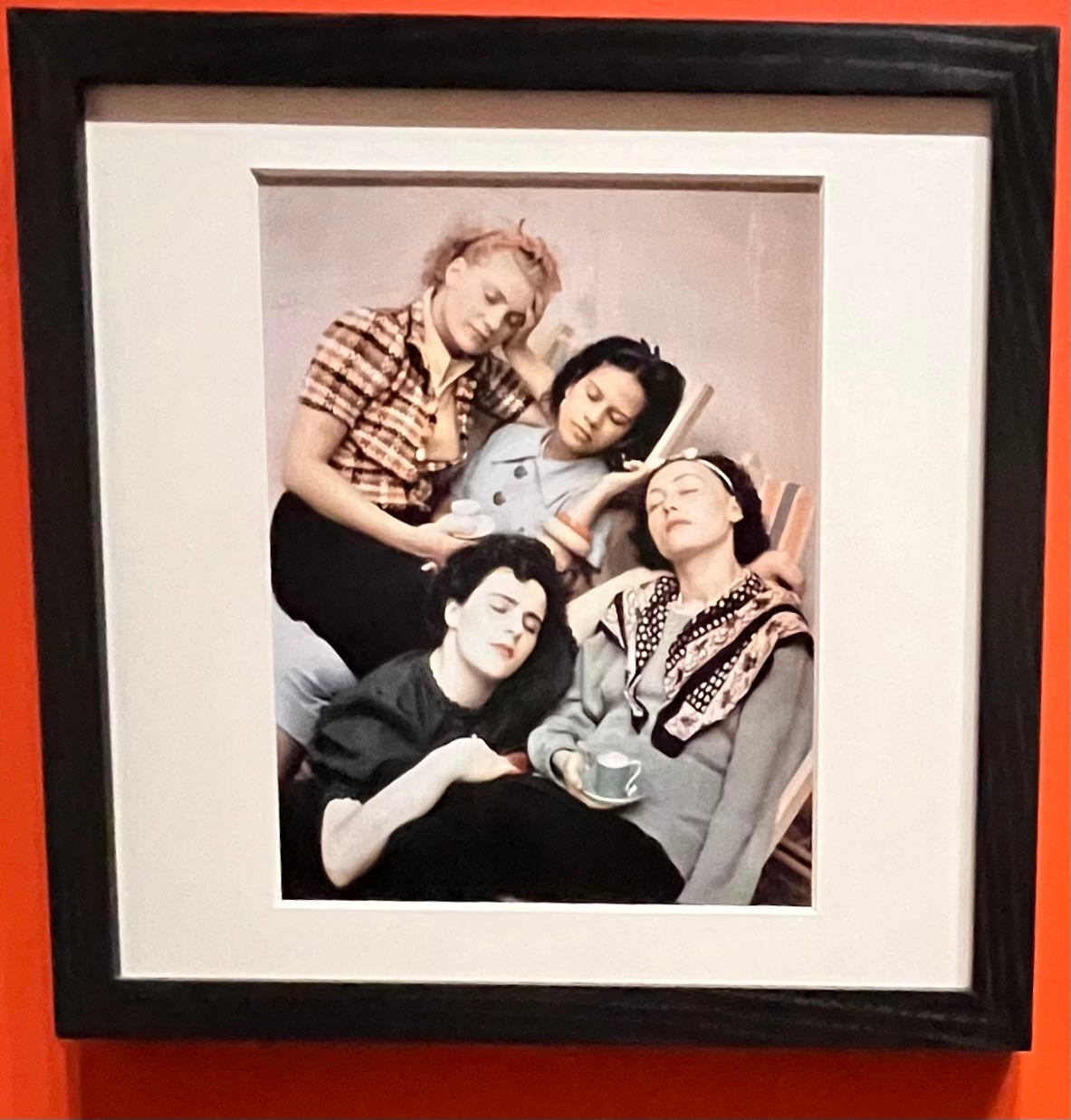
A couple of years ago, I picked up Leonora Carrington’s Down Below, a memoir she details a psychotic break that she had, in 1940, as the invading Germany army took her partner, Max Ernst, to a concentration camp and she tried to flee across the Pyrenees into Spain. The memoir introduced me to Carrington, whom I had not heard of before, and later I read Mary and Bryan Talbot’s graphic novel Armed with Madness: The Surreal Leonora Carrington where I learned more about her extraordinary life and the ways she fought for the rights of women, both in Europe and Mexico where she fled in 1942. Recently, I had the chance to see some of her work at the Musée du Luxembourg, and the exhibit, like everything else I have learned about Carrington, left me in awe.
On art, Carrington proclaimed, “There are things that are not sayable. That’s why we have art.” Her melding of surrealism, mysticism, the esoteric, and more bring this statement to life because her images, filled with countless symbols and references, help to say what we cannot necessarily say with our words. Elsewhere, in her novel The Hearing Trumpet, speaking with herself, Marian Leatherby says, “You may not believe in magic but something very strange is happening at this very moment. Your head has dissolved into thin air and I can see the rhododendrons through your stomach. It’s not that you are dead or anything dramatic like that, it is simply that you are fading away and I can’t even remember your name.” The image of plants springing forth from the dying body depict the “not sayable,” the ways that, even if we know it, death perpetuates life, bringing life forth from its decaying body.
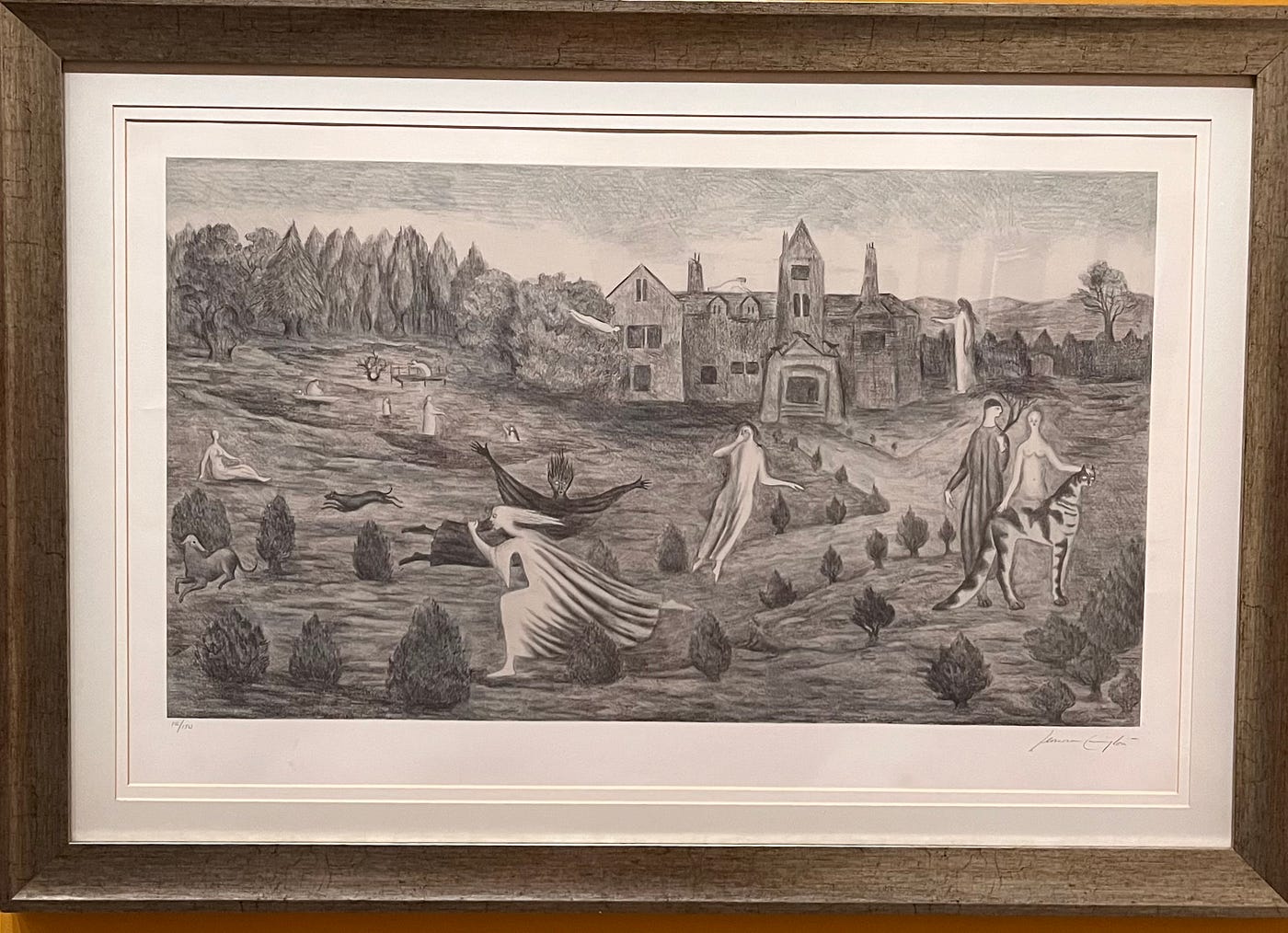
This surrealism draws me to Carrington’s work, and while I am not steeped in surrealism or even in Carrington’s ouvre, I am intrigued by a lot of her work and the ways that it makes me think about our own existence. A lot of Carrington’s pieces stood out to me, but I immediately found myself in front of Crookhey Hall, the lithograph on the cover of the copy of Down Below that I read. The image contains very surrealist and gothic elements from the old, gothic home to the two figures on the right with a large, what appears to be, leopard. The focus on the image, though, is a figure representing Carrington herself in the foreground a little to the left of the middle. Fleeing the dark figure behind her, who has his arms outstretched trying to capture and maintain her, the image invokes, amidst the calmness of the loungers in the grass and the figures to the right, a feeling of fear and flight. In Crookery Hall, Carrington depicts the “not sayable” fears she had when her father and one of her brothers had her committed to the institution in Spain. It’s an image that bears the psychological weaight of that moment, tied to growing up in a patriarchal society where her father did not support her desire to pursue art.
Along with Crookery Hall, I found myself spending time with one of Carrington’s earlier works, The Elements, from 1946. This painting has a lot going on, and I will in no way do any justice to the myriad symbols and ideas Carrington presents in The Elements; however, I want to focus on some things that stood out to me as I looked at in the gallery. My eyes first went to the middle where a figure dressed in white approaches another figure, seated and under a snowy mountain. The first figure, leading a herd of what appear to be oxen, holds her hand open to the seated figure, as an offering. Moving from the first figure to the second figure, my gaze travelled down to the bottom right, where a boat moves across a body of water towards us. This section makes me think of death and Charon, the ferrier who takes people, once they have died, across the river Styx to the afterlife.
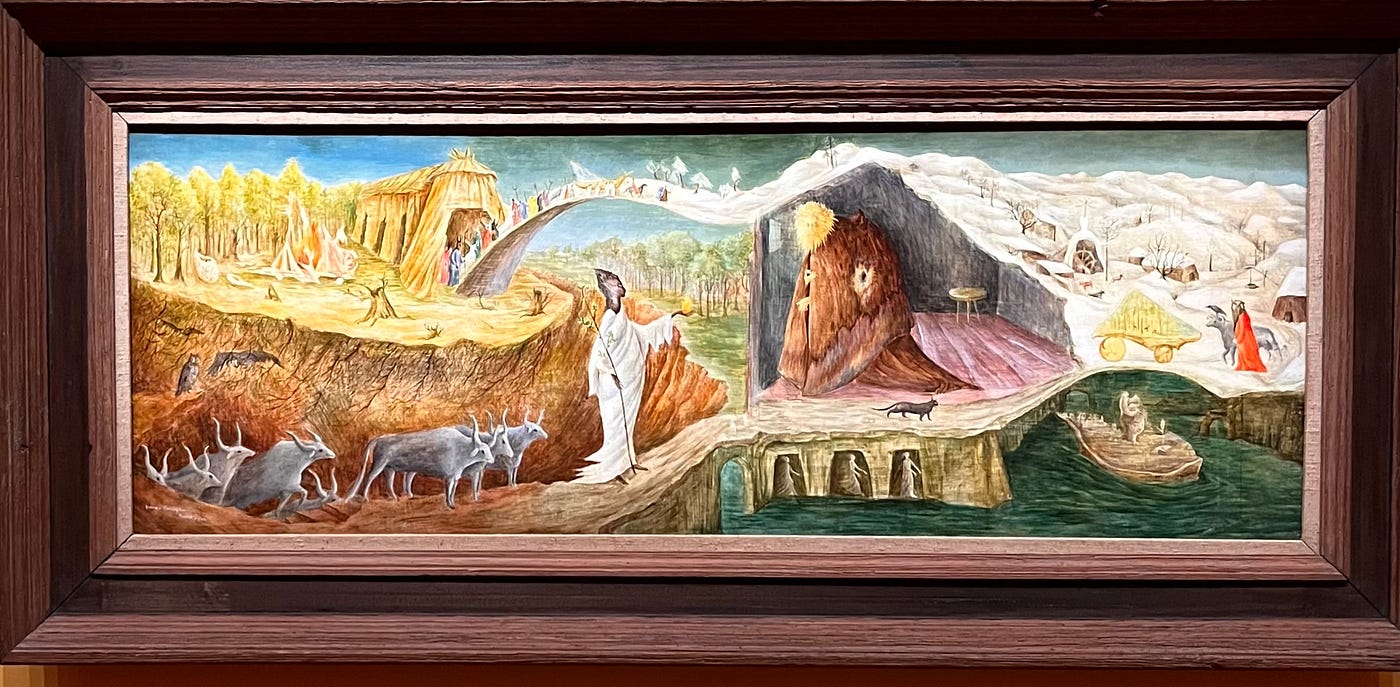
After looking at the bottom of the image, my eyes then moved to the top, and I read it, as I would read a written text, from left to right. The top moves from a scene of golden harvest, where plants sprout forth from the ground and populate the earth. From one of the stacks of grain, people emerge, walking a path over the top of the image to the right. The path, covered in snow, leads to a more desolate, snowy landscape on the right with bare trees and nothing growing. Following this trajectory, and coupled with the scene underneath it, I read the painting as the movement of our lives, from birth to death. We exist on the upper plane, going about our lives while the beings underneath the surface, who we could possibly read as the orchestrators of our existence, control what happens to us. It’s an image of transition and life, a way of explaining the “not sayable” of our existence.
The final painting that I want to look at is Ladies Run, There Is A Man in the Rose Garden. Like The Elements, there is a lot going on in this image, but I want to focus specifically on the man, who appears in the botton left, and the women heading back to the house. I just finished rereading some of Alan Moore and Stephen Bissette’s The Saga of The Swamp Thing, and the man in Carrington’s painting reminds me a lot of the elementals and Swamp Thing himself in the series. However, unlike Swamp Thing who seeks to protect people and the landscape, the title of Carrington’s painting conveys that the man in the rose garden seeks to do harm to the women and the landscape. He appears amidst rose bushes, and it seems as if he is caught in an enclosure, something meant to keep him contained so he does not contaminate the other plants. However, it also looks like he can escape that enclosure.
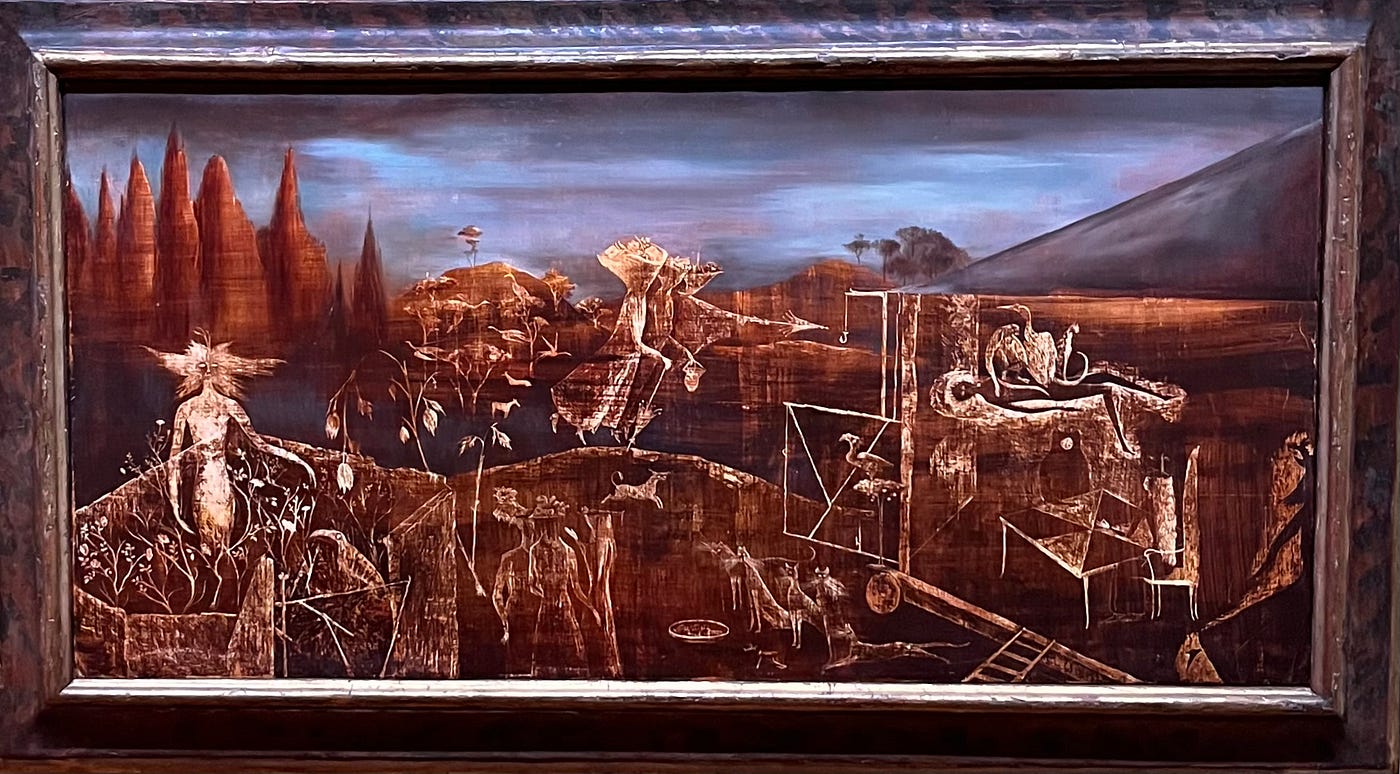
Two groups of women appear in the middle of the painting. At the bottom, we see a group of three women, roses gathered on their heads, conversing together. Right above them, we see a group of three women, carrying umbrellas and with roses atop their heads, moving towards the house on the right side. One of the women points her umbrella towards the house. Do they seek the house for safety from the man? Probably. Yet, the house does not necessarily appear safe. In one room, two birds and a cat sit on a woman who lies prostrate on a bed. The scene reminds me of Zeus turning himself into a swan and raping Leda, thus producing multiple children. Thus, the man in the garden is not the only concern. The man in the house, like the father in Crookhey Hall, also presents a real threat.
Crookhey Hall and Ladies Run bring to mind one of Carrington’s quotes on the wall in the gallery. Carrington, through her art, placed women at the center, unlike other surrealists. She foregrounded women’s experiences and pointed to the ways that patriarchy harms society. She knew what agency meant. She knew what art meant. She knew the harm of patriarchy. She said, “And the only one to give me absolute permission is myself. Conscious deliberate permission to allow miracle. Since civilization is rolling quickly toward absolute destruction for Earth, blind inane mass suicide for all living beings, the last hope is an act of will to step out of the mechanical trap and refuse. If all the Women of the world decide to control the population, to refuse war, to refuse discrimination of Sex or Race and thus force men to allow life to survive on this planet, that would be a miracle indeed.”
What are your thoughts? As always, let me know in the comments below. Make sure to follow me on Bluesky @silaslapham.

