Recently, I took a trip to Lyon, at the confluence of the Rhône and Saône rivers, for a few days away from Paris. While there, I went to the Basilique of Notre Dame of Fourvière, where I saw two bas-reliefs of Cain murdering Abel and Cain’s expulsion. I found these interesting, of course, because I have seen numerous depictions of this biblical story during my time in France. I went to the Roman ruins and the I went to the Centre d’Histoire de la Résistance et de la Déportation (CHRD), a museum detailing the resistance in Lyon and France during World War II. I went to Musée Lumière and learned more about the Lumière brothers, early filmmakers. I went to Musée des Confluences, which I did not intend to do, but thoroughly enjoyed. However, my favorite spot had to be the Musée des Beaux-Arts, partly because I am sucker for an art museum.
The Musée des Beaux-Arts covers a lot of ground from antiquity to the twentieth century, and it includes a lot of Christian art from the early Christian period to the medieval period and forward. As I walked through the galleries, two things begin to stick out to me. The first was the countless paintings I saw depicting the Magi coming to see the baby Jesus. In each of these depictions, dating from the fifteenth century to about the seventeenth or eighteenth centuries, one of the Magi is of African descent. I knew about this before, but seeing multiple images depicting Balthazar stood out to me, especially after I learned that began to appear in Northern European paintings around the twelfth century and became common in the subsequent centuries.
While the paintings of the Magi’s adoration of Jesus caught my attention, I really became intrigued by the works depicting Jesus’ circumcision. For some reason, I had never seen any works on this scene, so it caught me a little by surprise, but as I strolled through the galleries, I came across a myriad of pieces showing Jesus’ circumcision when he was eight days old, following Jewish law. Biblically, this scene appears in one verse in the gospels, Luke 2:21. There, the author writes, “On the eighth day, when it was time to circumcise the child, he was named Jesus, the name the angel gave him before he was conceived.” It struck me that the musuem contained multiple works of this moment, based solely on one verse in one of the gospels.
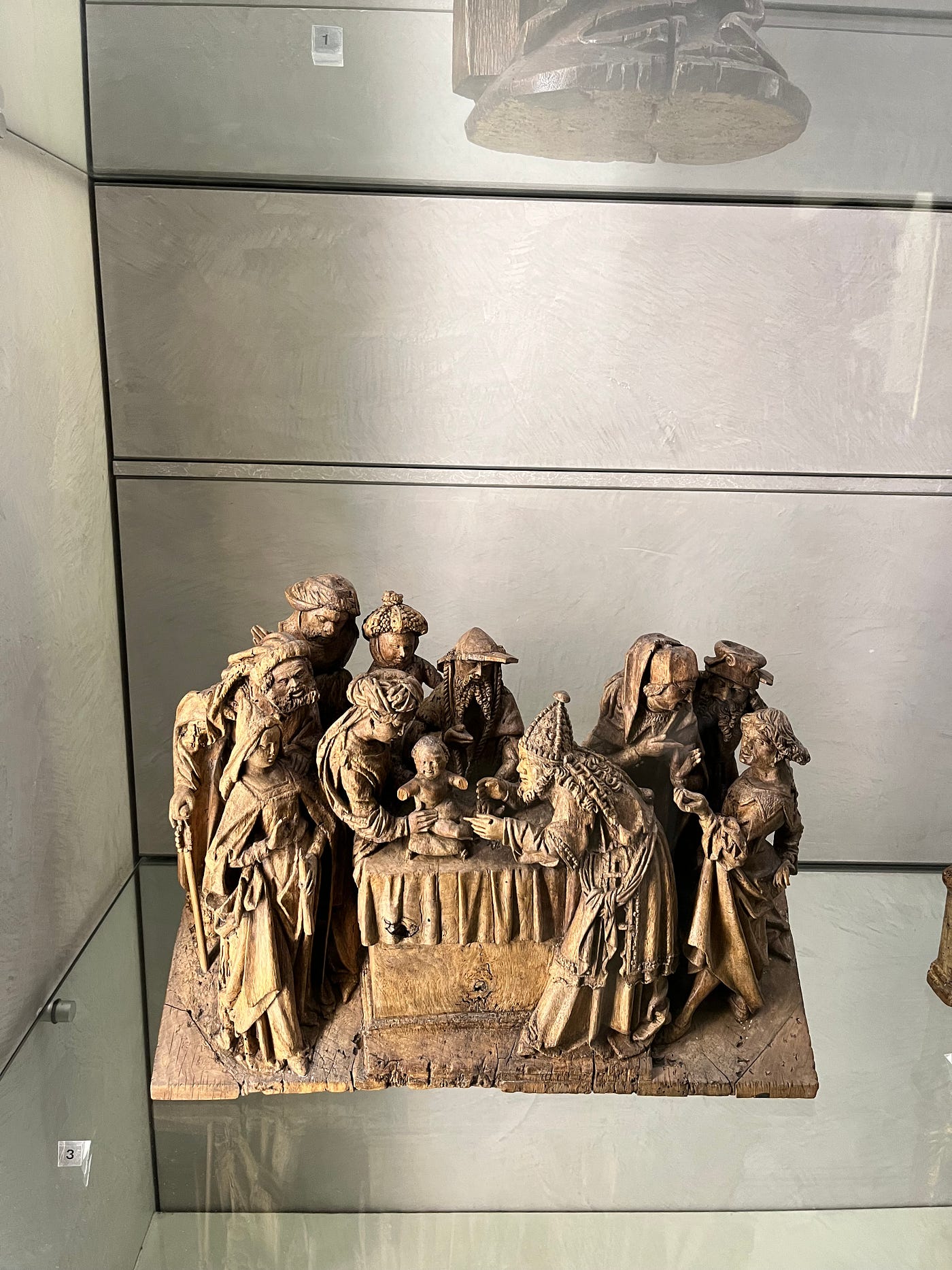
The first piece I saw was a small carving. I tried to look up the artist, name, and date of the piece on the museum’s website because I forgot to take a picture of the information. However, I couldn’t find anything. Needless to say, the piece centers of Mary holding Jesus ad the mohel prepares to circumcise him. Jesus’ arms have fallen off as others gather around for the event. Since this was my first encounter with this scene, I just took a picture of it, not thinking that I would see more as I went through the museum. What strikes me with this piece, too, has to be the crowd gathered around Jesus and the mohel. As well, there are three figures on the right side of the carving: a woman, a man, and what appears to be a servant. It looks like the woman is making a sign with her hand, as if to show the cutting of the foreskin, but I am not sure about this.
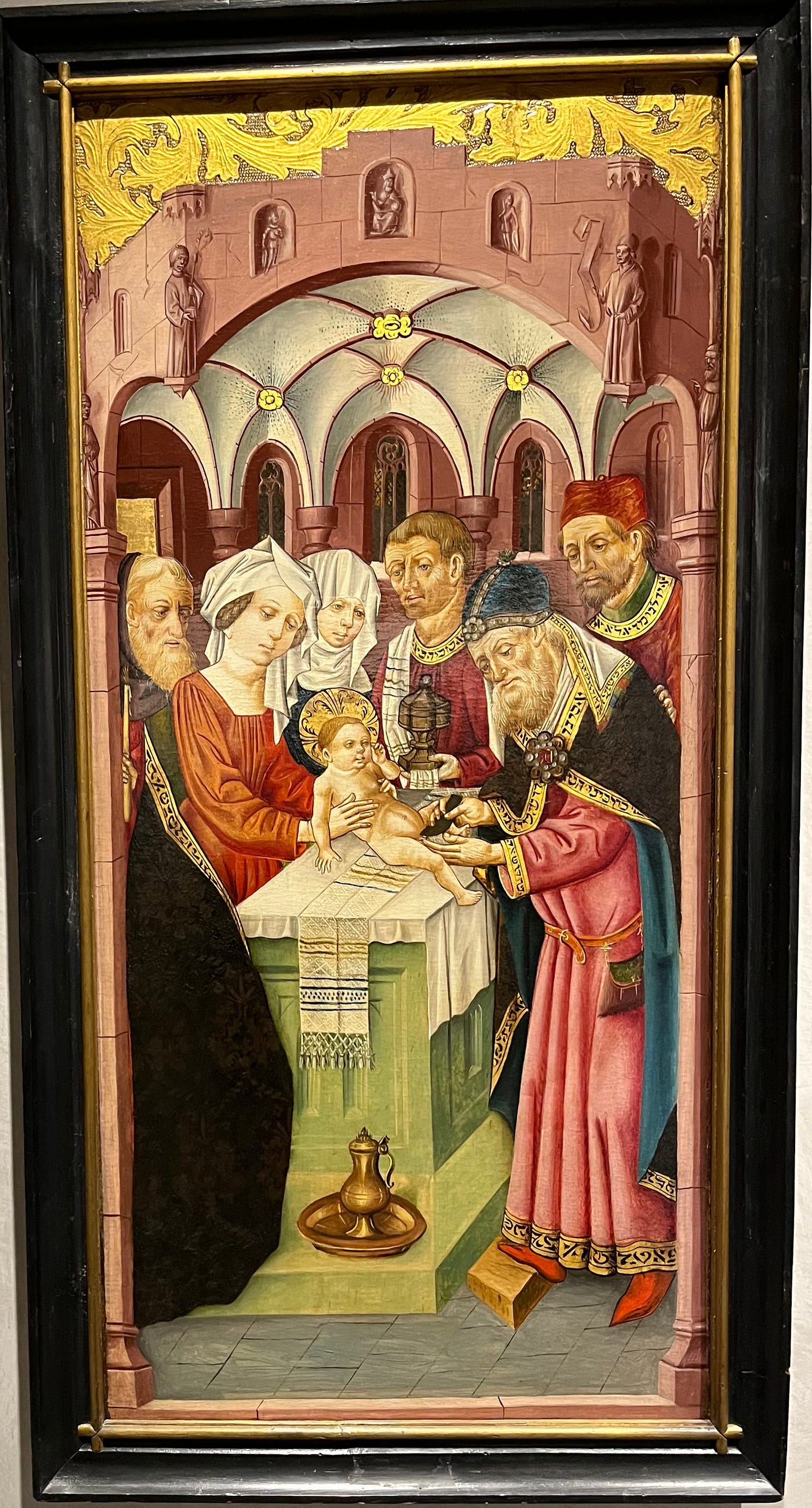
The next piece I saw dates from around 1460 and comes from the Upper Rhine or Lake Constance school. It appears to be part of a series depicting the life of Mary, including her death. This image, like the carving, focuses on Mary holding Jesus in the middle of the image with the mohel on the right. A crowd, again, gathers around, and Jesus has an illumination over his head as he sits, not crying or fighting, awaiting the circumcision. Again, I find it extremely fascinating that one of the earliest depictions of this scene apperas near the end of the tenth century. Many of these representations didn’t show the proceudre, but every work that I saw, which came from centuries later, show the procedure about to take place.
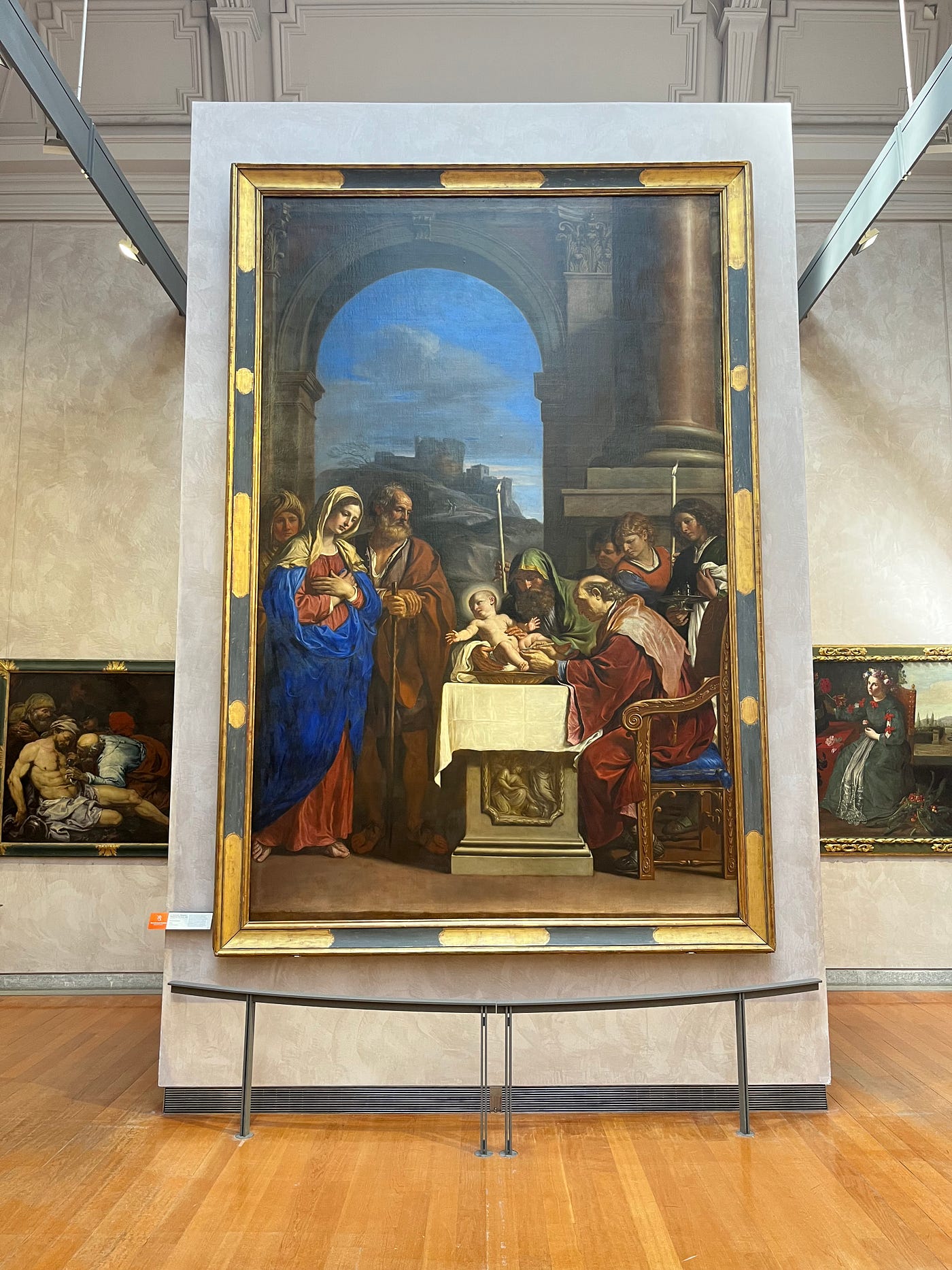
The largest depiction I saw was Guercino’s La Circoncision from 1646. Initially created for the altar at a church in Bologna, and surrounded by a semi-oval depicting the trinity, the image at the museum looks different than the other ones I encountered. In Guercino’s painting, the mohel and another man hold Jesus in the center as Mary, with her arms crossed over he chest, and Joseph, stand to the left. Jesus’s face looks left towards them, and he has an outstretched arm, as if reaching for them. Again, he doesn’t cry or wail, but this positioning draws attention to his connection to Mary and Joseph. Since the scene typically appears in relation to Mary’s life, this makes complete sense. Like the other images, a crowd gathers around Jesus and the mohel, making it a communal scene, not just a private ritual.
Since I did not encounter these scenes until this moment, and since I somehow glazed over Luke 2:21 when hearing the Christmas story, I am really interested in learning more about these depictions over time. Whenever I encounter religious art, I pause and reflect. I know that the artist takes inspiration from the biblical account and from theological history, and these facts really catch my attention because they reflect the ways that individuals interpret the bible and Judaism and Christianity over time. While I did not see any grotesque depictions, these appeared in the sixteenth century, and their grotesqueness specifically appeared anti-Semitic due to the caricatures and the depictions of the mohel as threatening. Again, like the depictions of Cain and the Magi, this fact can tell us a lot about the history of Christianity because art does not arise in a vacuum. It arises from everything encircling it.
What are your thoughts? As usual, let me know in the comments below. Make sure to follow me on Bluesky @silaslapham.bsky.social.