
Over the past two posts, I’ve been sharing my journal entries from the study travel trip I led to France a couple of weeks ago. Today, I want to finish up this series by sharing a short post from the beach overlooking the Mediterranean in Nice and a post about my journey to St. Paul de Vence to walk through the village that James Baldwin called home during the latter part of his life.
17 May 2023
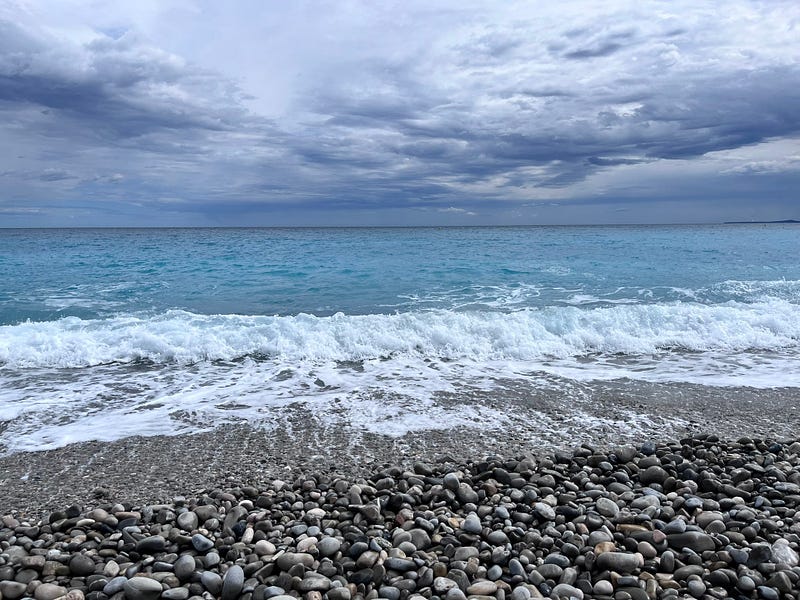
Sitting on the rocky beach in Nice, I watch the Mediterranean lap up onto the shore, spraying me with sea foam as I pick up multi-colored rocks and twirl them between my fingers. The smell of salt hangs in the air, and as the waves crash upon the rocks and retreat, the water rolls back into the sea, causing a cascading sound of rocks clattering together. If energy never dissipates and merely changes with what is affected upon it, then the water I see and the sound I hear have been here for centuries, carrying sailors across these waters to Marseille and beyond. What voices exist within the clear blue waters that lap up against me? Whose voices? Whose stories?
19 May 2023
Yesterdy, we were all supposed to go to St. Paul de Vence and see where James Baldwin lived the latter part of his life. We tried to catch the bus, but do to construction and Ascension Day, we were unable to catch one, so we decided to let the students have a free day since we had already scheduled for them to have the afternoon free.
I was determined, some way, to make it up to St. Paul de Vence, and after waiting, the 655 bus running on the holiday schedule arrived at the Gare Cagnes sur Mer. I paid my € 2,50, got on, and rode thirty minutes to the mountain top village where I could see the Mediterranean in the distance to the south and the Alps pressing against me from all other sides.
As we approached the village, I tried to see where Baldwin’s house was, the home he rented from a French woman for 17 years. I knew the home had either been demolished completely or incorporated into a new development. It was unclear where it resided, but this, for me, wasn’t the main thing. I knew the home and Baldwin’s existence in St. Paul de Vence had been erased, and this fact, more than finding the exact location of his former home, impacted me.
Today, St. Paul de Vence is an artists’ village where tourists visit to buy art and French souvenirs to take home with them, wherever they are from. I walked through the village’s gate, and immediately I saw the village, in its current state, as a tourist destination, not as a site of pilgrimage for Baldwin or Marc Chagall, the latter of which lies buried in the village cemetery.
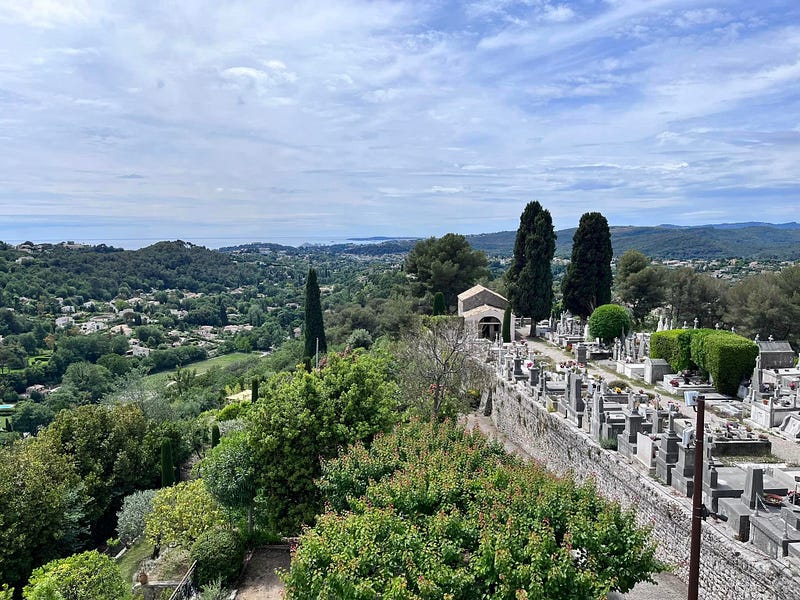
For me, though, this trip to St. Paul de Vence was a pilgrimage to walk the cobblestones that Baldwin passed over, to see the views he gazed upon, and to experience his refuge, his escape from the United States where he could reflect back across the Atlantic on his homeland from his adopted postage stamp of land overlooking the Mediterranean and the Alps. The spot where he could breathe and exist. If Marseille embodies humanity, St. Paul de Vence embodies respite. the pastoral outside the urban. It embodies, for me, a sacred space where Baldwin existed, unrestrained by the strictures and oppression of his native land.
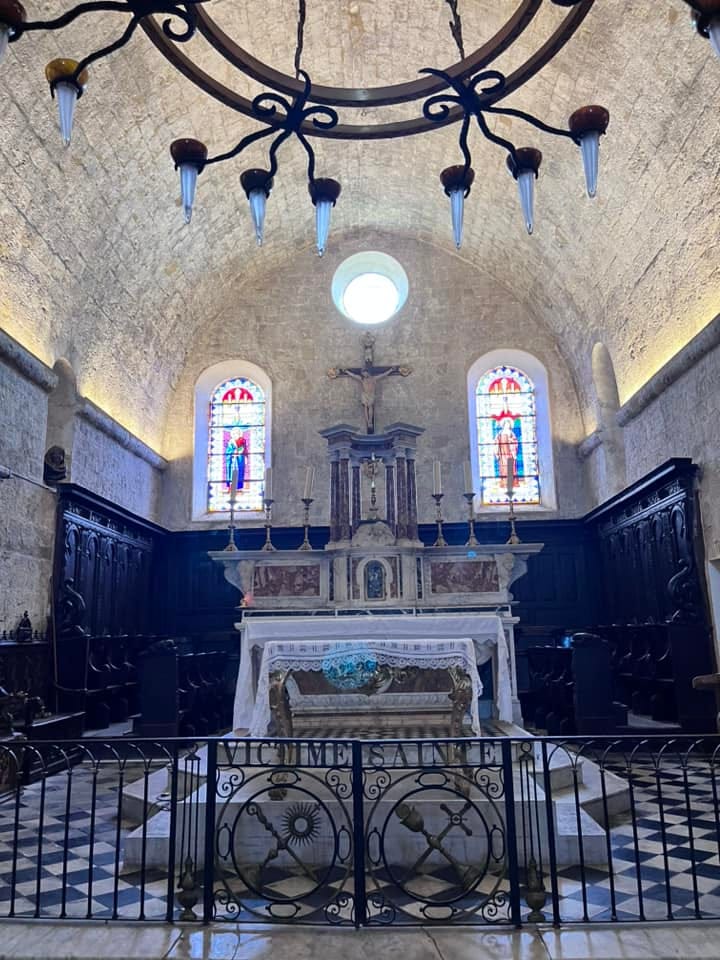
I stepped inside the Chapelle des Pénitents Blancs in the middle of the village and started to read Baldwin’s 1961 essay “The New Lost Generation.” Baldwin begins the essay by talking about a friend of his who killed himself by jumping into the Hudson River in 1946. The last time they really spoke, Baldwin and his friend argued over the path forward. After Baldwin’s friend proclaimed that Baldwin had chosen the path “which ended in fascism, tyranny, and blood,” Baldwin told his friend he had chosen the same path before saying, “One fine day, you’ll realize that people don’t want to be better. So you’ll have to make them better. And how do you think you’ll go about it?”
This is a question I constantly ask myself. How do we make the world better when people don’t want to be better? How do we cure a disease when people don’t believe that the disease exists? How do we encourage emapthy amongst selfish desires? The disease of white supremacy has infected us deeply and rotted our core. It’s akin to the horrors of was that Baldwin describes later in the essay.
Discussing a Jewish friend who fought in World War II, Baldwin details the change he observed in his friend’s face following the war: “It was not a child’s face now. He had seen what people would do to him — because he was a Jew; he knew what he had done to Germans; and not only would nothing be undone, it might very well be that this was all that the would could do or be, over and over again, forever.” If this is all the world could ever be, what is the point of fighting? It’s a futile act. However, we must fight to keep Buchenwald, Rohwer, Hiroshima, Wilmington, Birmingham. Montgomery, Uvalde, Bossier, and countless other atrocities from happening again.
To fight, we must be able to breathe, to merely exist. Otherwise, we will exist in a state of constant suffocation, gasping for air between each atrocity. We will choke on the toxic fumes that surround us. St. Paul de Vence and France gave Baldwin the chance to breathe. It saved his life and focused his vision of the world. Baldwin writes, “In my own case, I think my exile saved my life, for it inexorably confirmed something which Americans appear to have a great difficulty accepting which is, simply, this: a man is not a man until he’s able and willing to accept his own vision of the world, no matter how radically this vision depart from that of others.”
We must know ourselves and our vision of both ourselves and the world in order to fight for a better world. But before that vision forms, we must breathe. Baldwin concludes “The New Lost Generation” by pointing out that Europe provides Americans with “the sanction, if one can accept it, to become oneself” apart from all of the baggage others heap upon us.
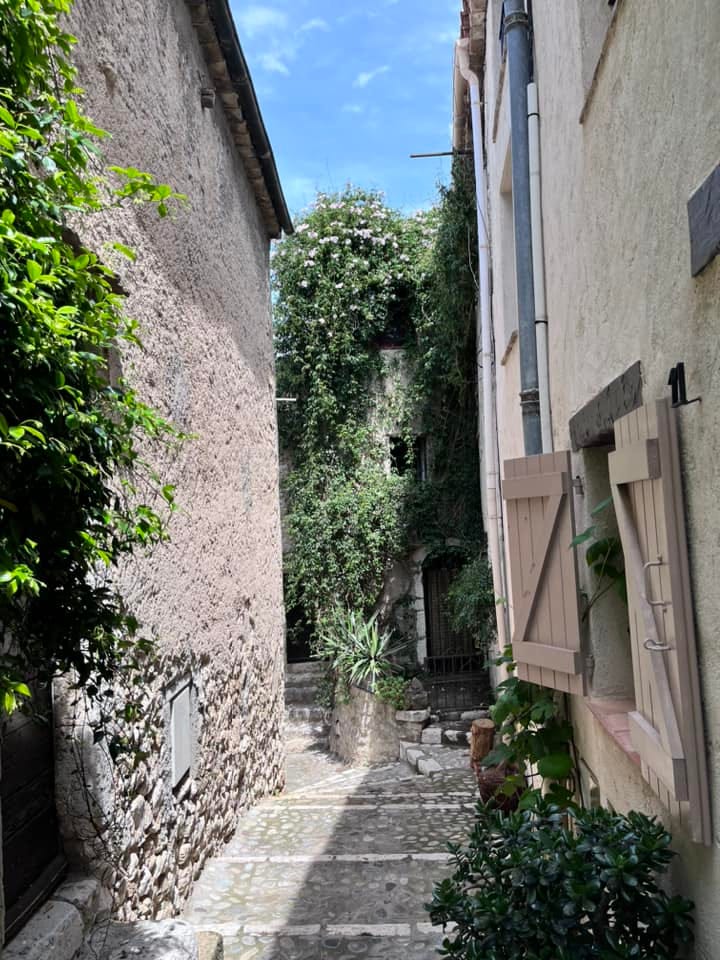
As I walked over the cobblestones in St. Paul de Vence, I wondered who, of the numerous people surrounding me, knew of Baldwin’s residence here. Who came to this tiny village seeking Baldwin? No marker exists mentioning his residence in the village. The house he rented for seventeen years doesn’t exist anymore. It’s apartments. St. Paul de Vence is a tourist spot with artists and venders selling their creations and wares on this mountain. Baldwin lived, but I am sure that the multitude of people there that day didn’t know this or care. Baldwin’s existence had been collectively erased.
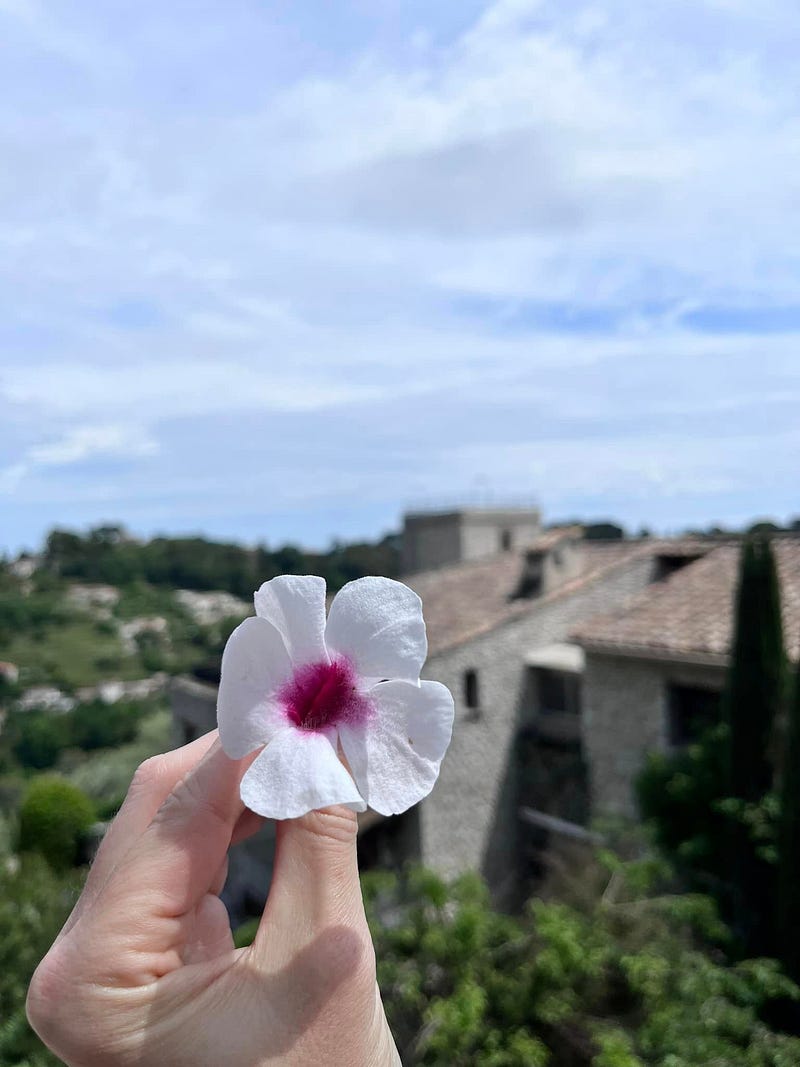
Yet, I knew. On my way out of the village, I looked down and saw a purple and white flower on the ground. I picked it up and admired it in the sun. This purple allamanda will be with me forever, reminding me of Baldwin and the continual need to fight for our vision of a better world and to love.
 Interminable Rambling