
Sometimes, right before I wake up, I hear sounds. The sound arrives in my mind, I wake up, and then the sound occurs in my ears. This all takes place in a split second, the recognition of the sound, a beat, then the actual sound. I’m not a neuroscientist, and I can’t explain it. However, I think they are Hypnopompic Hallucinations, events that register in my brain either as I’m falling asleep or waking up. I don’t experience these all of the time, but I do experience them occasionally.
The most memorable occurrence took place on September 11, 2021. My wife had left for class and I was slowly waking up. As I stirred, it sounded like the television was turned on to a news report, detailing some event. I couldn’t make out the words, but I heard voices. When I got up and turned on the news, I saw one of the towers burning before the second plane flew into the other tower. September 11 was the first time I remember experiencing something like this, and if it wasn’t on that day, I don’t think it would have stuck with me in the same way.
Along with these occurrences, I frequently experience déjà vu where I dream something, sometimes weeks or months before a conversation, then that conversation takes place. It never takes place in exactly the same manner, but it has enough similarity, specifically in sentences and words, that I immediately recognize it as a dream I had at some point. This phenomenon has always interested me, and reading Szymon Kudranksi’s Something Epic has piqued my interest in these and other experiences I’ve had over the years.
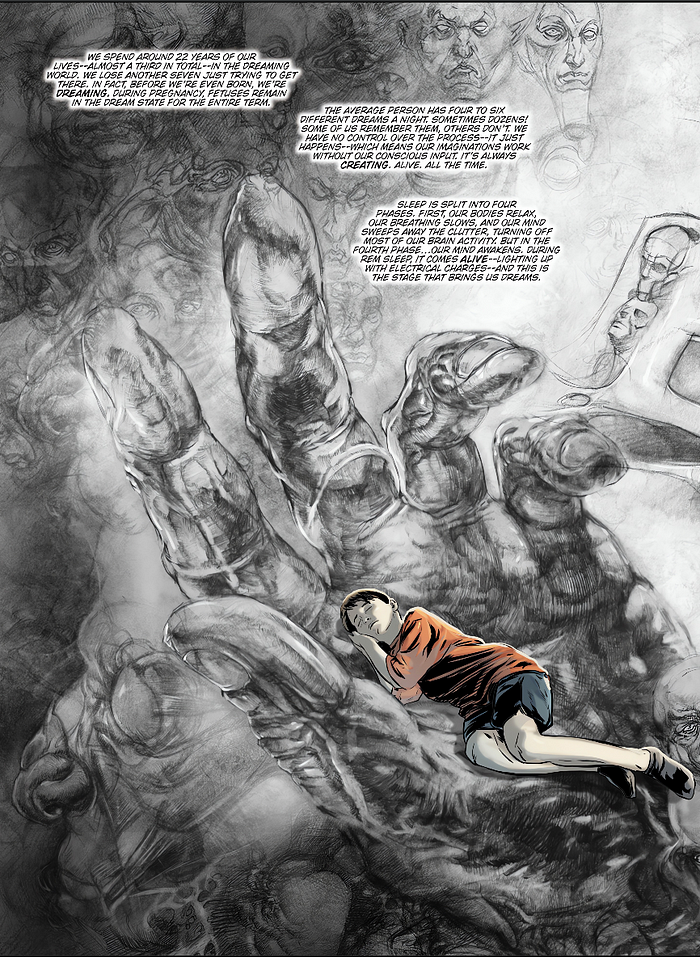
A few weeks back, I wrote about Kudranski’s new series and how it explores the ways that we construct reality. In the latest issue, Danny’s mother passes away from cancer and we see him engaged with his dreams and memories of her. On a two page spread, Danny sleeps at the bottom left, surrounded by sketches of faces as he lays curled up inside the sketch of an open hand. Danny narrates about sleep, telling us that “[w]e spend around 22 years of our lives — almost a third in total — in the dreaming world.” That’s a long time for our body to rest while our brain actively works.
“The average person,” Danny continues, “has four to six different dreams a night.” Sometimes we remember these dreams, other times we don’t. We create in our dreams, bringing our subconscious thoughts to the surface as our brain works to decipher our lives. We don’t know, exactly, why we dream, but, as Danny puts it, “Our imagination serves as a sort of tour guide within the dream state, or like a librarian — it processes our experiences, cataloguing them, confronting things we push away while conscious. The logical parts of our brain are switched off while we’re dreaming — the most active are the emotional and visual centers. Rational thinking is muted.” We bring our connections into our dreams; they populate our dreams, pulling threads in all directions to form the subconscious dream state.
Danny continues by describing things he has experienced in his dreams, and his experiences made me think about my own. He tells us, “I’ve experienced everything possible within my dreams — the good and bad. Sometimes I was unable to move, or unable to shout, or even unable to wake, but I always remembered them. And once I realized I had no power over them, I accepted it. Sometimes I wished reality was the same.”
Danny’s inability to move or scream reminded me of times, when I was younger, when I had the same feeling. I’d wake up, flat on my back in bed, and see dots standing over me, dots in the shape of a figure — not quite human. I’d try and move; I couldn’t. I’d try and scream; my throat was dry. At the time, I kept thinking that I’d encountered alines, since I was into the X-Files and things of that nature. I’d have dreams about alien invasions with ships coming down from the heavens as I looked out of the window. I never saw them, but they were coming. The media I took in, namely shows like the X-Files, influenced my dreams. The same happened when I played a lot of Call of Duty. I’d see the screen in my sleep.
Looking back, I believe I was having sleep paralysis, a “phenomenon,” according to the National Library of Medicine, “in which resumption of consciousness occurs while muscle atonia of REM (rapid eye movement) sleep is maintained, leading to intense fear and apprehension in the patient as the patient lies awake without the ability to use any part of their body.” This is what happened to me in those moments. Yet, my memories of those moments still contain a sense of imagination because they are so intimately connected with my thoughts about extraterrestrials and their arrival on earth. Even though I know that was not the case — I was not abducted — those feelings remain because they were part of me during that period.

These thoughts make me think about John Okada’s No-No Boy and the opening to chapter two. There, the narrator comments on what we do as we sleep, especially when we do not remember our dreams. The narrator says, “There is a period between each night and day when one dies for a few hours, neither dreaming nor thinking nor tossing nor hating nor loving, but dying for a little while because like progresses in just such a way. From that sublime depth, a stranger awakens to strain his eyes into focus on the walls of a strange room. Where am I? he asks himself.” Danny points out that we are not in control while we sleep. We are at the mercy of our thoughts as our body rests. We are, in some ways, dead. When we awake, especially if we are in a new place, we feel disoriented and confused until our brain and body catch up to one another.
Kudranski’s Something Epic continues to intrigue me because it explores topics that I’ve thought about for a long time, and it does so in a manner that makes me think about myself. Like Danny, I’ll see things on walls, in streets, and elsewhere. It’s like looking at clouds and seeing shapes, but I see them everywhere in bathroom tiles, in trees, in patterns on the road in the distance. As I walk, I creates songs in my head, counting out time between cracks in the pavement, shifting between 4/4 and 3/4 or 5/4 or so on. I add melodies. I forget them when my mind shifts to something else, but they existed. Danny reminds me of all of this, and that is why I find so Something Epic so powerful.
What are your thoughts? As always, let me know in the comments below. Make sure to follow me on Twitter @silaslapham.
 Interminable Rambling