
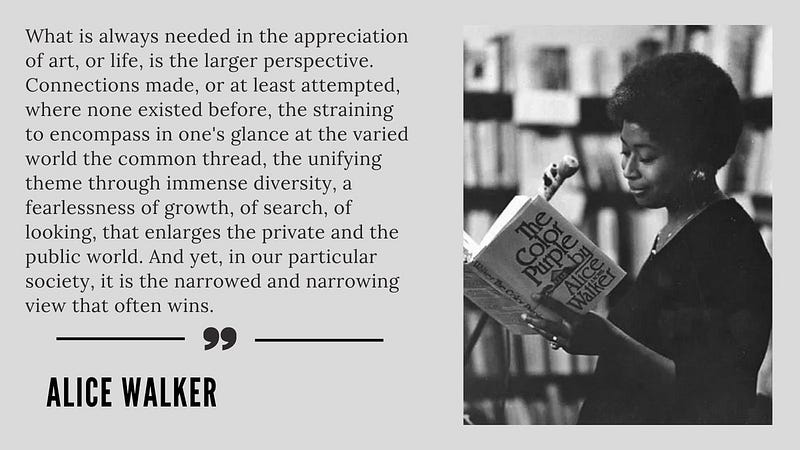
Next semester, I’m teaching Alice Walker’s The Color Purple alongside a couple of her essays, Toni Morrison’s The Bluest Eye, Ernest Gaines’ Of Love and Dust, and other works. Preparing for the class, I recently read Walker’s 1976 essay “Saving the Life That is Your Own: The Importance of Models in the Artist’s Life.” Walker wrote the essay in the mid-1970s, at a moment when Black studies programs were increasing across the nation and when she had already published The Third Life of Grange Copeland and Morrison had published her debut novel The Bluest Eye. Even at this moment, Walker pointed out the need for literature and artistic models, specifically African American women models for authors such as her and Morrison.
Walker details how she came to learn about Zora Neale Hurston and her work. Hurston’s now-canonical 1937 novel Their Eyes Were Watching God was out of print, and Walker did not know about Hurston until she started doing research for her short story “The Revenge of Hannah Kemhuff.” Walker wanted to incorporate voodoo into her story, but she did not have the knowledge to do so properly. So, she began to research anthropologist and encountered white and racist perspectives. She writes, “There were Botkin and Puckett and others, all white, most racist. How was I to believe anything they wrote, since at least one of them, Puckett, was capable of wondering, in his book, if ‘The Negro’ had a large enough brain?”

Walker began to ask herself about “the black collectors of folklore” and “the black anthropologist.” Amidst “the white voice of authority,” Walker found a footnote with Zora Neale Hurston’s name. By the early 1970s when Walker wrote her story, Hurston, a luminary of the Harlem Renaissance and prolific writer and anthropologist, had become nothing more than a footnote, flotsam in the sea of “white authority.” The majority of people, even in when speaking at a university where students had taken a “Women in Literature” course, did not know about Hurston. They did know, however, about Kate Chopin’s The Awakening.
During her own time in college “a prestigious black and then a prestigious white college,” Walker didn’t hear anything about “early black women writers,” and she sought out to discover “whether they had existed.” The women were out of print, so finding them would not be easy, but she did find them, and they gave her “assurance about the profession” that she chose to pursue as a writer. They provided models for her to use to tell her own story and the stories of those she knew in Georgia and elsewhere. They provided the foundations for what would become novels such as The Color Purple, Meridian, or The Third Life of Grange Copeland.
Walker’s discussion of this lack of cultural knowledge reminds me of Ernest Gaines as well. When he moved to California as a teenager, he went to the library to find books by African American writers and about his people, the people he knew and loved in rural South Louisiana. However, he didn’t see any. So, he decided to go and find books about “peasants” and people who worked the land. This led him to Russian writers such as Ivan Turgenev and to white American writers such as John Steinbeck or Willa Cather. He read these authors vigorously, and they informed his own writing. He took when he learned from Turgenev or even someone like William Faulkner and created the stories he sought.
Walker and Gaines began to write the stories they wanted to read. When someone asked Toni Morrison why she wrote, Morrison responded by telling them she writes “Because they are the kind of books I want to read.” She would also say, “If there’s a book that you want to read, but it hasn’t been written yet, then you must write it.” Walker, Gaines, Morrison, and countless others, who did not have access to earlier Black writers as models wrought books that they wanted to see on the shelves. They wrote books that they wanted to read.
Gaines highlights this thought exquisitely in The Autobiography of Miss Jane Pittman when Tee Bob locks himself in the library and kills himself. While this moment takes place because Mary Agnes, the Creole school teacher, rejects Tee Bob because of society’s views on interracial intimacy, the fact that Tee Bob locks himself in the library surrounded, as Miss Jane tells us, by books on slavery and race, and that Tee Bob’s father tears down the door to the library, points us to Gaines, metaphorically, having to break into the library to place his book on the shelf as a counter to the books on slavery and race that infected Tee Bob’s mind and the minds of whites. Gaines did not find models in the library in California, and with Miss Jane, the story of a Black woman’s life from slavery to the Civil Rights Movement, he adds himself as a model to that library.
Walker expounds upon Morrison’s quote by pointing out that while she writes things she wants to read she also writes things that, as she puts it, “I should have been able to read.” Writing, for Walker, Morrison, and Gaines, saves lives and tells the stories of those who cannot tell their own stories, for whatever reason. Near the end of her essay, Walker states, “It is, in the end, the saving of lives that we writers are about. Whether we are ‘minority’ writers or ‘majority.’ It is simply in our power to do this.” When I read Walker’s quote, I again think about Gaines because Miss Jane, while not a one-to-one correlation, is an embodiment of his aunt, Augustene Jefferson, who raised him.
Art, in any form, works to save lives because it tells us about ourselves and it shows us, especially if we are struggling with something, that we are not alone. It provides us with individuals and stories that we can identify with to learn about ourselves and the world around us, hopefully paving the way to make society a better place for all. James Baldwin put it this way, “You think your pain and your heartbreak are unprecedented in the history of the world, but then you read. It was books that taught me that the things that tormented me most were the very things that connected me with all the people who were alive, who had ever been alive.” Art connects us. Art inspires us. Art saves us.
What are your thoughts? As always, let me know in the comments below. Make sure to follow me on Twitter @silaslapham.
 Interminable Rambling