
Currently, I’m reading David F. Walker, Damon Smyth, and Marissa Louise’s graphic narrative of The Life of Frederick Douglass based on Douglass’ autobiographies. There are a few things from this graphic novel that I plan to write about in the near future; however, as I read it, the above panel stood out. In this panel, Douglass discusses the similarities between systems of oppression that sought to keep African Americans and white women removed from the body politic. This panel made me think about my dissertation, “We Wish to Plead Our Own Cause”: Rhetorical Links Between Native Americans and Africans Americans during the 1820s and 1830s where I explore the intersections between African American, Native American, and white women’s rhetoric during the early 1800s. Specifically, I look at Elias Boudinot, John Russwurm, William Apess, Hosea Easton, Lydia Maria Child, and Catharine Maria Sedgwick.
I wrote the dissertation back in 2013–2014, and after seeing this panel, I wanted to share part of the introduction to the dissertation. I have not revisited it for a few years, and my research has taken me in different directions, as you know if you read my blog regularly. However, I think that this is still an important topic that we need to think about, especially at this moment. You can read part of the introduction below and you can read the entire dissertation by following the links above and at the end of this post.

John Marrant, in his 1785 A Narrative of the Lord’s Wonderful Dealing with John Marrant, describes his appearance upon his return to his family after an extended “captivity” with the Cherokee tribe: “My dress was purely in the Indian stile [sic]; the skins of wild beasts composed my garments; my head was set out in the savage manner, with a long pendant down my back a sash round my middle, without breeches, and a tomahawk by my side.” Here, Marrant presents himself as the amalgamation of two cultures, African American and Native American. After crossing over the field “which divided the inhabited and cultivated parts of the country from the wilderness,” Marrant reenters “civilization” more culturally aware of himself and those around him. While one can examine Marrant’s narrative solely as that of a free African American’s struggle with his place in American society during the latter part of the eighteenth century both before and after the Revolutionary War, this would severely hinder one’s full apprehension of the text. One could also read the narrative as a captivity narrative or a conversion narrative, but again those readings, while viable, would fail to recognize a significant feature of Marrant’s narrative.
Marrant’s narrative provides an early example of the confluence between rhetorics by and about Native Americans and African Americans that would arise fully during the 1820s and 1830s when the calls for Cherokee removal and African colonization became stronger. The narrative works to invert the view of Native Americans as savage and Christians as civilized; Marrant converts his Cherokee captors causing them to turn from his “enemies to become [his] great friends” while the Christian mistress of a plantation seeks to have Marrant flogged for teaching her slaves to read. As Rafia Zafar notes, “Nineteenth-century writers would take the premise of captivity a step further, substituting the depiction of savage heathens with portraits of equally savage Christians. In fact, narratives of the national and antebellum periods are characterized in part by their inversion of the implicit structure and moral of those written in the century and a half before.” Authors and activists such as David Walker, William Apess, Hosea Easton, Elias Boudinot, John Russwurm, Lydia Maria Child, and Catharine Maria Sedgwick all employed this inversion in one form or another to show the discrepancies between the “imagined” view of the Other and “civilization’s” proclaimed superiority over the savage, that, as Elaine Scarry puts it, creates “[t]he difficulty of imagining others [that] is both the cause of, and the problem displayed by, the action of injuring.”
While Marrant shows the convergence and interaction between Native Americans and Africans Americans during the early national period, the interaction between the two groups has remained largely underexplored by scholars. In 1920, Carter G. Woodson wrote, “One of the longest unwritten chapters of the history of the United States is that of treating the relations of the Negroes and Indians.” Over sixty years later, in 1986, William Loren Katz made the same basic argument with his book Black Indians: A Hidden Heritage, stating that “Dr. Woodson’s chapter still remains unwritten.” In 1997, James Horton and Lois Horton showed that while “red-black relationships, sexual and otherwise, were common in the northern colonies,” and as Marrant shows in the southern colonies, the interrelatedness between the groups, especially in regards to slavery, is “frequently overlooked in American history.” My project explores this “frequently overlooked” aspect of American history in regards to the rhetoric that these two groups, and others on behalf of these groups, employed to argue for their place within the nation. There have been scholarly articles and books exploring the historical relationships between Native Americans and African Americans from colonization through nationhood; however, very little work has explored the intricate relationships between the rhetoric the two groups employed to argue for their place within the body politic. This project works to address three questions: What rhetorical strategies did Native Americans and African Americans, plus those writing on their behalfs, employ to argue for their place within the body politic? In what ways do these strategies overlap and engage their common rhetorical context in similar ways? And how did the influence of Scottish Enlightenment rhetoric affect Native American, African American, and female practicing rhetoricians?
Horton and Horton point out that “[t]he extent of the combined Indian and African heritage in the early American population is difficult to estimate.” However, a few clear examples exist, and the connections can be seen clearly in Marrant’s narrative, but they can also be seen in individuals such as Crispus Attucks and Paul Cuffe, who are two people from the late eighteenth century that we label as African American, who were of mixed ancestry, most notably African and Native American. As the first person to die during the Boston Massacre, Attucks, of African American and Natick ancestry, embodied for some the dangers of allowing Native Americans, African Americans, and poor whites to interact with one another (Horton and Horton). Sandra Gustafson argues that British soldiers sought to show support for enslaved Africans and “created a potential internal threat to white colonists” that “[a]s patriot leaders sought to negotiate the separation from Britain and to create a non-English identity for themselves, they foregrounded British allegiance as complicity with black and red threats to white colonists.” During his lifetime, people referred to Cuffe, the son of an African father and Wampanoag mother, “at various times as Indian or black” and he added his signature to petitions from groups of Native American men and from African Americans (Horton and Horton. Attucks and Cuffe represented threats to the upper class colonists because of the interracial alliances that these men represented, alliances that would be harder to maintain in the nineteenth century, but ones that would still cause fear among the nation’s elite, especially when those relationships threatened the expansion of slavery in the South during the calls for Cherokee removal and the Seminole Wars.
Along with Attucks and Cuffee, the correspondence between Phillis Wheatley and Samson Occom provides another example of the connection between Native American and African American writers during the formation of the United States. The Countess of Huntingdon supported both Wheatley and Occom, along with African American preacher John Marrant, solidifying the link even more.4 In a letter to Occom, Wheatley, as Zafir notes, “could raise concerns other than salvation and heavenly refinement” that she presented in her correspondence with whites. Wheatley writes to Occom about her feelings on both racism and religion:
I . . . am greatly satisfied with your Reasons respecting the Negroes, and think highly reasonable what you offer in Vindication of their natural Rights: Those that invade them cannot be insensible that the divine Light is chasing away the thick Darkness which broods over the Land of Africa . . . [revealing] the glorious Dispensation of civil and religious Liberty, which are so inseparably united, that there is little or no Enjoyment of one without the other.
Here, Wheatly appears far removed from the quiet, submissive poet that some critics make her out to be. Later in the letter she calls slaveholders “our Modern Egyptians” and calls on God to “get him honor upon all those whose Avarice impels them to countenance and help forward the Calamaties of their Fellow Creatures.” The fact that she could write openly about her feelings on racism and religion to Occom shows that beneath Wheatley’s neoclassical verses lies a subversive voice. As Zafir notes, Wheatley appropriated, as other Native American and African American writers did, “the master’s tools to dismantle the master’s house.” My project will show how both Native American and African American authors, and those who wrote on their behalf, used rhetoric, specifically the ideas of the Scottish Enlightenment, to counter the widely held beliefs that Native Americans, African Americans, and women did not deserve a place within the body politic of the early Republic.
The links between rhetoric by and about Native Americans and African Americans became even stronger during the calls for African colonization and Cherokee removal that arose during the first half of the nineteenth century. Before he started The Liberator, William Lloyd Garrison joined Benjamin Lundy’s The Genius of Universal Emancipation in 1829. Even though Garrison’s and Lundy’s views on whether or not gradual or immediate emancipation should be the answer to the slavery question differed, the men worked together until Garrison left to start his own anti-slavery paper. Before his departure from the Genius, Garrison wrote a six-stanza poem praising Theodore Frelinghuysen’s impassioned six-hour anti-removal speech that spanned three days on the Senate floor in April 1830 for the July edition of the paper. The first stanza of the poem focuses on the fact that Frelinghuysen’s speech would move “marble statues” or “icy hearts congeal’d by polar years” even though it did not sway the senators. The next two stanzas focus on the government’s “avarice” and its “bandit-like” thievery that broke treaties and usurped “those rights [of the Native Americans] which nature’s God bestowed.” Stanzas five and six go on to praise Frelinghuysen for taking a stand against the removal bill. Placed in between these stanzas, the fourth stanza sees Garrison drawing a distinct link between slavery and Indian removal:
Our land — once green as Paradise — is hoary,
E’en in its youth, with tyranny and crime;
Its soil with blood of Afric’s sons is gory,
Whose wrongs eternity can tell — not time;
The red man’s woes shall swell the damning story,
To be rehearsed in every age and clime.
While Garrison’s goal was an immediate end to slavery throughout his career, he clearly felt that a link existed between the oppression of African Americans and Native Americans. This acknowledged link became even stronger when Garrison began to publish The Liberator in 1831.
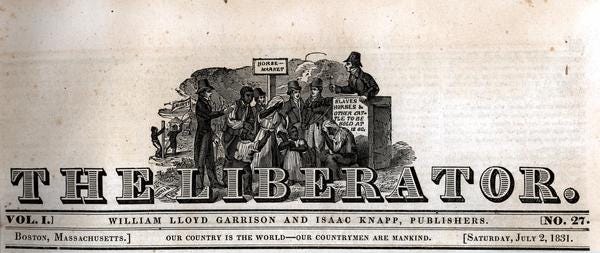
On January 1, 1831, William Lloyd Garrison published the first edition of The Liberator in Boston, Massachusetts, and the first masthead, which appeared on the April 31, 1831 edition and continued throughout the paper’s duration, presented an image that made the relationships between Native American removal and slavery explicitly clear. The controversial image shows a slave auction in the foreground taking place under signs that read “HORSE-MARKET” and “SLAVES HORSES & OTHER CATTLE TO BE SOLD AT 12 00.” In the background, the Capitol can be seen with a flag inscribed with the word “Liberty” flying above it while a white man flogs a black man tied to a post. While the images of the brutality of slavery appear prominently in the masthead, two pieces of paper lay on the ground between the words “The” and “Liberator.” The pieces of paper contain the words “Indian Treaties,” and as Alisse Portnoy says, “Although slavery appears the greater tragedy, the masthead of the United States’ primary abolition newspaper indisputably and controversially linked the nation’s sins against African Americans with its sins against Native Americans.”
Throughout The Liberator’s run, the link between the oppression that African Americans and Native Americans experienced appeared not only on the masthead but also within the columns and articles. A cursory glance shows the paper carrying articles about David Walker alongside those on Cherokee removal and the Mashpee Indian Revolt in Massachusetts which William Apess participated in and wrote about in The Indian Nullification of the Unconstitutional Laws of Massachusetts, Relative to the Marshpee Tribe: or, The Pretended Riot Explained (1835). In June 1833, The Liberator published the Mashpee Indian’s resolutions at the request of Apess, and after the “riot,” the paper reported on the incidents in the January 25, 1834 edition.6 The January 2, 1836 edition of The Liberator contained an announcement for Apess’ speech, Eulogy on King Phillip.
Along with The Liberator, the nation’s other prominent anti-slavery newspaper, the National Anti-Slavery Standard, linked the struggles of African Americans and Native Americans as well. After the Civil War, Lydia Maria Child published her An Appeal for the Indians in the April 11 and 18, 1868 editions of the National Anti-Slavery Standard before publishing the work as a pamphlet. In the Appeal, Child argued that “without intermitting our [abolitionists’] watch over the rights of black men, it is our duty to arouse the nation to a sense of its guilt concerning the red men.” Carolyn Karcher states that Child’s Appeal “led the way, initiating what would become a new abolitionist crusade by 1869.” Two years later, in 1869, the paper asserted that “the Indian question is not any more difficult than the slavery question, and it is not very different from it.” While the abolitionist focus shifted after the Civil War to fighting for the passage of the Fifteenth Amendment, they also reoriented their focus on the oppression of Native Americans. Abolitionists began by arguing for Native American rights in the 1820s;however, that focus shifted dramatically in the 1830s when abolitionists began to put most of their energy into arguing for an immediate end to slavery. Where did this focus on Native American rights go from 1830 through 1865? Maureen Konkle argues that the shift from arguing against Cherokee removal during the latter part of the 1820s to arguing for the abolition of slavery can be attributed to the passage of the Indian Removal Act and can be linked to the fact that “[t]he demands of African Americans held as slaves are in some respects easier to assimilate and easier to subvert: African Americans can’t demand political autonomy, as they had no land; they could only claim inclusion in the political system, which allows for a benevolence that essentially keeps the oppression of African Americans in place.”
You can read “We Wish to Plead Our Own Cause”: Rhetorical Links Between Native Americans and Africans Americans during the 1820s and 1830s at ProQuest. What are your thoughts? As always, let me know in the comments below. Make sure to follow me on Twitter @silaslapham.
 Interminable Rambling