
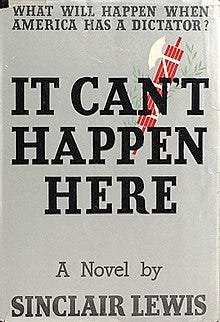
Earlier this week, Edwidge Danticat published “It Can Happen Here” in Harper’s Bazaar. Danticat details how legislation in Florida reminds her of oppressive regimes in her Haiti and the repression of knowledge. She reminds us that no matter what we think, oppression and fascism can happen here, even if we think it can’t. The title of the article harkens back to Sinclair Lewis’ 1935 novel It Can’t Happen Here, a novel that shows the ways that fascism progresses within a nation. Lewis saw, two years after the Nazi’s rise to power in Germany, the tendrils of fascism embracing the United States, and It Can’t Happen Here served as a plea and a cry to wake up and realize that while one may proclaim immunity from such tendencies, the indoctrination occurs over time.
We see this in the novel’s protagonist, Doremus Jessup, “a mild, rather indolent and somewhat sentimental Liberal” who sees the rise of a fascist element in the United States but fails to act in a timely manner. From the outset, Jessup sees the rise of fascism, but he sits on the sidelines and goes about his life until it is too late and he must actively fight back against the rising tide. Lewis’ novel, and Jessup in particular, highlight what Robert McLaughlin says about the novel, “it becomes clear that the installation of a fascist government will not be a revolution or a coup d’état; rather, the groundwork for fascism has already been constructed in the ideological worldviews of the majority of Americans. The riposte to claim that ‘It can’t happen here’ is ‘It already has.’”
In her piece, Danticat doesn’t use the term fascism to describe what we see happening in Florida and elsewhere. She compares it to François “Papa Doc” Duvalier’s dictatorship in Haiti and his regimes suppression of thought. She points out that many immigrants who live in states such as Florida, Texas, West Virginia, and elsewhere have stories of relatives or people they know being jailed or killed for dissenting and pushing back against repressive regimes. While some still say, “It can’t happen here,” Danticat unequivocally states, “Sadly, it is happening and will worsen if we’re not vigilant.” We see it in abortion restrictions, anti-LGBTQ legislation, attacks on Diversity Equity and Inclusion initiatives, attacks on higher education, and so much more.
The attacks on education, at all levels, creates an atmosphere of fear for educators as they work to navigate the landscape. Remember that DeSantis and Florida rejected the Advanced Placement African American Studies course and that DeSantis signed his “Stop W.O.K.E. Act” into law. These moves, coupled with the others mentioned above, create fear and anger within individuals. Danticat states that many educators she knows “fear more might be at stake” and they “consider their current reality dystopian.” The educators walk around being “[a]friad of breaking draconian laws” if they teach or provide access to any works that those in power deem “divisive” or “obscene.”
As we know, the majority of attacks on books and education target already oppressed groups, specifically in regard to race, gender, and sexuality. It’s not just a removal of books. It’s also the suppression of history and education. Florida approved using right-wing Prager U materials to supplement classroom assignments, and to learn about September 11 for at least 45 minutes during the semester. The latter, in and of itself, is not bad because students need to learn about the horrific events that took place on September 11 and the lives lost. However, looking at a list of what the lesson must cover, we run into problems because the first point is that students need to learn “the historical context of global terrorism.” This, we can assume, does not include the United States’ role in funding and even leading to the rise of global terrorism following the end of teh Cold War.
Books and education, as Audre Lorde notes, are “powerful and dangerous” because they open our eyes to the world around us, getting us out of our silos. Danticat points out that the increased access to knowledge influenced the protests during the summer of 2020 following the murders of George Floyd, Breanna Taylor, and Ahmaud Arbery. Danticat writes, “As the playwright and actress Anna Deavere Smith told PBS NewsHour, this was partly a result of how education has increased young people’s awareness of Black culture. Many of the youth had been influenced by writers like Morrison, she said: ‘They have experienced this together, and they expect much more from the system.’”
I fit within Smith’s comment. I wasn’t introduced to Morrison in school, even during undergrad if I recall. However, between undergrad and my M.A. I read Ralp Ellison’s Invisible Man, and Ellison’s novel opened my mind to the perspectives of others. Ellison opened the door for me to read Morrison, Ernest Gaines, Jean Toomer, and on and on. Ellison opened the door for me to eventually discover Frank Yerby, after I moved far away from my hometown, and to learn, from Yerby, about the history of racial violence in my hometown. Morrison led me to interrogate our history, especially with novels such A Mercy. Morrison led me to interrogate the ways we use and deploy language. Each of these, and countless others, led me to understand what we see day to day.
The key to fascism lies in the creation of enemies, an “us” versus “them” mentality. As Toni Morrison puts it in “Racism and Fascism,” one must “[c]onstruct and internal enemy” and then “demonize” that enemy. Once this happens, those pushing the agenda “[e]nlist and create sources and distributors of information who are willing to reinforce the demonizing process because it is profitable, because it grants power, and because it works.” This point is where education enters because these “distributors” of information exist on the airwaves and in the classroom, look at Prager U for example.
When fascists tap the “distributors of information,” they move to “[p]alisade all art forms; monitor, discredit, or expel those that challenge to destabilize processes of demonization and deification.” This is what Danticat speaks about in Florida. It’s the monitoring through book bans, the discrediting through legislation, and the expelling through the removal or books from the classroom and library. Morrison’s point is that racism lies at the heart of fascism and its goal is to “reproduce the environment that supports its own health: fear, denial, and an atmosphere in which its victims have lost all the will to fight.”
Morrison wrote “Racism and Fascism” in the 1990s. Sinclair Lewis wrote It Can’t Happen Here in 1935. Each wrote in different periods, at different historical moments, but each speaks to us in this moment. If we ignore Morrison, Lewis, Danticat, and others we become Doremous Jessup. We go about our lives without paying attention to what happens around us. When we do this, we allow fascism to flourish, to spread, to infiltrate deeper into the psyche. When we look up, it becomes too late to curb the tide. Before that happens, we must act to push back the wave and to promote democracy, because if we don’t, it’ll be too late.
 Interminable Rambling