
Kaare Andrews run on Iron Fist deeply engages with issues of whiteness, capitalism, loss, revenge, and more. These are all extrmemly important themes that, at some point, I want to write about in relation to the series. Today, though, I want to continue the discussion I started in my previous post about the ways that Andrews’ Iron Fist engages us as readers, making us active collaboraters in the narrative process. Andrews accomplishes this in various ways, from the positioning of the reader as an interviewer asking Danny Rand questions on the opening page of the series to the construction of panels throughout the series. This latter aspect is what I want to briefly explore in this post.
I’ve written some about the ways that Andrews’ work, through its lack of clearly defined borders, showcases movement and causes us as readers to engage with the images and text in a different manner. Through this, Andrews involves us within the space that the characters inhabit, sometimes showing their movement across the page or panel and somethings showing them in different spatial places in the scene through the panels and layout. One specific example of this occurs when Pei runs from Davos’ minions in the hospital. This page has numerous elements that warrant examination.
At the top of the page, Andrews deploys shilouttes, a technique used throughout the series, showing Pei running down stairs on the right side of the panel and individuals chasing her from the right. The stark use of red and black signifies the danger of the chase, and the arrow, depicted through lightening shades of red, both highlights Pei’s trajectory and serves as a point to how we must read the image, from left to right. Andrews then guides us down the page where we see, in a small panel on the left, Pei dive into an undergorund area as the ninjas start descending the stairs.
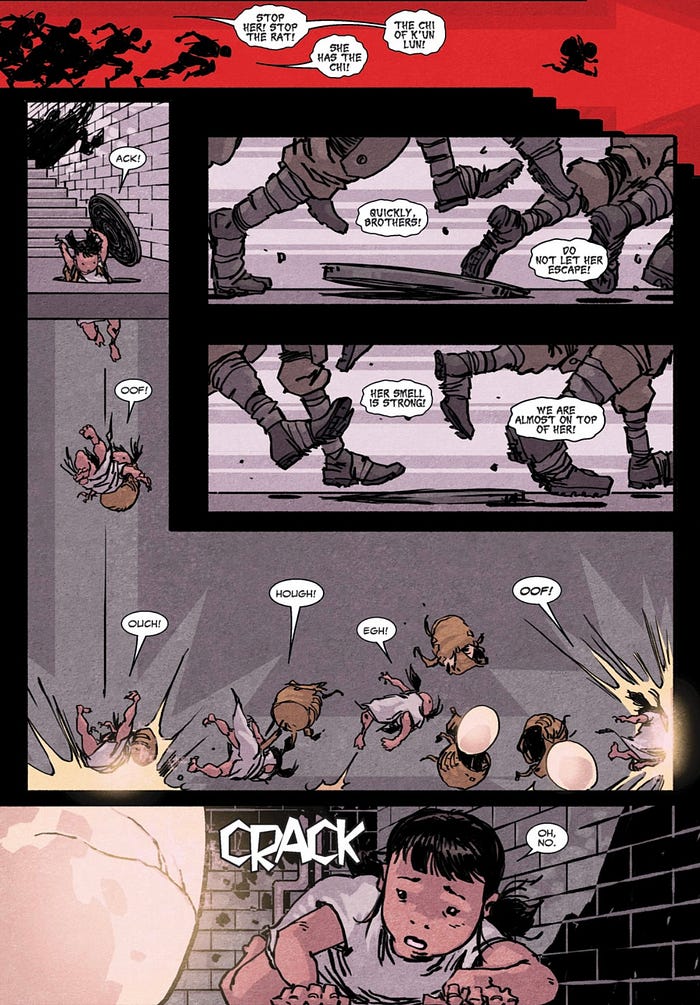
This section contains four panels, separated with physical features that construct the borders. The floor serves as a border between Pei being above ground and her fall into the subterranean area. The bottom panel forms an “L” with two horizontal panels showing the manhole cover closing and the ninjas’ feet running across the floor as they serch for Pei. In the “L” shaped panel, Andrews depicts Pei’s fall and her tumbling when she hits the ground through six renderings of Pei twisting and turning before she hits the wall and with the egg falling out of her backpack. This sequence works in a spatial and animated manner, showing underneath the floor and Pei’s movements as she tries to control her fall. As readers, we fill in the small gaps in Pei’s movement. Andrews could have drawn three distinct panels showing Pei in various positions, having us fill in more gaps, but the uninterrupted panel with Pei’s movements adds a feeling of action and fluidity to the scene, and the placement of the panels adds a feeling of space.
Earlier in the series, as Sparrow protects Pei from Davos in K’un’Lun, Andrews creates anticipation of upcoming events through the use of panels made of words. All total, the page contains five panels with characters and action occurring in each. The top panel shows Sparrow kicking one of Davos’ minions as she tells Pei to run. The next panel shows Davos in the foreground as Sparrow battles his army. However, we also notice that the bottom of the panel starts to appear jagged. It doesn’t show anything specific, but the panel begins to change. The next panel shows a closeup of Sparrow’s face as someone grabs her. Here, we see the panel starts to take on the shape of a word, “Thump.” The final panel in the battle sequence makes this clear where we see “Thump” as the panel and a shilouette of Sparrow getting attacked and restrained. Within the context of the fight, the word “Thump” makes sense as the “Thump” could serve as onomatopoeia for punches and kicks hitting felsh. However, it also foreshadows the next page.

The final pane on the page, which bleeds into the previous three along the edges of the page, shows Yu-Ti standing on a dais as he wonders where his sons and daughter are for the event with Shou-Lau. “Thump” appears two more times within this panel, getting smaller into the bottom right of the page, as Yu-Ti’s advisor asks, “What is that sound?” When we get to the next page, a large panel at the top shows helicopters descedning onto the scene, with the word “Thump,” in various sizes, scattered across the panel. The repetition of “Thump” on the previous page signal sthe appearance of the helicopters, priming the reader for their entrance. Again, Andrews could have ended the page with the advisor’s question and no visual indication of the approach; however, he doesn’t do this. Instead, he uses images, and especially the construction of panels, to connect us with the upcoming scene.
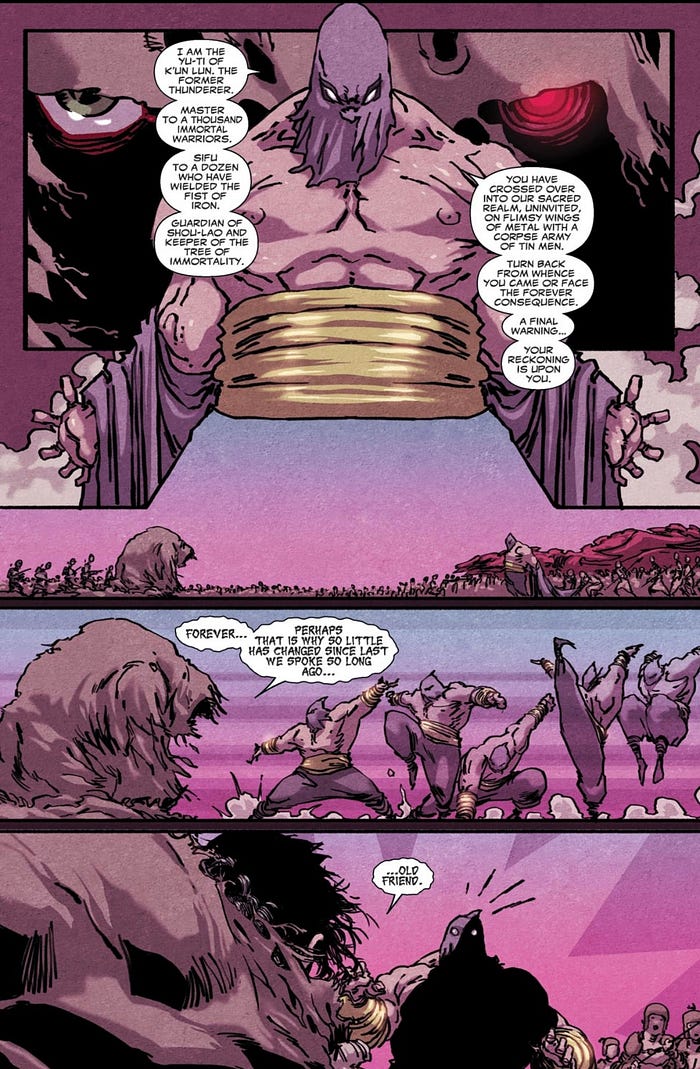
Once the helicopters land, a mysterious, cloaked figure gets out an approaches Yu-Ti. Ostensibly, this page has five panels, but the layout does not rely of convential panel layouts. Yu-Ti stands at the top in the middle of the page, arms outstrected, and we see a bordered panel with the eyes of the stranger behind him. Yu-Ti’s robe flows outwards from his belt, leading us to the next panel that shows a horizontal view of the stranger on the left and Yu-Ti on the right with their soldiers behind them. This layout makes the reader flow down and outward, connecting the closeup images at the top of the page with more distanced images in the third panel. The fourth panel mirrors, in many ways, the one with Pei described above. We see the stranger on the left and five iterations of Yu-Ti as he flips towards the stranger and ends in a fighting stance. Again, Andrews could have done this in multiple panels, but that would take us, as readers, out of the scene. Rather, by having the fluid movement, from right to left no less, we remain within the scene, providing minor moments of closure in between each of Yu-Ti’s movements. The final panel looks over the stranger’s shoulder as Yu-Ti stares at him in amazement when he discovers who the stranger’s identity.
The above sequences are just a handful of the myraid sequences in Kaare Anderws’ Iron Fist series and his other work that use page layout to highlight the fluidity of movement, spatial positioning within the scene, and to lead the reader from one moment to another through the varying structure of panels. Whenever I come back to Andrews’ Iron Fist, I’m always in awe of the ways that he structures his pages, providing readers with an engaging experience that, in many ways, transcends the story. The story, in and of itself, is thoroughly engaging for the themes it tackles, and what makes Andrews’ work so compelling is that the images and layouts work in tandem with the narrative to create a series that I want to return to again and again.
What are your thoughts? As usual, let me know in the comments below, and make sure to follow me on Twitter at @silaslapham.
 Interminable Rambling