
In Cold Crematorium: Reporting from the Land of Auschwitz, József Debreczeni provides a detailed and graphic recounting of his time in Nazi concentration camps during 1944–1945. While in Eule, Debreczeni speaks with other individuals about the ease with which people fall into savagery, becoming part and parcel of the atrocities, violence, and murder enacted against their neighbors. Debreczeni contemplates how people who have given the world so much can also become so virulent, continuing to argue that even if only ten million of the eighty million German citizens “have a direct or indirect interest and even employment in the machinery of a great outrage against humanity” they drive the other seventy million along.
Before they go to sleep for the night, Maurer asks Debreczeni if he remembers Jakob Wasserman’s novel Der Fall Maurizius (The Maurizius Case), a story of the wrongfully accused Leonhart Maurizius and the reopening of his case. Murer asks if Debreczeni remembers the scene where Kalkusch hears Maurizius’ story and believes in his innocence. After Klakusch thinks about Maurizius “unjustly” being in prison for eighteen years, Murer asks, “How does Klakusch reply to society? He hangs himself.”
Murer expands by connecting Klakusch’s reaction to the seventy million Germans who do not necessarily adhere to the Nazi’s ideology. He tells Debreczeni,
There may be some truth in the notion that we’re not facing eighty million murderers, after all, but a few million — yes. I know that lots of Germans maybe even feel sorry for us, but those like Klakusch, who stand up for what they believe in, who take risks, who, at the cost of their own lives, call the most brutal wholesale slaughters of the past thousand years by their names, well, there are no such Klakusches, or there are infinitesimally few.
Murer, like Debreczeni, sees how the the virulent ideas of a fraction of the population can bring an entire nation into the depths of hell with them, leading the Klakusches to become numb to the atrocities occurring around them because those atrocities do not impact them and if they speak up they will be silenced through violence. As Lillian Smith put it in 1960, “The Devil knows that if you want to destroy a man, all you need do is fill him with false hopes and false fears. These will blind him to his new direction and he will inevitably turn away from the future and destroy himself and those close to him.” The fear of violence, of death, holds a heavy sway.
Debreczeni responds to Murer by asking, “What do you expect? . . . Surely you don’t expect people to stand out in Berlin in the middle of Alexanderplatz and right there on the spot tell Hitler the truth to his face?” The implication here, of course, is that the SS or others would attack that person, either beating them to death or shipping them off to a concentration like Eule. To this, Murer invokes Abraham’s bargaining with God in Genesis 18 where Abraham gets God to agree that if he finds ten righteous people in Sodom and Gomorrah he will spare the cities.
One August August Landmesser in the face of millions will not change the path, but ten, one hundred, one thousand, one hundred thousand, a million, can push back. Murer argues that individuals have lost “human compassion,” they have become so numb to everything that they fail to be compassionate to those around them. When Debreczeni points out that the Nazis have incarcerated political prisoners, not just Jews, Murer reminds him that “[i]t wasn’t political conviction that led old Klakausch to that noose he’d tied himself.” It was “human compassion” that led him to tie the noose.
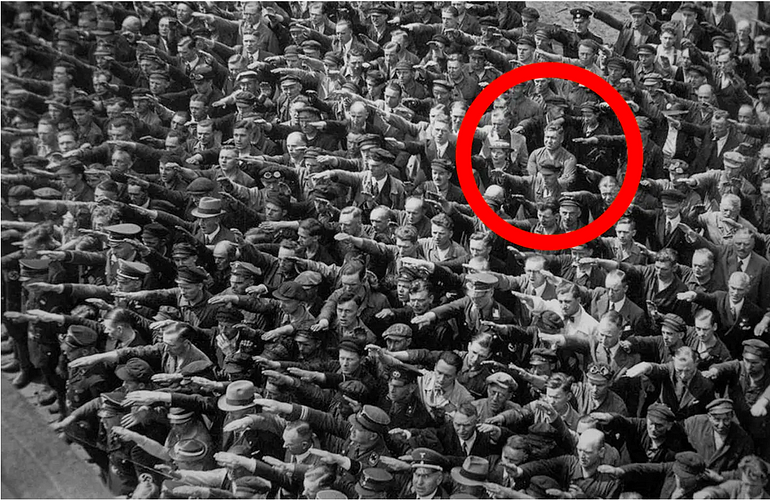
Murer continues, “This is what’s missing from Hitler’s Teutonia, and this is why the madness can get out of control. Millions cannot be forced to accept moral responsibility for such acts if within these millions there isn’t some subconscious, implicit assent at work.” Somewhere, deep inside, the “millions” desire the outcome; they desire the violence and retribution. They may not recognize it, but it exists.
All of this makes me think about Miriam Katin’s and Anna Seghers’ work. Katin’s memoir We Are On Our Own details how Katin, two years old at the time, and her mother escaped the Nazi invasion of Budapest in 1944. Returning to her apartment in Budapest, the landlord catches Miriam’s mother and tells her that they need to move out. He tells her that the Nazis have put him in charge of overseeing that Jews move out of his building, and when Miriam’s mother asks him how he can do this because he has always been so nice to them, he responds, “I am only following orders. It is terrible! Terrible!” He acts as if he has no choice, as if he can’t allow Miriam and her mother to stay, lying about their status. However, as Miriam’s mother leaves, he tells her to make a list of everything, and the last panel shows him the doorway, walking back into the building, as he says, “Dirty Jews!”
The landlord has no issue obeying the Nazi’s orders. In fact, while he puts on a sympathetic face for Miriam’s mother, he relishes the deed because it means he can acquire their belongings. However, his tone changes after the war. When Miriam’s father returns, looking for his wife and daughter, he encounters the landlord. The landlord tells him about the “misfortune” and “tragedy” of his wife and daughter leaving. Miriam’s dad asks if his wife and daughter are dead, and the lanlord only replies by giving him the list of their belongings, along with the “names and addresses of the people who borrowed” them. Miriam’s father coruches on the floor in anguish repeating, “Dead! List?” The landlord merely walks out the door, his hand to his face, as he says, “We all suffered so much.” The landlord epitomizes Debreczeni and Murer’s conversation because he could stand up, but he doesn’t, and when the war ends, he acts as if he had no hand in any of it.
The landlord holds Nazi beliefs, as we see from the first interaction with Miriam and her mother, even though he tries to keep them underneath. Anna Seghers provides more overt examples in her short stories, specifically “The End,” a story about Volpert, intered at a concentration, and his search for an SS soldier Zillich after the war. The story follows both Volpert as Zillich as the former seeks out the latter. At one point, one of Volpert’s friends tells him that he’ll be “happy once they string up that thug.” However much that act will make Volpert and others happy, it will not destroy the evil. The friend continues, “We won’t have gotten rid of the evil itself, of course. You can’t kill Satan. You’d have to completely finish off this old, ugly world first.”
Volpert’s friend understands that even if Zillich dies, the ideas remain. The landlord doesn’t die. He isn’t a member of the Nazi party, yet he retains their ideas and expresses them behind Miriam’s mother’s back. He remains after the war, and he tries to make it seem like he did nothing wrong even though he “followed” the orders to kick Miriam and her mother out of the apartment. Throughout her work Seghers asks questions about individuals such as the landlord, specifically how they fit within all of this. In her fable “The Innocent Ones,” a short story where Allied soldiers after the war go throughoput the region searching for individuals who committed atrocities, Seghers moves up the ladder from the mayor of a town to a concentration camp commandant to Hitler himself. Each of them passes the buck, saying they had nothing to do with any of it.
The mayor, the first person the soldiers interview, tells them he was never a Nazi and that he did everything to protect his citizens. Others tells the soldiers they were merely following orders. Hitler, who disguises himself as a Jew at the end of the war, telsl them that he has always yearned for peace. None of them takes responsibility, making it seem like everything just happened, without any impetus whatsoever. What each shows is that not even ten spoke up to save the millions. They all went along with Hitler and the Nazi’s plans.
As Martin Luther King, Jr. said, “In the end, we will remember not the words of our enemies, but the silence of our friends.”
What are your thoughts? As always, let me know in the comments below. Make sure to follow me on Bluesky @silaslapham.
 Interminable Rambling