
In “The White Christian and His Conscience,” Lillian Smith breaks down the ways that religion, specifically Christianity, works to maintain power and how it causes individuals to lose their conscience, causing them to live, ostensibly, with the warring teachings of Jesus and the white supremacist society they exist within. Smith, also, presents readers with analogies between Southern white Christians and Nazi Germany, at one point writing, “nowhere is hatred of the German Nazi worse than in the Deep South.” Smith notes that this hatred arises because Nazi Germany scratches at the white Southerner’s conscience and the hurt it endures due to white supremacy because it holds up a mirror to the white Southerner, showing him what he does to African Americans in his own nation.
Smith continues by stating that as white Southerners “[o]ur conscience has never let us rest,” and she compares the issues of race, what many dubbed “the Negro problem,” as a millstone around our necks. With the use of millstone, Smith pulls on Matthew 18:6 when Jesus tells those gathered around him that “it would be better for [someone] to have a great millstone fastened around his neck and to be drowned in the depth of the sea” than to lead a child into sin. Smith argues that we have burdened Blacks with “the millstone that our conscience has hung around our own soul.” Through this, Smith points out that instead of taking responsibility for Jim Crow and white supremacy, white Southerners blame Blacks for the issues, hanging the millstone on their necks when the millstone should rest squarely on our own. It’s a means of deflection, of turning away from reality in order to maintain positions of power, whether that power is almost absolute as with wealthy whites or miniscule as with poor whites.
The fear that individuals experience when they gaze upon themselves in the mirror exists. Individuals face themselves and their own willing or unwilling complicity in systems of oppression and decide whether to continue with oppressing others or to fight against the oppression of others. This moment, this awakening to oneself in this situation, creates a feeling of harm within an individual because the individual, if they choose to fight against oppression, enacts upon themselves, as Paulo Freire puts it, “an act of self-violence,” because the individual actively engages in surgery upon themselves, removing the myths that have formed them and their very being. If the individual rejects surgery, then they double down on the myths of oppression, and in that doubling down, what they come to fear is their actual freedom.
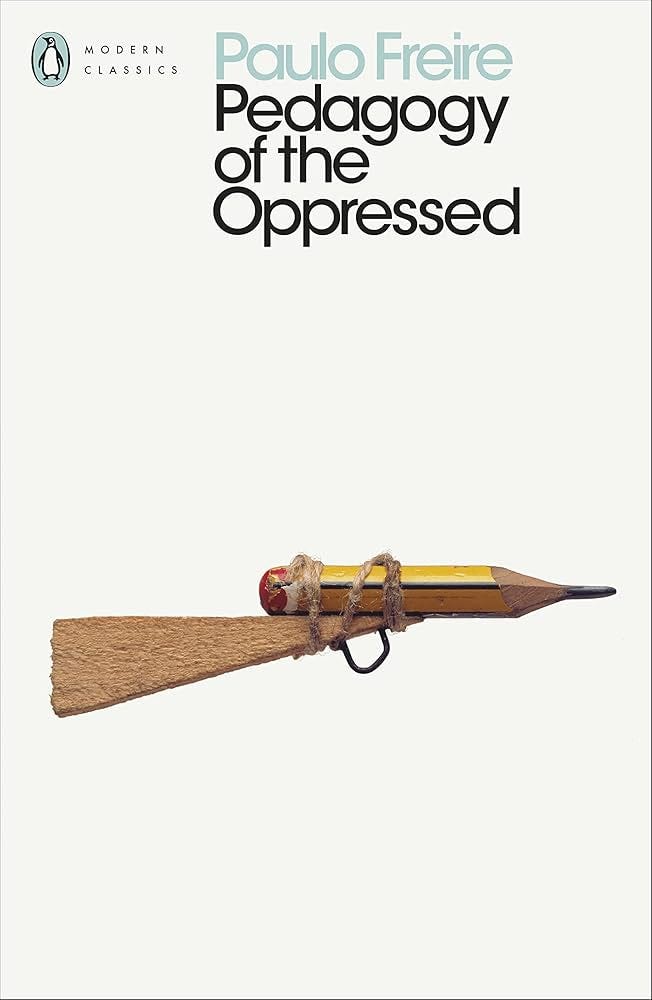
This fear of freedom causes the individual to mask their fear by positioning themselves as the protectors of freedom. Freire writes in the preface to Pedagogy of the Oppressed, “Men and women rarely admit their fear of freedom openly, however, tending rather to camouflage it — sometimes unconsciously — by presenting themselves as defenders of freedom. They give their doubts and misgivings an air of profound sobriety, as befitting custodians of freedom. But they confuse freedom with the maintenance of the status quo.” Freedom thus becomes a guise to protect themselves from the realization either of their own role as oppressors or of their position as one of the oppressed. This becomes dangerous because when the individuals view themselves as the arbiters of freedom they engage in oppression, thus denying true freedom to themselves and others. Freedom requires liberation. It requires “self-violence,” a self-surgery on oneself to remove the cancerous tumors of myth that metastasize within our very beings.
While the fear of freedom causes some to remain steadfast in their position, a fear of losing one’s power and prosperity makes individuals stay the course of their oppression. As he discusses the ways that Josiah Nott, Samuel Morton, and others used words and language to dehumanize Blacks during enslavement, Ta-Nehisi Coates lays out that everyone, as some point in their lives, must face the victims of their oppression and within that facing they must decide how to react. He writes,
It may seem strange that people who have already attained a position of power through violence invest so much time in justifying their plunder with words. But even plunders are human beings whose violent ambitions must contend with the guilt that gnaws at them when they meet the eyes of their victims And so a story must be told, one that raises a wall between themselves and those they seek to throttle and rob.
Coates begins this three-sentence section by pointing out that even when individuals gain power they must find a way to justify their actions through words. They must create a narrative that does not condemn them but that lauds their actions. Yet, when the individual comes face-to-face with their victims, they must “contend with the guilt that gnaws at them.” They must face those they oppress. To alleviate this “guilt,” this realization, the individual then creates a story, a myth, that justifies their actions against “those they seek to throttle and rob.”

We know about the ways that the Nazis “justified” the mass murder of Jews, dissidents, Roma, Sinti, gay men, and others. But, what some don’t know is that they created their policies based on what they learned from the United States or that many supported Hitler and the Nazis. As James Q. Whitman notes in Hitler’s American Model, “In the 1930s Nazi Germany and the American South had the look, in the words of two southern historians, of a ‘mirror image’: these were two unapologetically racist regimes, unmatched in their pitilessness.” Is it any wonder then that Smith proclaimed that “nowhere is hatred of the German Nazi worse than in the Deep South”? The mirror held up to white southerners caused them to project the hatred of their own reflections and atrocities onto the Nazis. It was a means of saying, “Look, we’re not as bad as them.” They created a story where they became the savior, the redeemer, as they oppressed individuals in their midsts.
Coates points out the ways that when one confronts the myths, the stories, the lies and actually sees their true reflection they become deathly afraid. During the summer of 2020, he points out that many whites came to realize they had been sold a bill of lies meant to keep them silent and unaware of their own position and in their own role within white supremacy, specififically on the narratives of law enforcement as “Officer Friendly.” He writes, “I think that is what the white supremacists feared most — the spreading realization that the cops were not knights and the creeping sense that there was something rotten not just in law enforcement but maybe also the law itself.” Once they saw their reflection, many sought to engage with it, to learn, to read, to confront it.
As we have seen, while many initially engaged, some turned their back on their reflection, turning their backs, as well, on the victims of white supremacy, themselves included. They faced it but decided the work would be too hard. They faced it but decided they didn’t want to give up their own position. They faced it but decided that they would rather remain ignorant than working with others to fix the systems.
Yet, even when some turned their backs, some remained. They engaged. We can look at 2020, as Coates points out, as a “futile” moment that didn’t lead to any “political change.” However, it was not futile because individuals confronted themselves. They engaged in acts of “self-violence,” removing the cancerous cells before they could metastasize. This moment pointed out that “[t]he cradle,” as Coates writes, “of material change is in our imagination and ideas.” It is within ourselves. We must be the ones to change the world. We must be the ones to learn the truth and espouse the truth. We must be the ones to change the reflection that stares back at us.
What are your thoughts? As always, let me know in the comments below. Make sure to follow me on Bluesky @silaslapham.
 Interminable Rambling