
Where we live, day-to-day, informs us and consumes our existence. We think about our little postage stamps of land and our interactions with the region, both in relation to individuals and land. William Faulkner, on the draw of Mississippi, and specifically his own region in the state, told the Paris Review, “I discovered that my own little postage stamp of native soil was worth writing about and that I would never live long enough to exhaust it.” Even though Faulkner wrote about the area where he lived in Northwest Mississippi, his works traverse the globe, from Poland to Japan to Australia. People connect with his works because while they depict a certain locale, the themes and ideas transcend space, linking people together.
Ernest Gaines composed works about his “own little postage stamp of native soil” in South Louisiana because he wanted to tell the stories of those he knew, those who had no voice. He left Louisiana as a teenager, joining his parents in California. There, he went into the library and searched for books that depictied the lives of those he knew, but he didn’t find any books that showed the lives of himself and others. Instead, he found works by Russian writers such as Ivan Turgenev, who wrote about their “own little postage stamp of native soil,” and Willa Cather, John Steinbeck, and Faulkner who all wrote about their regions. Those artists, both far beyond land of those he knew and those close to home, informed him and influenced him, allowing him to write about his rural African American community.
Our everyday lives and routines occupy our thoughts and actions. We have, for the most part, a very provincial view of our very existence. We have a myopic view of the world, thinking if it doesn’t impact me directly it doesn’t necessarily matter. We lose, in this manner, our connection with others, our empathy, our compassion. We ignore genocides in Gaza or Sudan. We ignore war and murder in Ukraine. We ignore communities who suffer at the hands of authoritarianism, where individuals get snatched up on the street and sent to concentration camps. We ignore these things because they do not impact us directly and we have things that we worry about everyday, such as how to pay for food, if our kids are behaving, how to get to an event, and so on.
This thinking extends to the ways we think about history. We think about those events that “matter” to us. For example, when Americans think about World War II, we think about Pearl Harbor, D-Day, and Hiroshima, events where American service members participated. We may think about the Holocaust. We may think about Japanese internment. We may think about the German American Bund. However, we mainly focus of the “good” things, those that led to the end of the war. Framing the war through the lens of “good,” obfuscates so much that continues to impact us today from the segregated military and health care to the ways that the beliefs of some of those in the United States and those in Nazi Germany overlapped.
When we think about history as events, or about literature as tied to a specific place, we miss the forest for the trees. We focus on a tree or two, ignoring the surrounding forest within which those trees live. We ignore the links that bind together the Jim Crow United States and Nazi Germany, the ways that Nazis looked to the United States for ways to weaponize the lagal system against Jews and “undesiureables.” We ignore the ways that even during the colonial period interchange existed between the United States and Germany with the latter seeking help from Booker T. Washington and Tuskegee to help colonial subjects in Togo grow cotton. We ignore the links between the German treatment of Polish immigrants who worked in Germany and the treatment of Black sharecroppers and migrants in the United States. We do not draw the links, links that do not just show us the through lines but links that connect individuals and movements across the globe.

Andrew Zimmerman details all of these colonial connections in Alabama in Africa: Booker T. Washington, the German Empire, and the Globalization of the New South. Zimmerman points out that seasonal Polish migrants conducted a lot of agriculture work in Germany. He writes, “The labor-intensive cultivation and harvesting of sugarbeets was carried out in large part by Polish migrants, who, like African American cotton growers, were regarded as ideally suited for such arduous and poorly paid labor because of their supposed racial inferiority.” The workers were known as Sachsengänger, those migrant workers who went to Saxony for seasonal work.
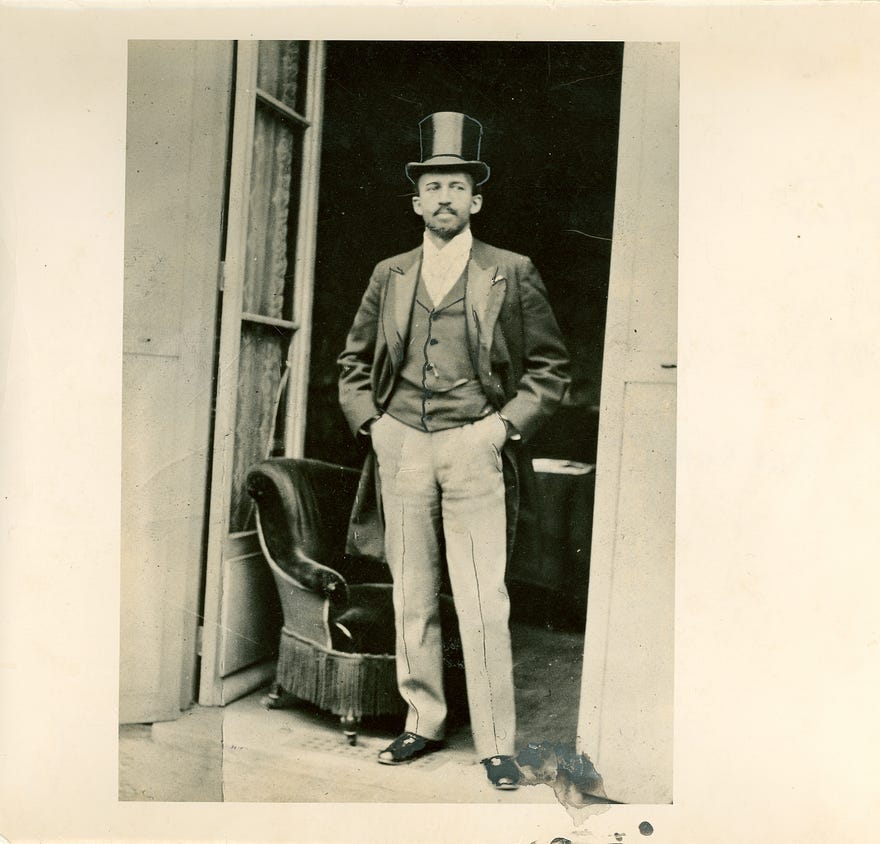
W.E.B. Du Bois studied in Germany during the late 1800s. At that time, Du Bois says that he viewed “the race problem in America [as] the only race problem and the greatest social problem in the world.” He kept saying this, and at one point his classmate Stanislaus Ritter von Estreicher told him, “You know nothing, really, about real race problems.” Stanislaus suggested Du Bois visit Poland to see “the problem of the Poles and particularly in of that part of them who were included in the German empire; of their limited education; of the refusal to let the, speak their own language; of the few careers that they were allowed to follow; of the continued insult to their culture and family life.”
Du Bois’ initial visit to Poland influenced him. It broadened his view of race and virulent ideologies in the world. He had thought of “the race problem” merelyt on the basis of color, but his first trip to Poland led him to see the intersections between race, religion, and other aspects of one’s identity. Du Bois knew white supremacy in the United States. He knew about “the scream and shots of a race riot in Atlanta; the marching of the Ku Klux Klan; the threat of courts and police; the neglect and destruction of human habitation.” He knew all of this, but none of that could prepare him for what he saw when he visited Poland a third time in 1949, three years after the war, and went to the Warsaw Ghetto.
What Du Bois saw in Warsaw helped him have “a real and more complete understanding of the Negro proble.” It highlighted the ways that virulent ideologies, whether that be white supremacy or antisemitism, overlap and work in tandem together to oppress individuals on every “little postage stamp of native soil.” He moved out of his “social provincialism into a broader conception of what the fight against race segregation, religious discrimination and the oppression by wealth had to become if civilization was going to triumph and broaden in the world.” Du Bois understand the interconnectedness of humanity. He understood the ways that systems worked in webs, not a single threads or specific moments. He understood the ways that the suffering of those in Gaza and Ukraine connected to the suffering of those in the rural United States. He understood all of this.
Combating virulent ideologies is not a provincial endeavor. It is a global endeavor. It is an endeavor that requires recognizing the interconnectedness then joining together to resist. If we think about literature as a way to connect us across time and space, we need only think about James Baldwin’s words when he states, “You think your pain and your heartbreak are unprecedented in the history of the world, but then you read. It was books that taught me that the things that tormented me most were the very things that connected me with all the people who were alive, who had ever been alive.” We can worry about our “little postage stamp of native soil,” and we must do that, but that focus does not deter us from worrying about those who do not reside on our “postage stamp” of land.
What are your thoughts? As usual, let me know in the comments below. Make sure to follow me on Bluesky @silaslapham.bsky.social.

