
We all know the power of words and the ways that words shape our reality. The student in Ernest Gaines’ “The Sky is Gray” points this out when he gets into a conversation with other individuals in the waiting room at a dentist office. He tells those around him that the grass is black and that the wind is pink. Immediately, they laugh at him and think he has lost his mind, but he merely replies, “You don’t know it’s green. . . . You believe it’s green because someone told you it was green. If someone told you it was black you’d believe it was black.” The student highlights the ways that words work, to help us understand the world around us and to convey that understanding to others. Yet, language also acts a means of control.
N.K. Jemisin and Jamal Campbell, like Gaines, interrogate the ways that language works in Far Sector. They begin issue #8 with a quote from George Carlin who, in one of his standup routines, pointed out, “Bullshit is the glue that binds us as a nation.” Carlin’s focus lies on the fact that we have words and ideas, such as “land of the free” and “home of the brave” and “the American Dream” and “all men are equal” and “justice is blind,” that all, in essence, are bullshit because while they sound good, and at a base level are good, these sayings do not encompass everyone. However, we believe them because we do not critically interrogate the language of these myths. He calls these things “the American okie doke.”
We believe these things merely because, as Carlin puts it, “because they’re pounded into our heads since the time we are children.” We grow up with these ideas, these beliefs, and we fail to even question them because we gobble them up from the cradle through the classroom and beyond. When we start to question these ideas and actually interrogate them for ourselves, we realize the ways that language has duped us into believing myths, and we begin to recognize the insidiousness of these myths and the ways that they impact the ways that our society actually functions. We know that we can use “bullshit” as mortar for building structures, but we also know that “bullshit” is excrement. So, do we want a society built on “bullshit”?
Throughout Far Sector, Jo sees the ways that the City Enduring uses language and the okie doke to maintain power for those at the top, specifically the Council. She calls out the ways that individuals use words to dehumanize and minimize others. After she goes to Atville to capture three @At assassins who killed Councilor Averrup, Jo has a conversation with Peace Accountant Syzn about what will happen to one of the assassins. Syzn tells Jo that once an @At kills a biological the the @At get corrupted, making them into “living viruses” that taint them forever. Thus, as Syzn says, “Officially, they’re not AI anymore. We can’t ever release at @At who’s killed like this, even after they serve their time.”
Jo asks Syzn what she means by “officially,” and Syzn responds, “The public frowns on capital punishment. But eradicating a virus is another matter.” In the City Enduring, the @At work menial jobs, as basically slave laborers, and since they are digital beings, no one really considers them “people” or beings. Jo even has these same thoughts until she visits Atville with Canhaz. She knows that everything there is digital, and she initially thinks about all of it as unreal. Finally, though, she realizes that everyone in Atville is real. She tells Canhaz, “This is a world. I need to stop thinking about it as code and servers. You’re people. I thought I understood that before, but I guess I didn’t.” Jo stops seeing Canhaz and other @Ats as merely digital 1s and 0s. She sees them as individuals, something that Syzn and other fail to do because while they look down on “capital punishment” they have no problem, with “eradicating a virus.”
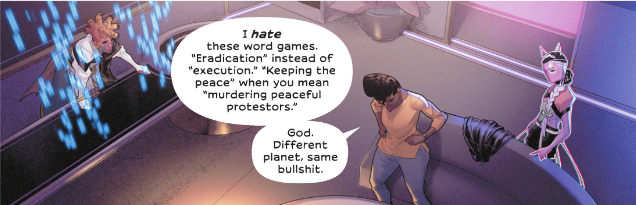
Jo calls all of this out when she tells Syzn, “I hate these word games. ‘Eradication,’ instead of ‘execution.’ ‘Keeping the peace’ when you mean ‘murdering peaceful protestors.’ God, different planet, same bullshit.” Here, Jo highlights the way that language creates meaning. Since the residents of the City Enduring do not believe in murder, of any kind, they cannot condone “capital punishment” because if they did then they would condone the murder of fellow people. However, by labeling it as “eradicating a virus,” they strip the @At assassin of their personhood, a personhood that Jo recognizes, and make the assassin a non-enity, thus providing them with justification for executing them.
Likewise, Jo’s reference to the earlier protest over Switchoff shows how the language of “law and order” serves the powerful at the expense of those that the powerful oppress. Upon arriving at the protest, Peace Accountant Tillij tells Jo, “If we don’t stop this, the law is meaningless.” Throughout Far Sector, individuals cite the law as something that must be upheld, no matter if that law is just or unjust. Tillij tells Jo this because the protestors arguing to legalize Switchoff didn’t get a permit, and she replies, “So they did’t get a permit or file a route map. Nobody deserves to die for that!” Tillij, though, sees it differently, and he feels that the law must be upheld, no matter the cost.
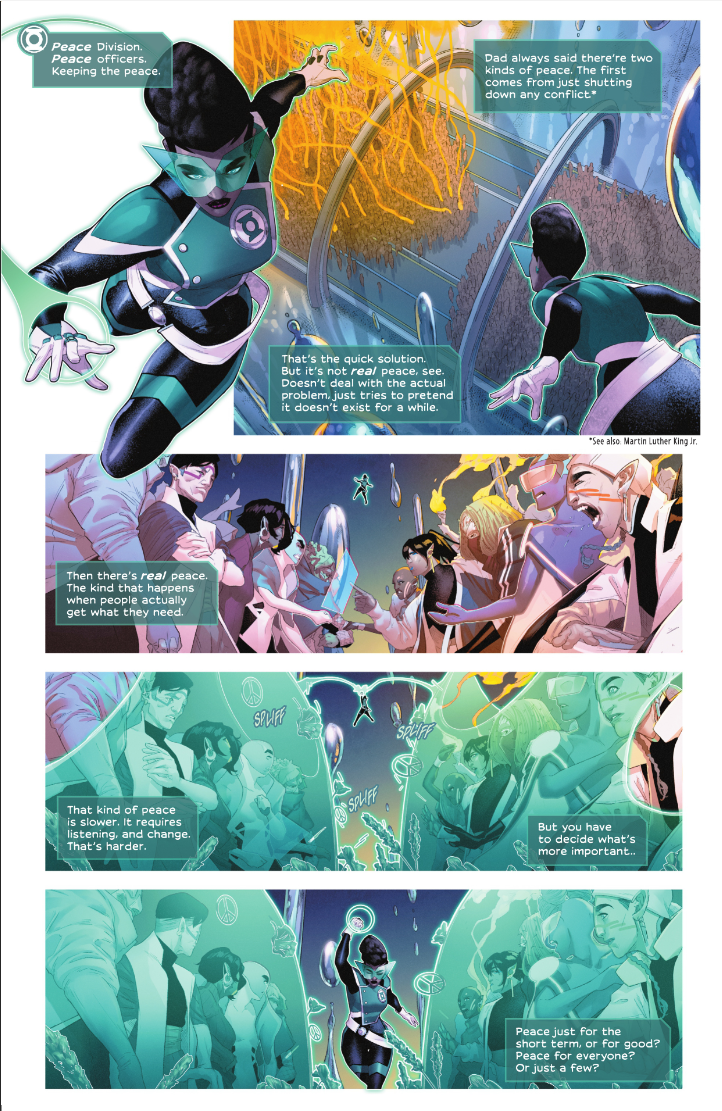
In this moment, Jo thinks back to something her dad told her about peace. On the one hand, peace “comes from just shutting down any conflict.” That type of peace just smooths things over for a time. It doesn’t “deal with the actual problem, just tries to pretend it doesn’t exist for a while.” The other type of peace, though, gets to the heart of the issue. This peace “happens when people actually get what they need.” It’s a “slower peace” that takes time and effort, “listening and change.” That type of peace comes through focus and hard work, and it leads to something ultimately better for all of society.
The work that Jo does in the City Enduring works to lead to this type of peace. Her interrogation of Syzn’s language and the systems of bullshit that uphold an oppressive society. Jo sees herself as upholding “law and order,” but over the course of Far Sector, she starts to question that position. During the final battle, she tells Minec “I was taught to maintain order at all costs,” which meant that she would “[e]liminate all resistance.” However, she comes to realize that by doing this she didn’t make the world safer; instead, under the guise of “protect and serve” and “justice” she, along with others, “were just hired thugs for the people in power,” supplying the “bullshit” that built the system.
There’s a lot on Far Sector, and it deserves a lot more than the two posts I have written about it. What are your thoughts? As usual, let me know in the comments below. Make sure to follow me on Bluesky @silaslapham.bsky.social.
 Interminable Rambling