
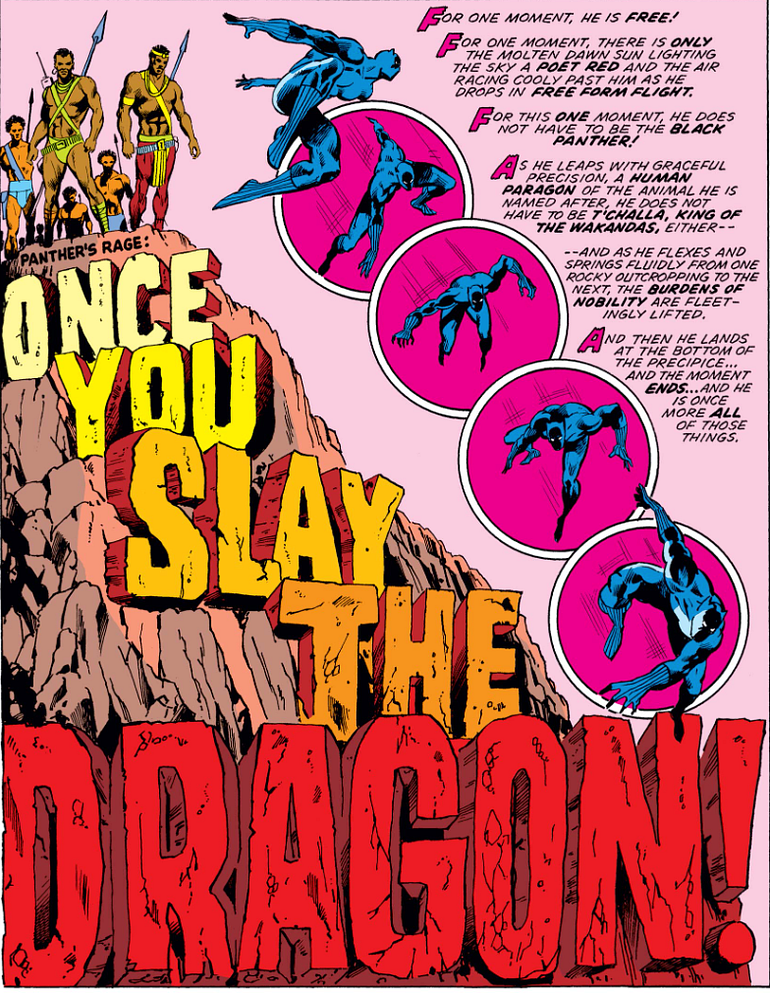
Recently, I examined some of Billy Graham’s layouts and panels in Jungle Action Featuring: The Black Panther #11. Since then, I can’t stop thinking about this issue and the ways that it confronts the physical and psychological destruction caused by war and hatred. It reminds me, in some ways, of Rick Remender and Daniel Acuña’s Escape, a series I have written about over the past few months as well.
While the issue deals with the violence of battle, as T’Challa’s men attack N’Jadaka Village, it ultimately leaves us, as we progress through the issue, with a pressing question, “What happens once the war has ended?” This question hovers over the issue, from the title page where we see T’Challa jumping to the ground in front of the issue’s title, “Once you slay the dragon!”, to the last page where T’Challa points out that slaying the dragon ultimately leads to blood staining much more than your own hands. For me, this inquiry into the impact of war, not just on the combatants but on all who get caught up in its jaws, makes issue #11 a powerful psychological exploration of the ways that war and violence warp the ways we view ourselves and others.
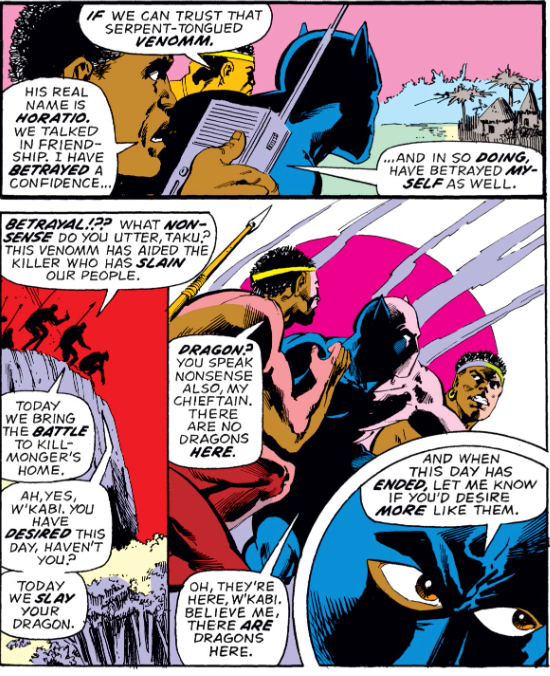
As T’Challa and those he has gathered overlook the village, W’Kabi proclaims that finally they will “bring the battle to Killmonger’s home.” T’Challa reminds W’Kabi that this is the day he has longed for, the vengance against Killmonger and his men for raiding and killing others. T’Challa concludes by telling his security officer, “Today we slay your dragon.” T’Challa’s use of “dragon” confuses W’Kabi because he says he sees no dragons, and T’Challa tells him, “Oh, they’re here, W’Kabi. Believe me, there are dragons here. And when this day has ended, let me know if you’d desire more like them.” From the outset of the issue, T’Challa reminds W’Kabi and us, as readers, that even though we may long for this confrontation, for this revenge, it will impact and damage everyone. No one will escape its wrath, and T’Challa primes W’Kabi to think about what may happen after they slay the dragon.
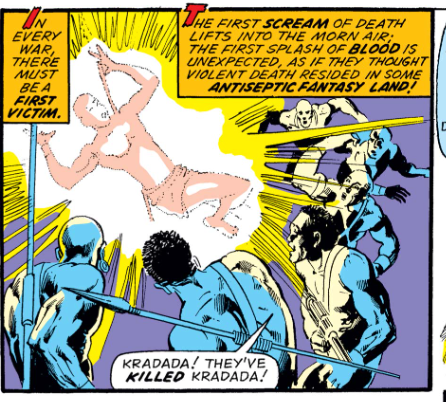
As the battle commences, Lord Karnaj opens his robe and pulls out a weapon. He then proceeds to shoot Kradada, who becomes the first victim. The narrtor intones, “The first scream of death lifts into the morn air; the first splash of blood is unexpected, as if they thought violent death resided in some antiseptic fantasy land!” In the panel, T’Challa’s men gaze at Kradada’s death in amazement, mouths agape and eyes wide. They have prepared for battle and violence, but once they encounter the violence and the realities of that violence, they retreat because they do not fully comprehend what they desire in that moment, the murder of others.
When Baron Macbre attempts to attack W’Kabi from behind, we see a panel depicting T’Challa’s hand grabbing Baron Macbre’s arm, and the narration points to the ways that war plays out not on a grand scale but in “minor conflicts within the whole.” These minor conflicts, in and of themselves and as a while, “disorients a man,” making them lose control of themselves and their emotions. It at this moment, where T’Challa saves W’Kabi, that we move, even in the heat of battle, to the past. (I wrote about this transition in a recent post.) The flashback directly corresponds to the overarching question of the dragon and what happens when we eventually destory the dragon. Specifically, it details the ways that we position others, within our own minds, as enemies and villians.
One of the main points of contention within the “Panther’s Rage” story arc concerns Monica’s place within Wakanda, specifically those like W’Kabi who view her as a threat to the kingdom. As such, she gets framed for a murder and imprisoned. In the flashback, T’Challa talks with Monica and reminds her that the people seem to be afraid of “any beliefs different than their own.” To this, Monica reminds him that it’s more than an ideological fear. They do not necessarily fear; rather, “they need a victim,” a scapegoat, someone they can blame for things they can’t control. With these comments, Monica points out the ways that, through the construction of enemies as others, we can justify attacks on individuals, specifically individuals who have no role in the atrocities taking place, notably the villagers of N’Jadaka.
Over a two page spread, we see the battle as Lord Karnaj, standing on the left side of the page, shoots his gun across the page to the right, killing a young boy in the process. The page highlights the disorientating nature of war, with people falling all over the pace and individuals conflicts occurring in multiple sections of the pages. The narration drives all of this home by noting that “[w]ar cannot be contained” or steered in a specific direction, and that war “ravages all it touches, and scars much past that.” The effects of war don’t end with the cessation of conflict. They linger, staining, as T’Challa tells W’Kabi at the starty of the issue, more than the soldier’s hands. This ravaging impacts innocents as well as combatants because war, as the narration tells us, doesn’t care if someone proclaims they have nothing to do with the conflict. No, war “has little respect for age or race or sex or shoe size.” It is indiscriminate.
The boy’s murder highlights the indiscriminate nature of war, and the page (which I wrote about in the previous post) where Taku holds the child then attacks Lord Karnaj, illuminates how someone who does not believe in war and violence can become violent. Taku almost kills Lord Karnaj, until T’Challa pulls him away. Taku, amidst the battle, has become anonymous, because the war has provided an opportunity for “the beast” to emerge “without fear of punishment by law or God.” If Taku kills Lord Karnaj, T’Challa tells him we will “no longer [be] the observer,” chronicling the atrocities. He will become part of it. Taku ceases pummeling Lord Karnaj and goes over to the dead boy.
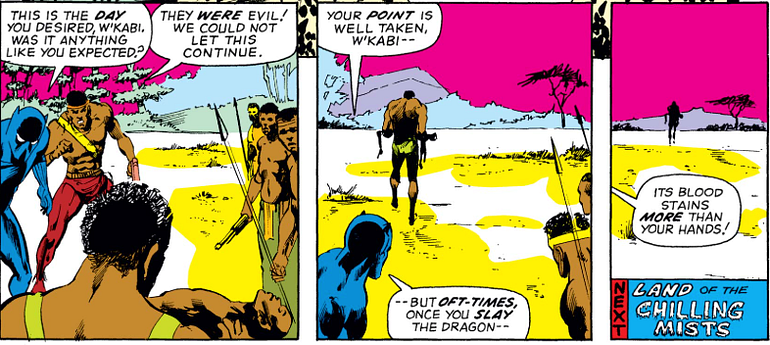
The final three panels of the issue have W’Kabi asking T’Challa to explain what he means about dragons. In these panels, we see Taku, with the child in his arms, move from the foreground in the first panel to the horizon in the last panel. As Taku walks into the horizon, W’Kabi pleads with T’Challa that those they attacked were evil and that they “could not let this continue.” To this, T’Challa simply responds, “oft-times once you slay the dragon its blood stains more than your hands!” The attack of N’Jadaka led to the young boy’s murder. It led to Taku losing his observer status as he becomes part of the violence swirling around everyone. It leads to the blood impact the future, never fully leaving the ground.
When I read this issue, I cannot help but think about the year it debuted, in 1974. This was one year after the United States’ withdrawal from Vietnam where we lost 58, 220 service members. The Vietnamese lost anywhere between 1 million to 3 million soldiers and civilians. Others included between 275,000–310,000 Cambodians and 20,000–60,000 Laotians. No one was left untouched. With World War II, casualties, overall, including the European and Pacific theaters along with civilians, was around 70 million. Again, no one remained untouched. It didn’t matter if you raised your hands and said, “I’m not an enemy. I am civillian. I have no stake in this fight.” You were touched, in some way, including with death.
There’s a lot I could still unpack with Jungle Action #11, but I’ll leave it there. What are your thoughts? As usual, let me know in the comments below. Make sure to follow me on Bluesky @silaslapham.bsky.social.
 Interminable Rambling