
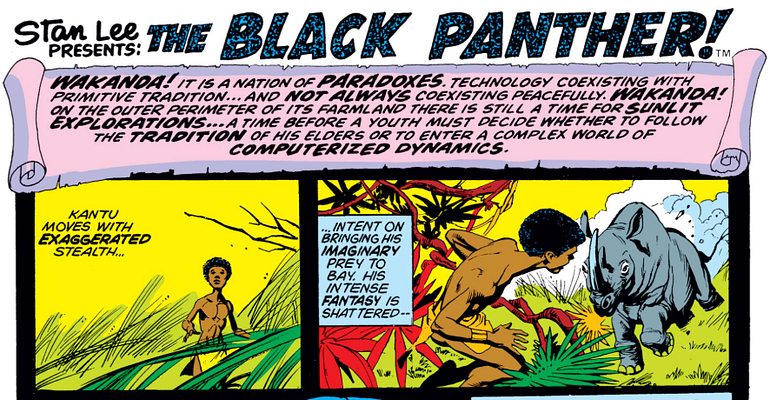
While T’Challa serves as the narrative center of Don McGregor, Billy Graham, and Rich Buckler’s “Panther’s Rage” story arc in Jungle Action Featuring: Black Panther, the series contains numerous supporting characters who have their own tragectories over the course of the arc. One of these is Kantu, a nine-year-old boy who appears in almost every issue of the arc. Early in “Panther’s Rage,” Killmonger’s men murder M’Jumbak, Kantu’s father, and we see, again and again, Kantu fomenting rage as his mourns his father’s death. In many ways, Kantu grounds the narrative, highlighting one of the overarching themes of “Panther’s Rage,” that war is indiscriminate and harms everyone it touches.
Recently, I wrote about Jungle Action #11, an issue that focuses on the phsycial and psychological impacts of war on individuals. Two key themes arise in that issue. The first comes about through the conversation between T’Challa and W’Kabai where T’Challa points out to W’Kabai that his desire to fight Killmonger consumes him, and that even if they defeat Killmonger that rage and anger will remain The other theme highlights the ways that war touches everyone. During a two-page spread that details the fighting in N’Jadaka Village, the narrator proclaims that war “has little respect for age or race or sex or shoe size.” Here, a young, unnamed boy, gets killed in the fighting, and Taku weeps before turning to rage and attacking Lord Karnaj.
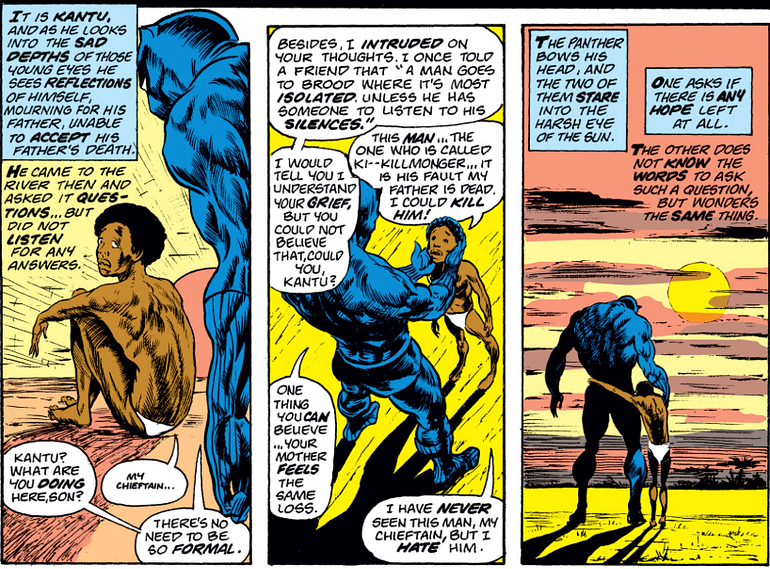
These themes recur over the course of the next few issues, culminating in the final battle between T’Challa and Killmonger in issues #16 and #17. In issue #16, T’Challa comes across Kantu as the boy sits on the shoreline mourning his father. At the sight of the boy, T’Challa thinks about his own father’s murder at the hand of Ulysses Klaw, and he tells Kantu, “I would tell you I understand your grief, but you could not believe that, could you Kantu?” Even though each lost their fathers at the hands of murderous villains, T’Challa recognizes that Kantu cannot fully grasp that connection. Kantu simply responds, “I have never met this man, my chieftain, but I hate him.” Kantu, like W’Kabai and like Taku, rightfully feels anger and rage, but while T’Challa chastises his men for that feeling, and letting in take hold of them, he doesn’t say anything to Kantu. Instead, he comforts Kantu, placing his arm around the boy, as they walk into the horizon.
When Killmonger’s attack on the paalace commences in issue #17, Kantu plays a pivotal role. As Killmonger’s men march through the countryside, they trample upon the cemetery where M’Jumbak lies, desecrating his final resting place and the final resting places of all of those interred there. Graham uses six panels to depict this moment, and in each of the panels we see Kantu, on the left side of the page, running as Killmonger’s men approach on the right and destory the cemetery. In the sixth panel, at the bottom right, we see a closeup on Kantu’s face as tears stream from his eyes.
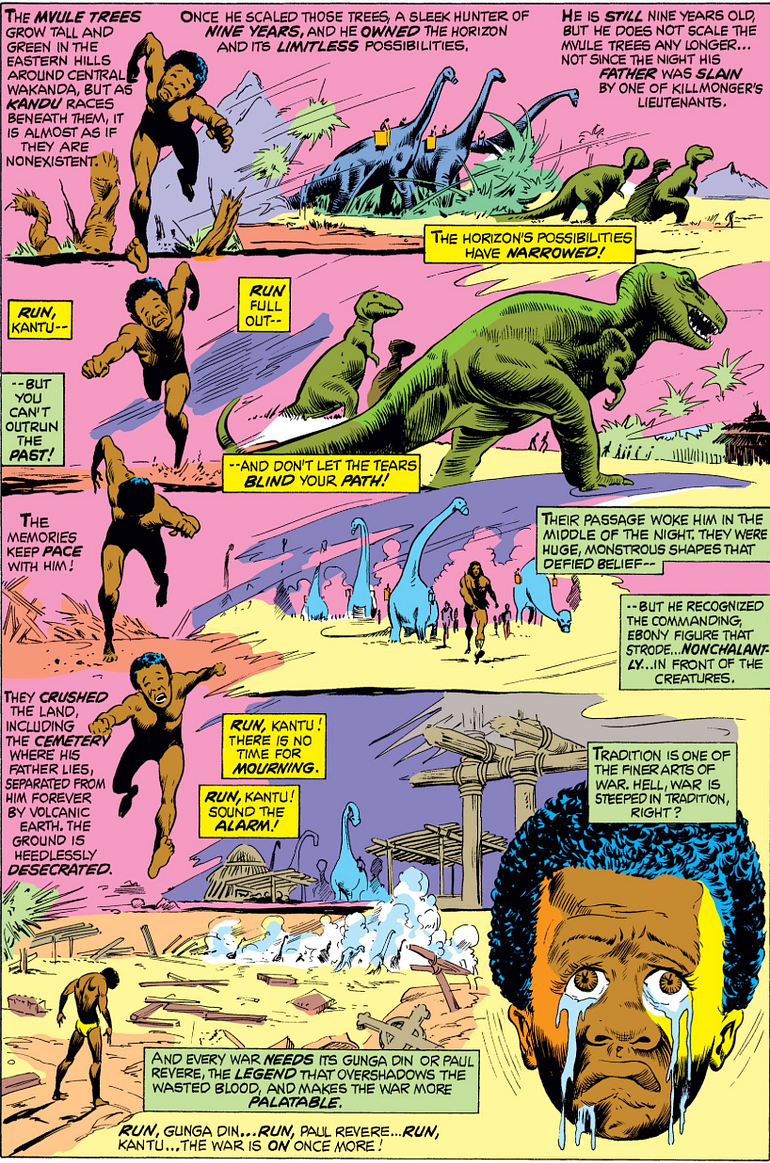
The page culminates with Kantu, head down, looking at the remains of the cemetery as the narrator states, “An every war needs its Gunga Din or Paul Revere, the legend that overshadows the wasted blood, and makes the war more palatable.” Within this line, the narrator highlights the “noble” mythology of war, that it exists as an act of patriotism and sacrifice that makes one heroic. The legends we tell ourselves about war, from fictional narratives such as Rudyard Kipling’s “Gunga Din” to Paul Revere’s midnight ride, add to this. However, these legends obfuscate the realities of the war, those like Kantu who live in its wake, hurt and traumatized by its ceasless march forward across the battered landscape.
Instead of cowering in the face of destruction, Kantu acts. “Panther’s Rage” ends with Killmonger and T’Challa fighting on top of warrior falls, and in one page, as the two battle it out, throwing barbs and fists at one another, we see three small panels of Kantu looking on, changing his expression from inquisitiveness to fear. This fear, though, doesn’t last, because on the final page Kantu acts. Killmonger soundly pummels T’Challa, picking up T’Challa’s wounded body and holding him aloft over the falls, in preparation of throwing T’Challa down onto the rocks below. This final act, though, fails to transpire because Kantu knocks Killmonger over falls, allowing T’Challa to fall and grab a hold of the rocks and pull himself up.
The final page, with T’Challa’s upside down head as the centerpiece, moves from Kantu charging at Killmonger to Killmonger’s facial reaction to Kantu knocking Killmonger over the falls to Kantu helping T’Challa climb up the rocks to Kantu and T’Challa, in a similar scene like the one from issue #16, walking towards the horizon. Graham’s illustrations convey emotion, and we could read this page without even looking at the narration, getting the weight of the moment; however, the narration drives home the ways that Killmonger and T’Challa’s war leaves everyone, no matter if they chose a side or not, scarred in one way or another.
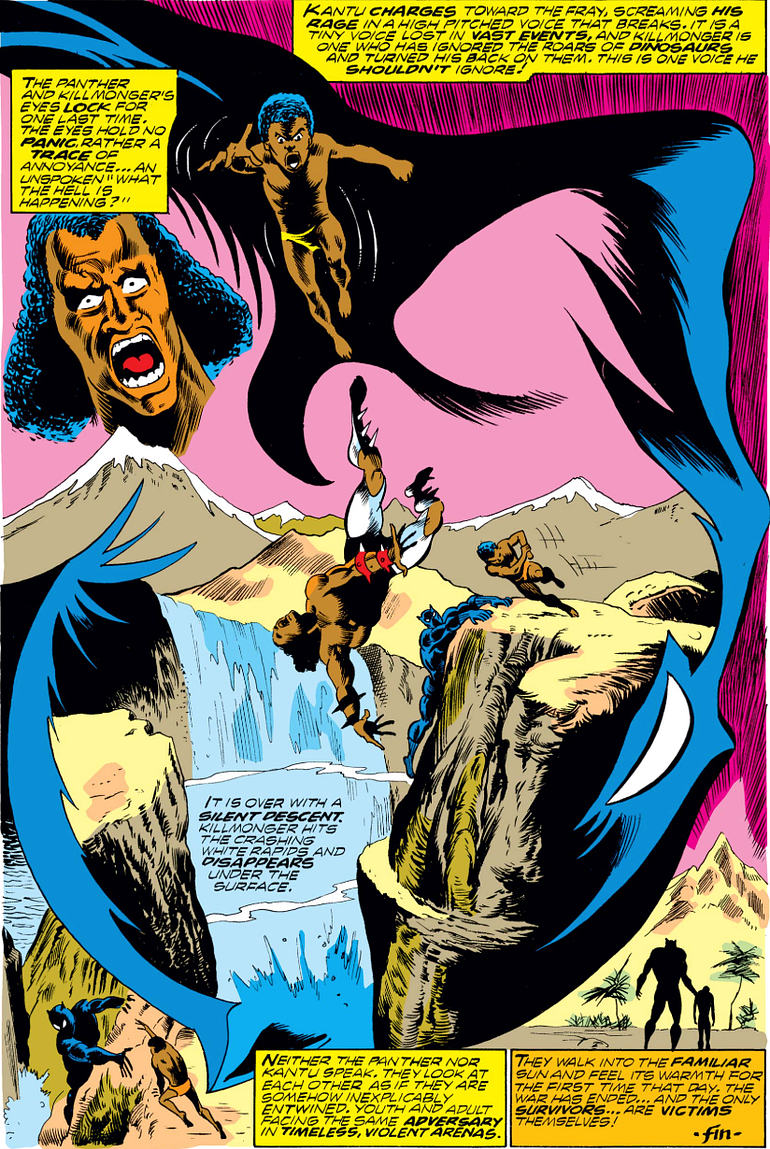
The war brings Kantu into the war, as he charges at Killmonger he screams “his rage in a high pitched voice that breaks. It is a tiny voice lost in vast events.” Kantu’s voice is like the bird who falls in the tar in issue #14, a voice that seems inconsequential and that gets passed over amidst the bombastic nature of war. Yet, unlike the bird who sinks into the tar, Kantu’s voice rises, and it is a voice, as the narrator points out, “[Killmonger] shouldn’t ignore!” Kantu acts, saving T’Challa, and as Kantu pulls the Wakandan king to safety, neither of them speak. They don’t have to speak because they are “somehow inexplicably entwined” to one another, the “youth and adult facing the same adversary in timeless, violent arenas.” They are linked, through their experiences in the war, through the loss of their fathers, and through this final moment. They are present and future, the one comforting the younger and the younger starting his path forward.
The issue ends with the two walking off into the horizon. In silhoutte, we see T’Challa with his hand on Kantu’s shoulder as the boy lowers his head. The narration reads, “The walk into the familiar sun and feels its warmth for the first time that day. The war has ended . . . and the only survivors . . . are victims themselves!” No one has won the war because even those who claim military victory live with the memories, the violence, the atrocities. They cannot escape it. They are victims, just like those who didn’t physically survive. It has touched them, regardless of “age or race or sex or shoe size.”
It has been a few years since I read “Panther’s Rage,” and as I have reread it for my course this semester, it keeps reminding me the depth and power of comics. Mcgregor, Buckler, and Graham created something that uses the comics’ medium, and specifically the superhero genre, to explore huge exestential and philosophical questions. It causes us to think about our past, our present, and our future, and the ways that we exist within the world. I’m glad I finally decided to teach this series, and I really can see doing it again in the future.
What are your thoughts? Have you done unessay projects in class? Are you thinking about it? As usual, let me know in the comments below. Make sure to follow me on Bluesky @silaslapham.bsky.social.
 Interminable Rambling