
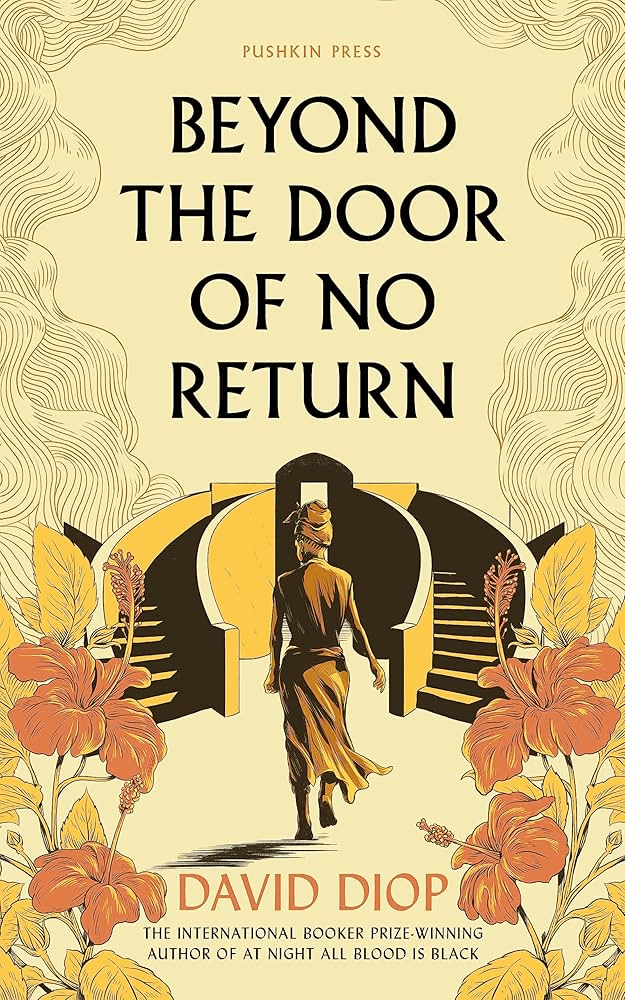
Last year, I picked up David Diop’s At Night All Blood is Black and devoured it in a single day. The novel details the experiences of Alfa Ndiaye, a Senegalese solider, during World War I, specifically as he fights for the French as a colonized subject. Diop’s novel grabbed me from the start and never let go, and after reading it, I knew that I wanted to read more of his work. Recently, I picked up Diop’s 2021 novel Beyond the Door of No Return, an epistolary novel told from the perspective of French botanist Michel Adanson to his daughter Aglaé Adanson through a writing that she discovers after her father’s death.
In his letter, Michel tells his daughter about Maram Seck, a woman he heard about while in Senegal in 1752. Abducted and enslaved, Maram escaped and returned. When he hears this, Michel sets out to find her, acting, as Alexandra Harris puts it, “a knight keen for a quest.” Over the course of his travels with his guide Ndiak, Michel encounters the horrors of the transatlantic slave trade and France’s colonial expedition in Senegal. Michel exists within a colonial structure, and he is a colonizer, even though he sees and understands the horrors of colonialism and enslavement. He becomes infatuated with Maram, and when he eventually finds her, the both get abducted by the colonial administration, and in their attempt to escape, Maram gets murdered. There is much more to this novel, but this brief summary sets up what I want to look at today, specifically Micheel’s thoughts about Maram at the end of the novel when he sees Marie-Guillemine Benoist’s Portrait of Madeline and Madeline’s response to the portrait.
Upon his return to France from Senegal, Maram’s memory staretd to fade for Michel, and he even succumbed to his selfish impulses in his “quest for fame and glory.” To help achieve these laurels, he writes, “I published a pamphlet for the Bureau of Colonies extolling the advantages of the slave trade for the Senegal Concession in Gorée.” He went against his “own convictions” and laid out the economic of the slave trade and how it could increase profits for individuals. As he dis this, he “killed Maram a second time” because he hid the realities of the slave trade from himself “behind an abstract, logical demonstration of its financial advantages.”
Maram and the horrors of enslavement all came flooding back for Michel as he neared death, and they specifically arose when Claude François Le Joyand gives a party for Michel. At the party, Michel sees a painting that Le Joyand borrowed from someone, and as he stares at the painting, he sees Maram staring back at him, “with sadness in her eyes.” Le Joyand tells Michel that the woman in the painting is Madeline, a woman from Guadalupe who, at the age of four, became enslaved by the Beboist-Cavays. Le Joyand doesn’t say “enslaved” though; instead, he tells Michel that she “was the servant of some friends.”
Michel stares at the painting, which hangs above the musicians who play excerpts from Christoph Willibald Gluck’s Orphée et Eurydice, Michel’s favorite opera. While listening to the musicians, Michel stares at the painting of Madeline and falls into “a sort of delirium of the imagination” that Maram, taking on the soparano’s voice, admonishes him for his actions since they last met fifty years ago. The memories race back into Michel’s mind, and he begins to recall Maram and the horrors of enslavement and colonization. To the power of art over an individual, Michel writes,
I realized then that painting and music have the power to reveal to ourselves our secret humanity. Through art, we can sometimes push open the hidden door leading to the darkest part of our being, as black as the depths of a prison cell. And, once that doors is wide open, the corners of our soul are so brightly illuminated that our lies to ourselves no longer have an inch of shade in which they can take refuge, as if exposed to the African sun at its zenith.
For Michel, art, and specifically the Portrait of Madeline, open up feelings within him that he had buried long ago, feelings that point out the loss of humanity and compassion that have accompanied him since Maram’s murder. He has the luxury of these feelings, the luxury of experiencing art in this manner, but Madeline and other enslaved individuals didn’t have the same luxury.
The novel ends not with Michel but with Madeline herself, who only enters the novel through the portrait, and Makou, a man who, when he was a young boy, Michel held on his lap in Senegal in 1752. The final chapter shifts from Michel to a third person narrator, and the narrator tells us that “Madeline hated her portrait,” and that “[s]he did not recognize herself” in it. She also felt that the portrait “would bring her bad luck for the rest of her life,” and to highlight this, she would think about he ways that when me looked at the portrait, with her gazing at the viewer with her right breast exposed, men would look “at her afterward as if they wanted to undress her,” with some, including Monsieur Benoist, even attempting to “touch her breasts.”
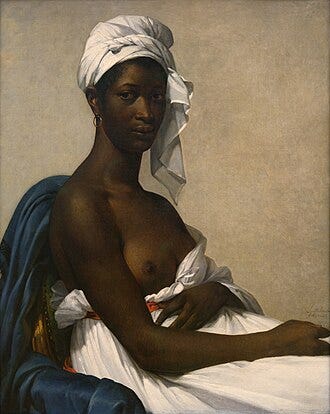
One of Michel’s last wishes was that his daughter would take a necklace with a louis d’or to Madeline for him, even though she had never met him. He wanted Aglaé to do this because, as he writes, “Madeline was probably not able to take anything with her” when enslavers captured her. When Aglaé brought the necklace, Madeline refused it because it “was not her fault if Michel Danson had mixed her up with someone else” and she did not remember anything “of Senegal and did not want to remember.” Ultimately, she refused because “[s]he was not something to be bought or sold. Not anymore.” She was not enslaved anymore, and Michel’s act, coupled with the portrait, made her feel as if someone still owned her and had the ability to buy and sell her.
Unlike for Michel, art did not liberate Madeline. Rather, it made her into another commodity for the consumption of the populace, specifically white men. She became, as we see, sexualized and nothing more than an image to them. For all of his poetic language and romantic inclinations, Michel does the same with Maram. She exists for his purposes, not for her own. She becomes a mere commodity in his mind, from his own perspective, without a voice or identity of her own separate from himself. She remains colonized in his mind, even though she escaped multiple times. The entirety of the novel drives this home, specifically with the appearance of Madeline and the portrait at the end of the novel.
This all makes me think about the way that Ayad Akhtar incorporates Diego Rodríguez de Silva y Velázquez’s Portrait of Juan de Pareja into his play Disgraced, something I wrote about a few years back. What are your thoughts? As usual, let me know in the comments below. Make sure to follow me on Bluesky @silaslapham.bsky.social.

