
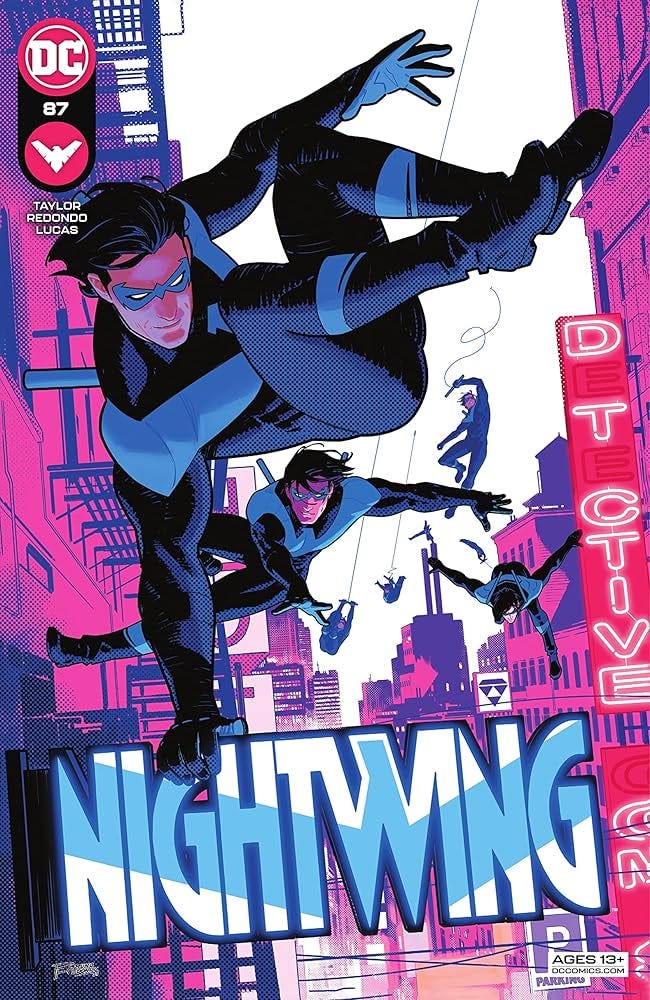
Over the past few posts I have been writing about some of my favorite comic issues and how these issues use the comics’ medium in engaging and experimental ways to tell compelling stories. Today, I want to continue that thread by looking at Tom Taylor and Bruno Redondo’s Nightwing #87, an issue that, Like Matt Fraction and David Aja’s Hawkeye #11, present readers with a new way to experience comics. While Fraction and Aja’s issue worked to tell the narrative through Pizza Dog’s point of view, Taylor and Redondo’s issue tells what we would consider a pretty typical narrative from Dick Grayson’s point of view. However, what makes the issue different is that if you were to place each page together in one continuous line it would create a single image with the characters moving across the page as in the Bayeux tapestry which depicts the Norman Invasion of England in 1066 or a 2-d platformer with your avatar running across the screen. As well, it reminds me of Joe Sacco’s The Great War: July 1, 1916, a comic that folds out to a 24-foot panorama depicting the first day of the Battle of the Somme. Sacco’s book came out in 2013 and Nightwing #87 came out in 2021, eight years later.
The issue, entitled “Get Grayson,” follows Dick Grayson (aka Nightwing) as he traverses Blüdhaven escaping and chasing after hired killers who want to claim the $10 million bounty placed upon his head. Over the course of the issue, the killers go to Grayson’s apartment and kidnap his dog Haley, and the issue culminates with him and Batgirl (Barbara Gordon) catching up to the kidnappers and freeing Haley. The narrative and the poing of view themselves aren’t all that unique, but the way that Taylor and Redondo tell the story makes this issue stand out as one of the prime examples of what comics, as a medium, can do that no other medium, apart from say tapestries or other forms of visual art, can accomplish.
The issue starts with a single page where we see Dick Grayson walking across a pedestrian bridge over a street as he talks to Barbara Gordon. No panels exists here or over the course of the issue. Rather, we see Grayson move from the foreground on the left of the page, with phone to his ear, towards the back of the page, and the start to descend the stairs on the back right side of the page. Through movement to movement transitions, without panels or borders, we see him six times over the course of the page. The rest of the issue, except for the final page, consists of two-page spreads, allowing us as readers to follow the action from the left side of the page to the right side of the page.
While the first page sets the scene for what we should expect over the course of the issue, the first spread lays it all bare. In this spread, we see Grayson, again with movement to movement transitions, in thirteen different moments as he ultimately dons his Nightwing costume. The scene begins with him still on the phone, walking normally. He is on the elevated path, and on the street, the hired guns get out of their car and fire upwards at him. This causes him, in the second image, to start to run. He moves from the elevated pathway to street level then, on the right side of the page, climbs up the fire escape of an apartment building before, at the top right, he grabs a pole and swings into the next page where he flings himself across scaffolding and other urban obstacles.
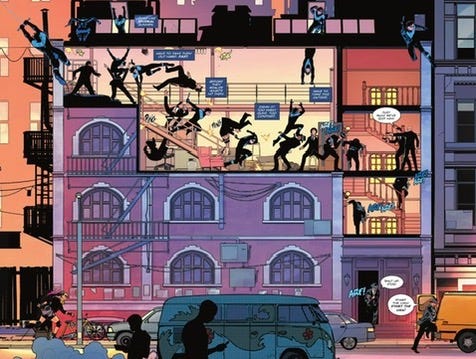
One of the most engaging pages shows Nightwing entering his apartment as the hired guns kidnap Haley. This two-page spread shows a cross section of the apartment building, as we look inside of the stairwells, as Nightwing encounters the kidnappers. When we read this page, we move up and down across the page, eschewing the normal left to right and up to down reading of “traditional” comics’ pages. We start at the top left, following Nightwing as he enters the apartment via a skylight, then we move, slightly, downwards and left before returning to the roof via a skylight. From here, with Nightwing, at the top right of the page,. preparing to move to the next page, we move down the stairwell, following the hired guns as they take Haley to a waiting van on the street.
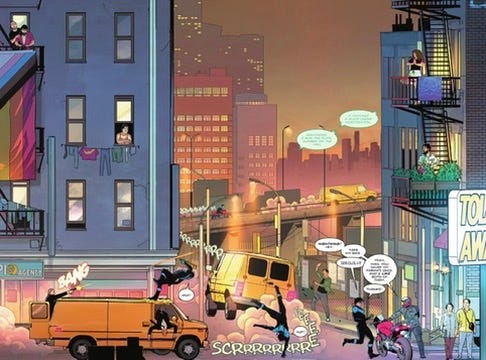
Over the next two spreads, we see Nightwing swinging across buildings as the van races along the street. Again, we must pay attention to everything in the image because one of the men hangs out of teh van and shoots up at Nightwing. On the right side of the first spread, we move from Nightwing moving through the air to him dropping down onto the roof of the van. In the following spread, another gunman shoots at Nightwing, knocking him off the van, and on the right side of the page, the van moves out towards the horizon, taking the onramp onto a bridge. What stands out here is the way that movement utilizes every aspect of the page, causing us to think about perspective and movement as characters and vehicles move not just across the space but into and out of the space as well.
The above are just a few examples from Nightwing #87 that highlight the ways that it uses the comics’ medium in an engaging manner for the reader. It’s an issue that relies upon the language of comics to convey the story, and it relies, since it appears as singluar pages and not as a foldout like Sacco’s book, to put the pieces together. For example, in the last two pages I discussed above, we see, on the firt spread, the left hand side of a pride flag, and on the next spread, we see the rest of the pride flag on the left hand side of the page. If we saw the image together, as one continuous image, this would all be together, just like the tow company or Nightwing entering a door near the end of the issue.
Nightwing #87 does not stray, as I mentioned, from a traditional superhero narrative that we have seen before. However, it does use innovative techniques to convey the narrative, making us, as readers, more actively engaged with the text than we may have been if the illustrations and layouts conformed to our conventional understanding of comics. This issue, like Hawkeye #11 or G.I. Joe: A Real American Hero #21, highlights why I like comics become they take what I expect out of a story and storytelling and make it something completely new, and they call upon me to engage, as an active participant, in that story in unique ways that I do not get when reading a novel or short story.
What are your thoughts? As usual, let me know in the comments below. Make sure to follow me on Bluesky @silaslapham.bsky.social.

