
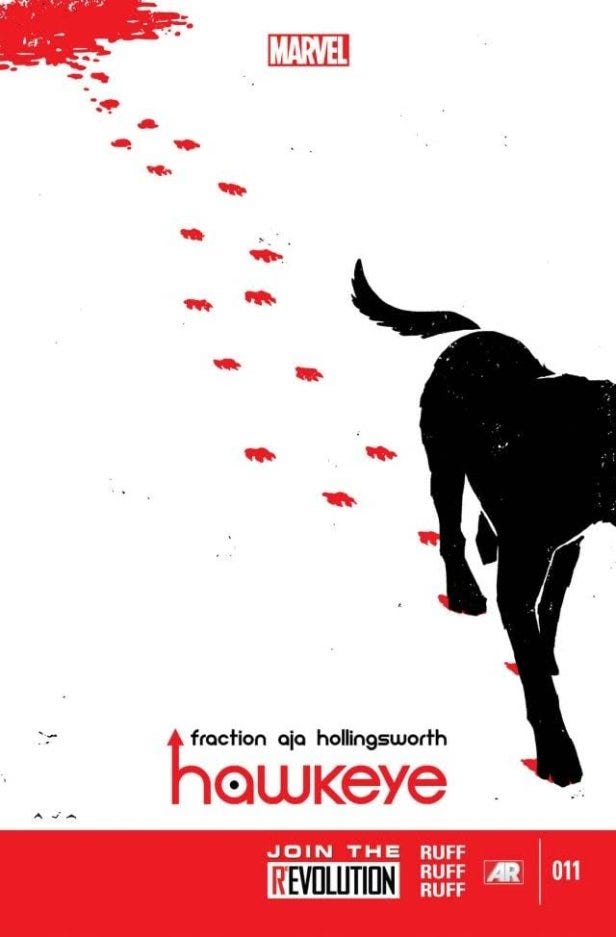
Over the past few semesters I’ve taught various comics in my courses. Last fall, I used EC Comics from the 1950s in my composition class, and when students read these books they encountered what I would call “traditional” comics that relied heavily of distinct panels and layouts in conjunction with both narrative text and speech bubbles. Some of these stories broke with convention, having panels that bled into one another, as in Jack Kaman’s work, but most remained pretty standard. This semester, I framed my course around Black Panther, and students read his debut in Fantastic Four #52 from 1966, Jungle Action from the 1970s, and Ta-Nehisi Coates’ Black Panther from 2016. This sequence moved us from “traditional” comics to more experimental layouts and narrative structures, part of which I wrote about last post.
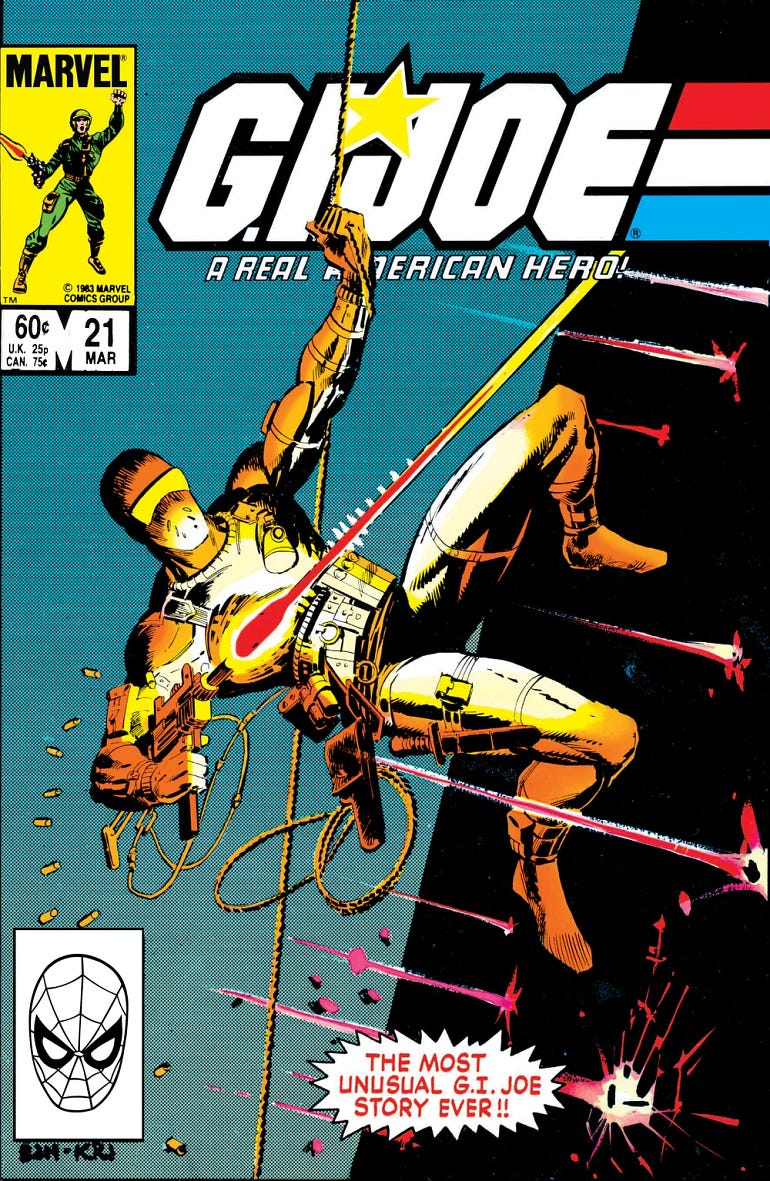
For me, I enjoy comics that really experiment with the medium, either through page layouts and images or through narrative strategies. With each of these aspects, I always think about Kaare Andrews’ Iron Fist run and the ways that Andrews uses the medium to convey different emotions with his color palette and silhouettes and the ways that he cues us, as readers, to know that a scene occurs in the past through the texturing he uses on the page, making it looked old, weathered, and as if it has been folded and put away in a drawer, with creases all over it. I enjoy issues such as G.I Joe: A Real American Hero #21 “Silent Interlude” from 1984 because the entire issue has no words. Larry Hama merely uses images to tell the story of Snake Eyes infiltrating Destro’s castle to rescue Scarlett.
All of this brings me to one of the most innovative issues I have seen in my time reading comics: Matt Fraction and David Aja’s Hawkeye #11. This issue, rightfully entitled “Pizza is My Business,” follows Lucky (aka Pizza Dog) as he investigates the murder of Grills, one of Lucky and Hawkeye’s neighbors. The plot itself isn’t what makes this issue amazing. No, the amazing part about this issue is the way that Fraction, Aja, and the rest of the team construct the issue through Lucky’s eyes. They could have merely had panel after panel showing Lucky traversing the apartment building and street working to uncover Grills’ murderer, but they don’t do that. Instead, they construct the entire issue around Lucky’s senses, specifically smell, sight, and sound.
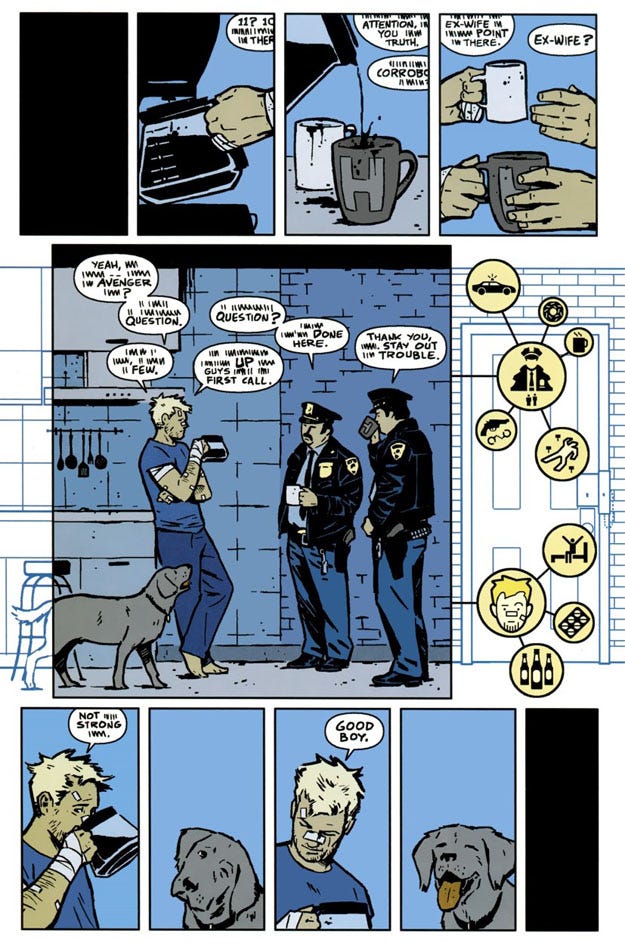
The first page, consisting of eleven panels, epitomizes all of this. The page is broken down into five small panels at the top, a larger panel with a focus on the middle in the center of the page, and five panels at the bottom. We start in the dark, with a completely black panel. Over the course of the top panels, we move out from a word bubble, moving from the black panel to a large “H” in the second panel to a closeup of the question “What?” in the third panel to two final panels that show Clint Barton and Kate Bishop arguing. Here, we also see words, but we don’t see every word. Instead, we only see words that Lucky understands, such as “What,” “Help,” “Kate,” “Don’t,” and “Bad.” All of the other words are scribbles and indecipherable.
In the middle panel, we see Kate angrily pointing at Clint with Lucky, head cocked, stares on in bewilderment. On the left, we see what I would call an identity sun with Clint’s head in the center and various things emanating from that center head. We see an archer at the top. On the bottom, we see a coffee carafe then a cup, we see a hand, and we see a dog bowl with food. For Kate, whose identity sun appears on the right side, we see an archer, pizza, a flower, and a heart, among other things. These identity suns present to us, as readers, what Lucky associates with Kate and Clint; it gives us insight into his psyche as he stares at the two humans he loves arguing with one another.
In the bottom five panels, we focus on Lucky. We see him looking quizzical in the first panel, head cocked to the side again. In the second, we see him put a paw over his face in semi-disgust, and in the final three panels we see him walk out the door, leaving Kate and Clint alone in the apartment. Out in the stairwell, on the next page, Lucky passes by numerous apartments and with each one he has an identity sun, with the occupant in the center and what Lucky associates with each individual emanating from that center. Again, without words Fraction and Aja convey the story from Lucky’s perspective, from the point of view of a character who, in this world, doesn’t speak any language that the other characters speak (English or Polish) but that understands words in those language.
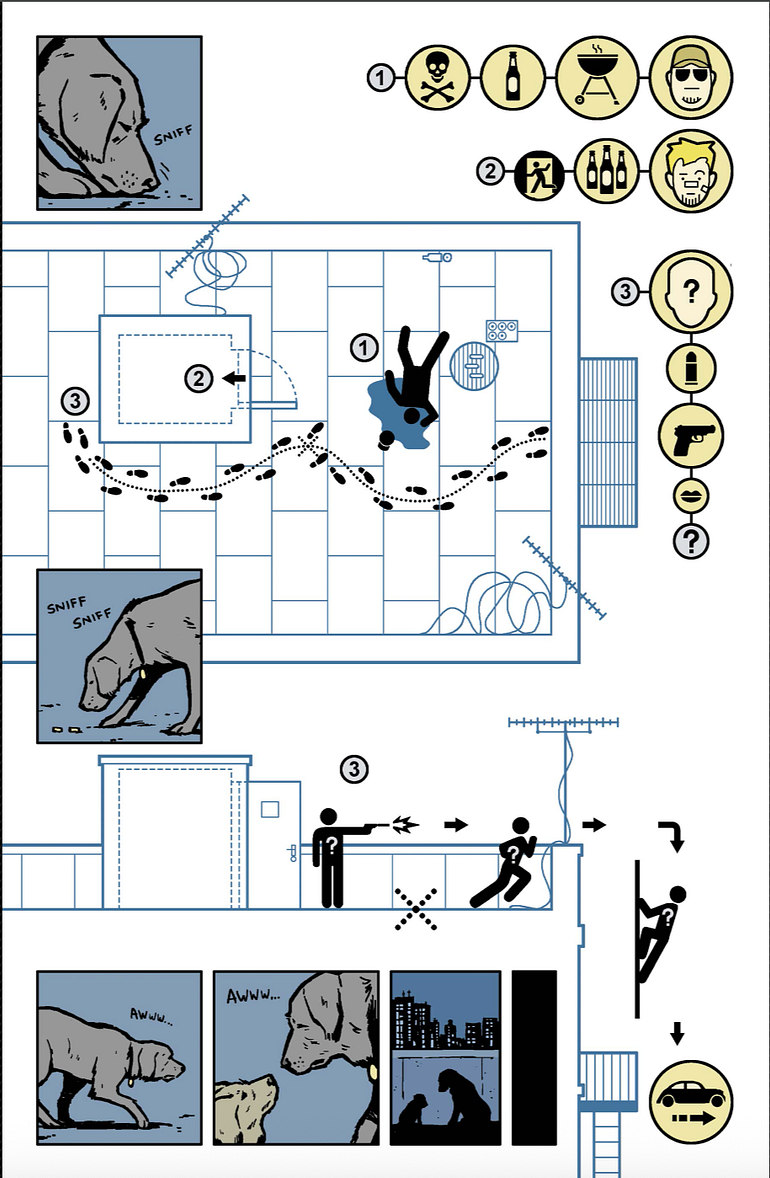
After Lucky befriends another dog, the pair head up the stairs to the roof where they find Grills’ body. The following page stands out because it serves as a masterclass in comics’ storytelling. It’s a page that, if we chose to break it down into panels, consists of eight panels of various sizes and focus, accompanied by connections that Lucky makes through his senses. The page essentially shows Lucky investigating the crime scene, putting the pieces together as he collects evidence as he walks around Grills’ corpse.
At the top left, we see a small panel with Lucky sniffing the ground. Next, we see a blueprint sketch of the roof with Grills’ body, footprints, and numbers. The numbers correlate to the associations at the top right of the page. The number 1 corresponds to Grills, and of Grills Lucky thinks about the grill, a beer, and death. The number 2 correlates to the door to the roof. Here, Lucky associates it with Clint, beers, and leaving the roof. Number 3 correlates to the footsteps, which Lucky connects to an unidentified individual, a bullet, a gun, lipstick, and something that Lucky doesn’t know.
We move back, in the middle left, to another panel showing Lucky sniffing the ground before we see sideways panel, again like a blueprint, depicting the killer in three distinct steps: pulling the trigger, running to the fire espcape ladder, climbing down the ladder, and concluding with a car driving away. The four smaller panels, which decrease in size, at the bottom show Lucky and the other dog getting closer together, sharing thoughts, before ending in an entirely black panel that moves us to the next page and the next morning.
Every page of Hawkeye #11 is like this, bringing us into Lucky’s mind and world. He does not become anthropomorphized, speaking so that the other characters can understand him, walking on his hind legs, or any other human characteristic. No, he remains a dog. We do not need Lucky to be anthropomorphized to understand the story or to feel various emotions as we turn the pages. As Chase Magnett points out, “Lucky is already a character possessing his own perspective, experiences, desires, and understanding.” We have seen Lucky; we know who he is and what he thinks, even if we have only heard him bark or seen him interact with human characters. This is what makes Hawkeye #11 special. We know dogs. We live with dogs. We love dogs. We treat dogs as we do any other family member, talking to them, loving on them, playing with them, ultimately forming meaningful relationships with them.
Magnett sums up the impact of this issue by stating that the issue calls upon us to expand our “definition of whose lives matter and asks that they consider those they do not share a species with by revealing the rich experiences and breadth of emotions that artists can only imagine in the lives of animals.” It calls upon us to think about those we share this life and world with and their experiences. It calls upon us to recognize that even though we tend to, at times, place too many human characteristics onto animals, they really do have the same feelings and emotions that we do, and they communicate those feelings and emotions to one another and to us.
I specifically chose not to focus on too many pages from Hawkeye #11 because I didn’t want to spoil it, even though we know, already, who killed Grills. That, though, is not the point of the issue; it’s just the impetus for the narrative. What are some of your thoughts? As usual, let me know in the comments below. Make sure to follow me on Bluesky @silaslapham.bsky.social.

