
Before I really started reading comics, I always thought of the page layouts in simplistic terms. That is, I would think about the classical structure of a set number of panels, with clear and distinct borders, presented in the same manner across the entirety of the issue. However, the more I read, I encountered numerous engaging page layouts and narratives that challenged my naive understanding of comics. This shift really started when I initially read Don McGregor, Rich Buckler, and Billy Graham’s Jungle Action series with the Black Panther, specifically issue #16. Looking back, the creators of that series really did a lot to expand the conventions of comic storytelling. They did this through the ways they depicted the story and in many cases eschewed traditional panels. I’ve written about this some before.
Multiple pages stand out to me from issue #16, but today only want to focus on a couple of them because I want to move forward from here to look at Matt Fraction and David Aja’s Hawkeye # 11 and Tom Taylor and Bruno Redondo’s Nightwing #87, two issues that really do a lot with both from a layout and narrative perspective. However, before I get to those issues, I want to focus on the opening of Jungle Action #16 where we see T’Challa and Monica Lynne riding turtles and sharing a kiss in a moment of reprieve from the attacks of Killmonger on Wakanda and T’Challa’s rule.
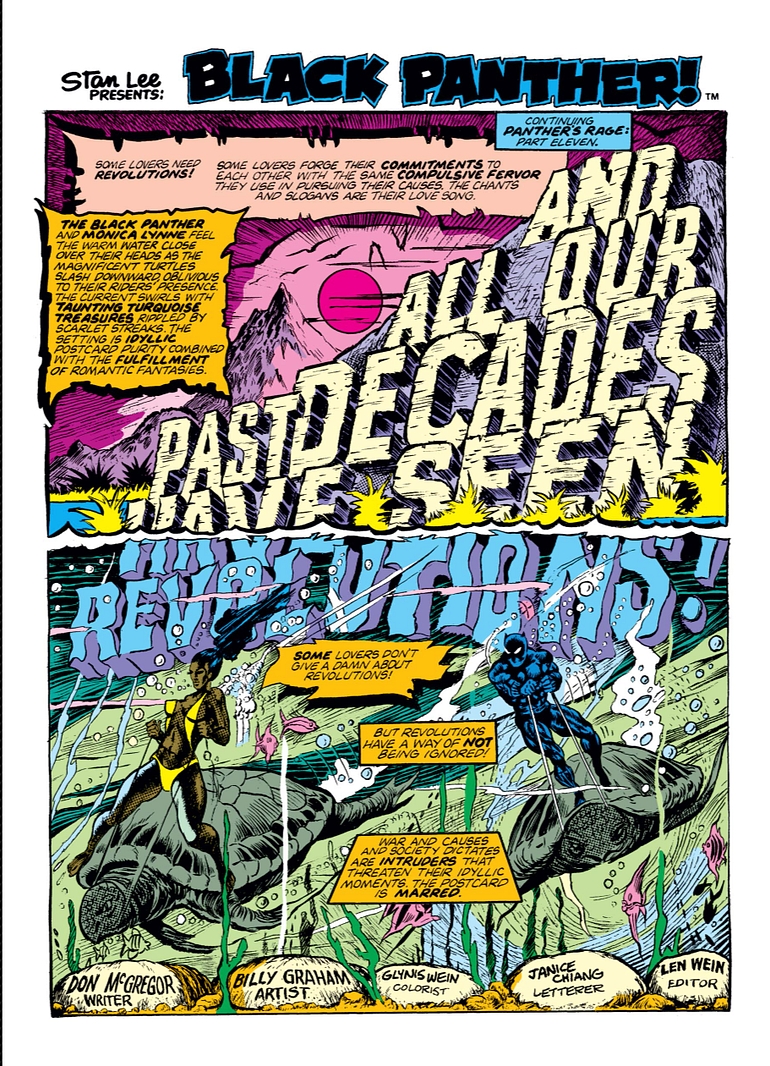
The opening of this issues really does a lot, and it all begins on the title page where we see the title, “And All Our Past Decades Have Seen Revolutions!”, spelled out it rocks on the side of a mountain, with the last few words descending beneath the water that occupies the bottom half of the image. A border exists between the land and the underwater image, severing the two spaces, and the border appears not as a straight line but as waves, rising and falling with the current. Underneath the water, we see T’Challa and Monica holding tight to two giant turtles as they ride the turtles through the water. They strain with the force of movement, holding on to the reigns tightly.
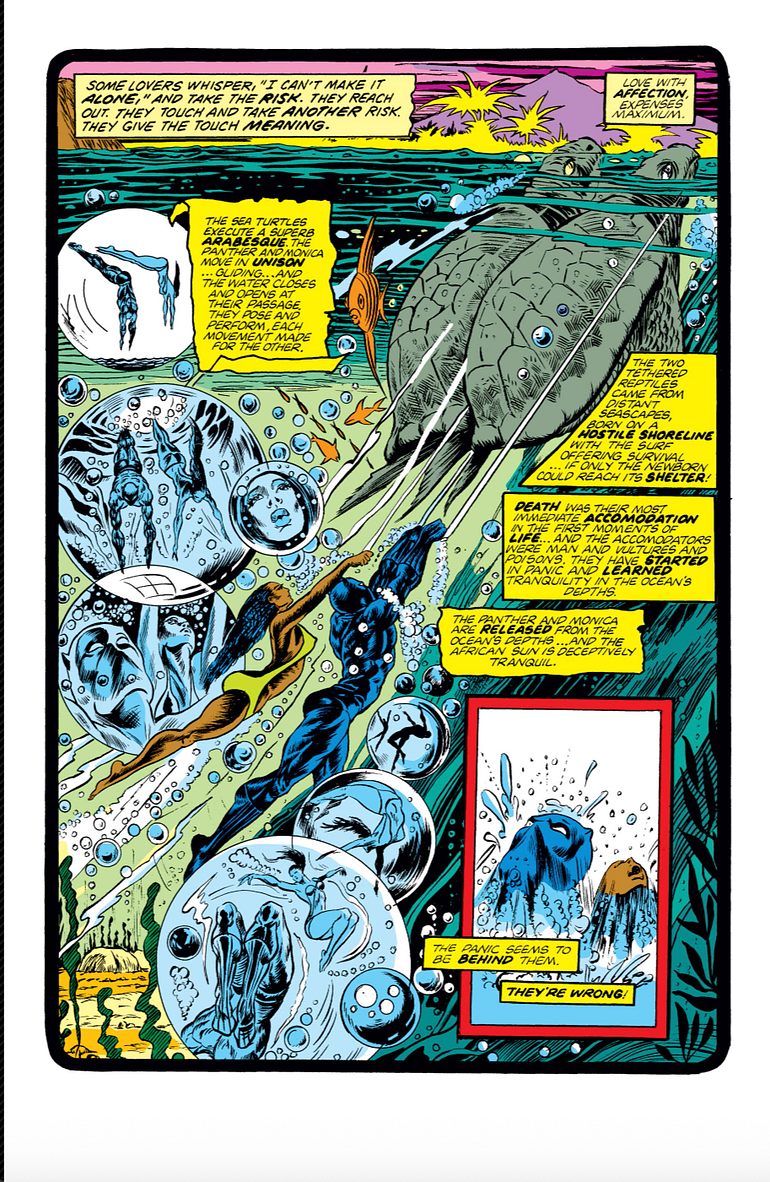
On the next page, the narrator describes love and also the action of the couple as “the sea turtles execute a superb arabesque.” The main image on the page shows T’Challa and Monica holding tight to the turtles as the animals race to the surface. We see follow them with our eyes, moving from the bottom left of the page to the top right, as we see the turtle’s heads break the surface of the water at the very top of the page. However, other images remain, not in the classic square or rectangular panels, like the one we see at the bottom right of the page wheen T’Challa and Monica surface, gasping for air.
No, we see, along the left side of the page, seven panels that take the shape of air bubbles forming below the surface of the water. In the first panel, T’Challa and Monica dive, in unison, into the water, and the other panels, apart from a singular panel that shows Monica breathing, show the pair performing various moves underwater, turning and flipping in unison and in contradistinction to one another before the grab hold of the turtle’s reigns again and surface. Graham could have presented this moment in the usual fashion of distinct panels, having a few small panels at the top and next level showing T’Challa and Monica in the water, followed by a larger panel with the turtles surfacing, then concluding with a panel or two showing T’Chall and Monica gasping for air as they break the surface. That layout would convey the same information, connected with the narration; however, it would not be as engaging because as a reader I would know what to expect. Graham’s layout calls upon me to examine the entirety of the page, not just the individual panels, and by doing this zooms me inward and outward and inward, making sure I see the ways that his image juxtapose and work with McGregor’s words in a way that makes me, as a reader, a more active participant in the story.
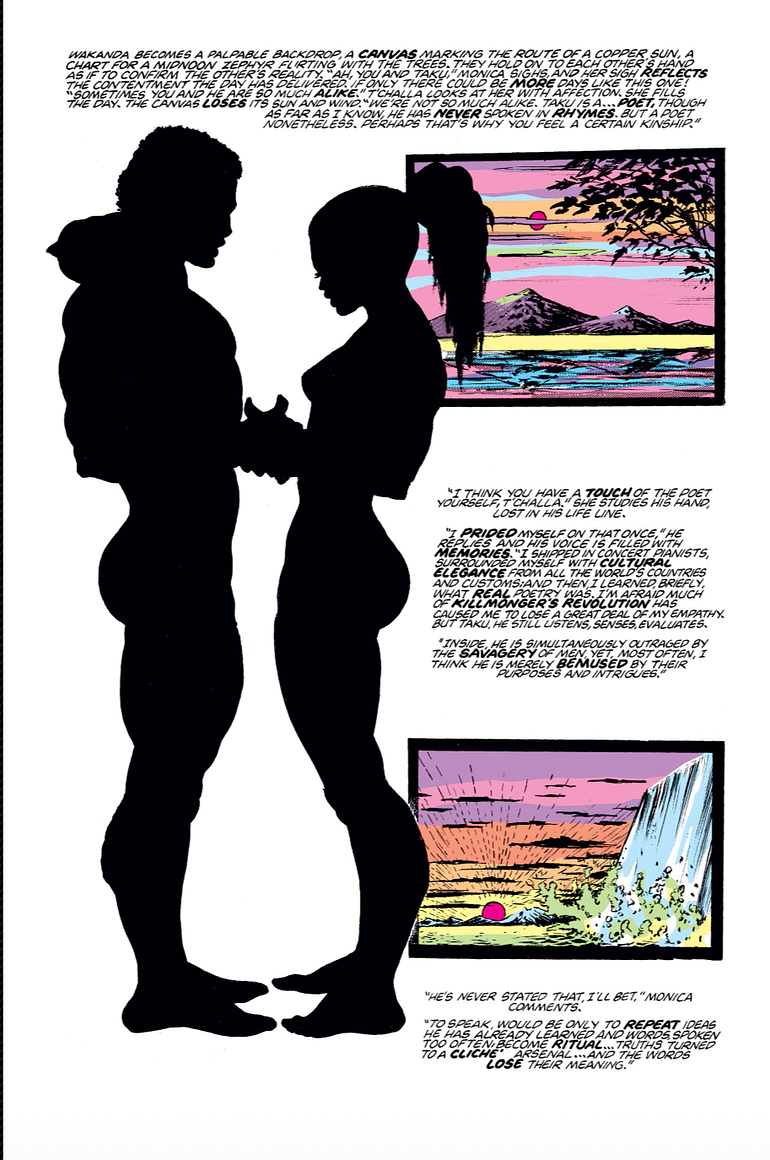
The other sequence that always stands out to me in issue #16 occurs a few pages later. It’s a two-page sequence that does a lot. On the first page, we see, along ithe entirely of the left side of the page, a silhouette of T’Challa and Monica holding hands. I am a sucker for silhouettes in comics because they allow me to place details onto the characters facial expressions and other aspects. On the right, Graham has two landscape panels, enclosed in borders, at the top and at the bottom. McGregor’s dens narration occupies the rest of the page. While this page stands to me, it’s really the next page that drives everything home. This page layout feels more traditional, but there are specific moments that really make it, conjoined with the previous page, something spectacular.
If we were to break down the second page, we would say it contains eleven panels, two of which don’t have borders, over three rows. Looking closer, though, we would see that the page, even with the traditional elements, breaks free from those elements. The first moment occurs at the top left of the page over the course of a six-panel sequence. This sequence really contains four moments and follows a movement-to-movement transition as we see T’Challa and Monica kiss. However, what makes this sequence unique is that in the first panel we see Monica’s face in silhouette approaching the right side of the panel, and in the second panel we see T’Challa’s face, in silhouette, approaching the left side of the panel, with the gutter separating them. In the next panel, we see both of their faces, in silhouette again, getting closer to oner another. In the fourth full panel we see more details on their faces, even though their mouths are still separated, and in the fifth and sixth panels, they kiss in the gutter between the two panels. What I like about this sequence is the way that Graham uses panels, the gutter, and silhouettes to convey the kiss, and I especially like the ways the gutter keeps them separate but they end up meeting in the gutter, coming together across T’Challa’s Wakandan background and Monica’s American background.
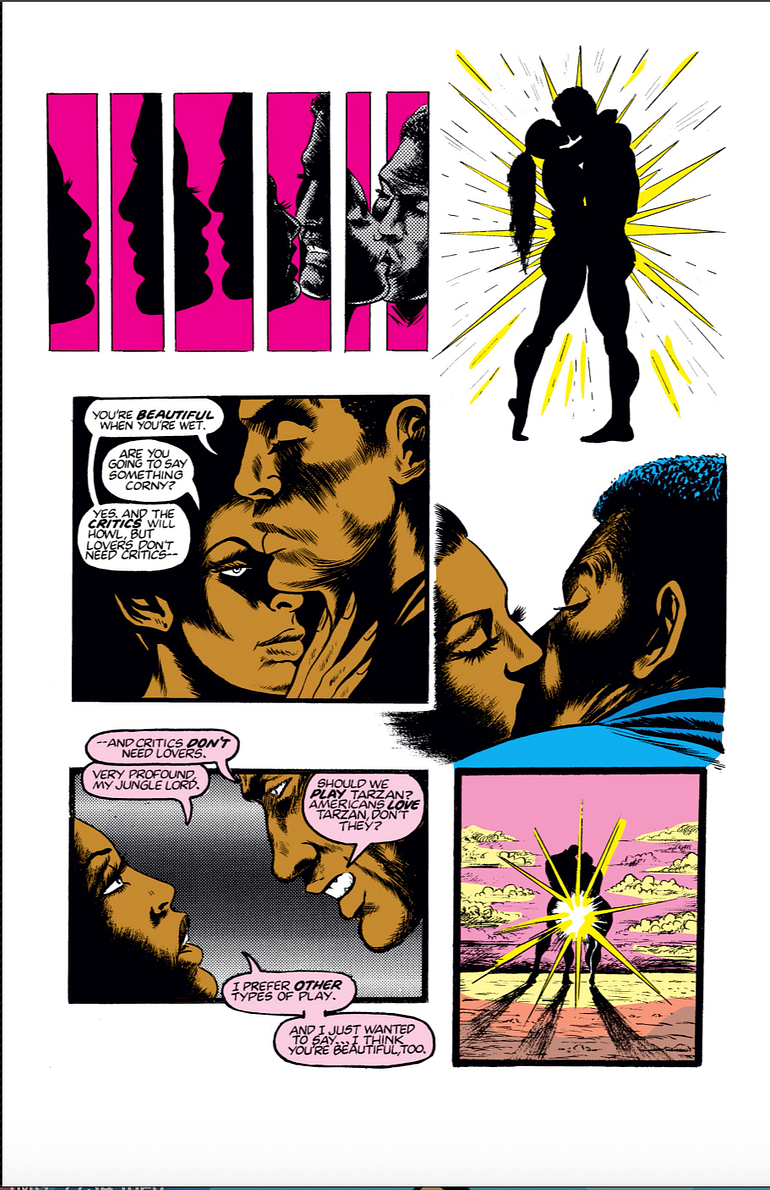
The next panel at the top doesn’t have a border. Here, Graham zooms out and shows the couple, again, in silhouette kissing. It is reminiscent of the image on the previous page, but they are closer together and a light, that looks like the sun and its rays, emanates from behind them. The next three panels, one of which has no border, shows T’Challa’s and Monica’s faces close together as they discuss their feelings for one another and kiss. The last panel, which has a border, shows the couple, again in silhouette, facing away from the reader towards the horizon, a positioning that Graham uses a lot in the series, as the sun sets in front of them. What makes this panel a fitting ending for this entire sequence is the beauty of it. Within the image, we see the intimacy between T’Challa and Monica, and that initimacy gets heightened by the fact that we see the sun shining, as it sets over the water, peeking between their bodies. They hold each other, but between their legs the sun peaks through. It’s a beautiful image of love and respect between the couple, and it conveys those feelings, as the silhouette on the previous page and the kiss at the top of this page do, without any words.
These pages from Jungle Action #16 show the ways that comics use images to convey the story and feelings. I talked about these moments to set up what I want to look at over the next couple of posts, specifically Matt Fraction and David Aja’s Hawkeye # 11 and Tom Taylor and Bruno Redondo’s Nightwing #87, two issues that use the comics’ medium to tell stories in very interesting and engaging ways. Until then, what are your thoughts? As usual, let me know in the comments below. Make sure to follow me on Bluesky @silaslapham.bsky.social.

