
Over the course of his Black Panther run, Ta-Nehisi Coates incorporatedcountless allusions to artists, writers, historical events and more. We see him directly referencing John Locke when Changamire, during our introduction to him, quotes from Locke’s Treatise on Government. We see his allude to Mr. Lif’s 2002 song “Post Mortem” when Zenzi quotes to song directly to Aneka, saying, “In times of famine we made more food. Food made more people,” to which Aneka responds by quoting another line from the same song, “need breeds more need.” I have already looked some at the allusion to Locke, and I could discuss any of the other allusions in the series. Instead of looking at multiple allusions, though, I want to look at the specific allusion that M’Bali makes to Audre Lorde’s famous 1979 speech “The Master’s Tools Will Never Dismantle the Master’s House.”
After the Midnight Angels talk with Tetu and Zenzi about forming an alliance against T’Challa and the throne, Ayo and M’Bali point out to Aneka that all Tetu wants to do is flip the tables over and mainatin the same table. Instead of moving forward to a new society for all, as the Midnight Angels seek to do, Tetu wants to place himself at the top, using the same tools that T’Challa has at his disposal. Aneka wants to partner with Tetu and Zenzi, telling the women that they need allies in order to protect what they have founded in the Jabari-Lands. During their conversation with Tetu, they ask him to pay attention to the women, to focus on everyone, not just a few. Tetu dismisses this and says that in the heat of war that is not possible. He seeks to maintain a fractured state, refusing to help everyone.
All of this leads M’Bali to chastise Aneka for wanting to partner with a man who doesn’t even recognize her existence. She tells asks Aneka, “What shall you build yourself? Are you but destroyers and killers? Butchers and bandits?” M’Bali asks if Aneka, like Tetu, merely wants to switch positions with those at the top, to move from oppressed to oppressor. She ends by asking, “Have you so soon forgotten the Parable of Zami? ‘A free house not is not built with a slave-driver’s tools.’” Here, M’Bali alludes to Lorde’s 1982 book Zami: A New Spelling of My Name, and to her 1979 speech at the Second Sex Conference in New York City. These questions appear in one panel, but the connections move outwards from this one panel to encapsulate the entire arc for A Nation Under Our Feet.
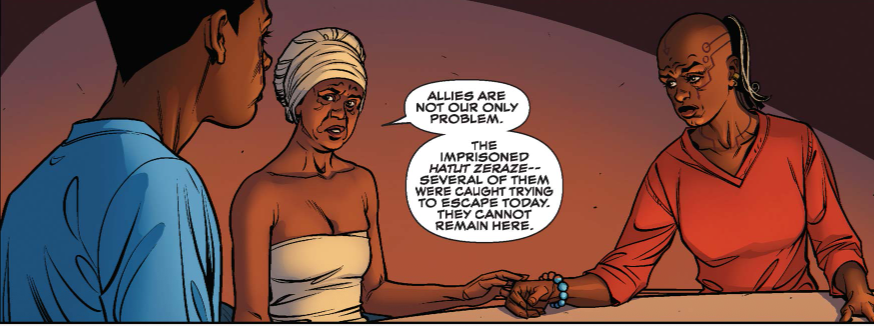
There are multiple moments in Lorde’s speech that bring us back to Coates’ Black Panther, but I want to zero in on two specific moments that draw focus to the various threads in Coates’ arc. Each of these moments deal with the tension between action and inaction that we see both in real life and in the series itself. Tetu criticzes Changamire for merely thinking about philosophical issues and not acting, and Queen Ramonda directly tells the philosopher, “My teachers were imaginative and visionary. But they dug no wells, built no walls, fed no children. The best of them were only men of theory.” For all of their pontifications and ideas, Ramonda notes that Changamire and her other teachers did nothing to help the people.
This assertion lies at the heart of Lorde’s speech as well. Lorde calls upon the women gathered at the conference to recognize their differences of race, sxuality, class, and age, embracing those differences and working together to bring about change. She says, “Interdependency between women is the only way to the freedom which allows the I to be, not in order to be used, but in order to be creative. This is a difference between the passive be and the active being.” Lorde poingts out that in order to move from be to being, from the passivity or merely existing to the action of existing and shaping the world, we must rely on one another. Tetu doesn’t see this, but T’Challa and others do, which is why in issue #12 we see various factions meeting and determing, even with their differences, how to move forward.
Stressing the importance of community, Lorde states, “Without community there is no liberation, only the most vulnerable and temporary armistice between the individual and her oppression.” We need each other to thrive, and we need each other to overcome oppressive forces that weigh down upon us. Both Tetu and Aneka experienced the oppression of T’Challa’s monarchy; however, they each experienced it in different ways. We see, early on in the series, the ways that these experiences differ, especially when Aneka takes justice into her own hands when the men fail to do so and kills the chieftain that has been abusing women and girls. The Midnight Angels work to create a community where these abuses don’t happen, and the set up laws and tribunals, creating a lasting change, not merely a “temporary armistice.”
Lorde shifts from the importance of community to pointing out that theory without action doesn’t lead to any sort of change because all that this exercise does is placate the individual and keep the same system of oppression in place. Speaking to the academics at the conference, she tells them, “Those of us who stand outside the circle of this society’s definition of acceptable women; those of us who have been forged in the crucibles of difference; those of us who are poor, who are lesbians, who are black, who are older, know that survival is not an academic skill.” Lorde speaks, here, to white academic women. She points out to them that while they may be white, wealthy, cisgendered, and secured, others are not. While they may talk about lofty ideals and how to help society, others don’t have that luxury; instead, others must merely work to survive. This is the same comment that Ramonda makes to Changamire about inaction and action. This is not a denunciation of “academic skill”; rather, it is a call to implement the “academic skill” and theories proposed to benefit those who do not have to focus on survival.
Ultimately, the point arises that one cannot dismantle the house with the master’s tools that built it. If this happens, the tables will only be turned and only some women, in Lorde’s speech, would remain safe, those “who still define the master’s house as their only source of support.” This lies at the heart of Lorde’s speech and the heart of A Nation Under Our Feet. T’Challa struggles with wanting to be a good ruler but with also wanting to uphold tradition, at least in the way he sees it. Shuri tells him, though, that stories are important and that tradition oppresses. Shuri has become the keeper of the past, the Griot. She tells her brother, “The past is a story, and tradition is that story backed by a resolute power.” Tradition, or the master’s tools, maintain power. The stories can liberate us. The community can liberate us. The master’s tools cannot create something new, moving us from passivity to action in creative thought and formation.
There is more I could say, but I will leave it there for now. What are some of your thoughts? As usual, let me know in the comments below. Make sure to follow me on Bluesky @silaslapham.bsky.social.

