
One of the through lines in Ta-Nehisi Coates’ Black Panther: A Nation Under Our Feet deals with the ways that individuals rule and with discussions of conquest and power. As I wrote about last post, we see this early on, specifically when we first see Changamire and he quotes from John Locke’s Second Treatise on Civil Government. Speaking to his class, Changamire, quoting Locke, asks them if the ruler and the petty thief, when each steal from individuals, should be judged equally. We may say they should, but as history tells us, the conqueror gets “rewarded with laurels and triumphs” while the petty thief gets thrown in jail or executed. This argument runs throughout A Nation Under Our Feet, and we see it in various conversations over the course of the series.
When Queen Ramonda meets with Changamire in issue #4, she reminds him that he has the ability to study philosophy because of the conquests and wealth of Wakanda. He retorts, when she asks him about who is leading the revolution, that he will not participate in the “national lie.” To this, Queen Ramonda tells him, “It is a lie — one that makes your life of philosophy possible. We studied a lot together, and in all our time we never studied a single nation founded on truth and candor.” Ramonda points out that Wakanda’s technology and wealth provide space for study, but she also notes that no nation, no matter what myths it tells itself about the “laurels and triumphs” of its past, founded itself on anything but conquest.
Even Wakanda, according to some, originated its power not through the discovery of vibranium but through the conquest of neighboring countries. On the map of Wakanda that accompanies he series, we see Wakanda bordered on the east by Nyanza (Lake Victoria), in the north by Mohannda, and in the south by Canaan, Anzania, and Niganda. Tetu and Zenzi’s base of operations are on the Nigandan border with Wakanda, a nation that claims Wakanda got its power not from vibranium but from taking over the Alkama Fields.
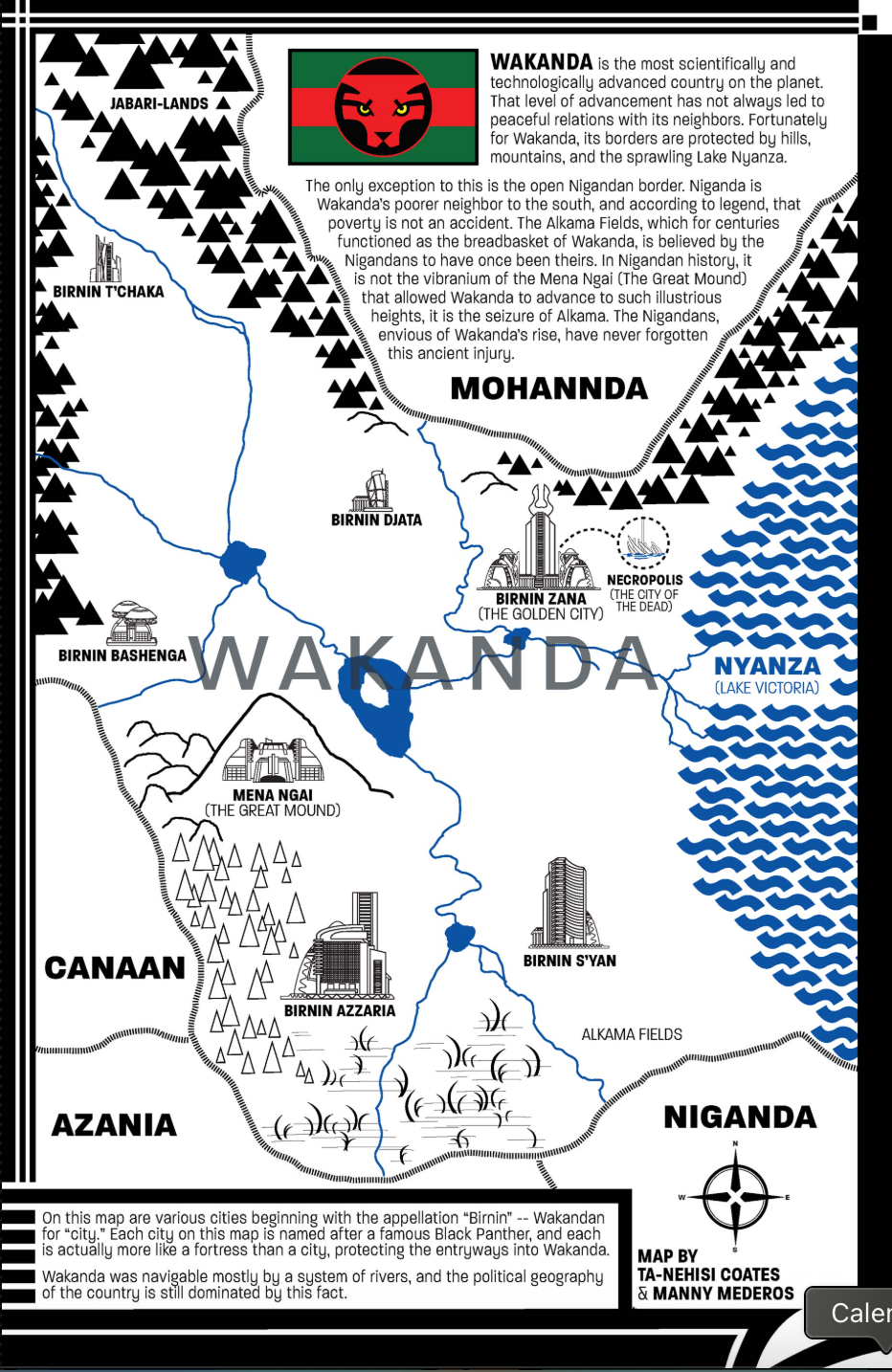
On the map of Wakanda, we learn that “Niganda is Wakanda’s poorer neighbor to the south” and that it is not poorer than its northern neighbor by accident. The description states, “The Alkama Fields, which for centuries functioned as the breadbasket of Wakanda, is believed by the Nigandans to have once been theirs.” While Wakanda points to vibranium as the source of its wealth and power, Niganda argues that Wakanda’s power and wealth arose from its “seizure of Alkama,” thus through the conquest of the fields from the Nigandans. This is importaant because it corresponds with Ramonda’s comment that every nation rises from a foundation of national lie that allows it construct myths about its past.
As well, Wakanda’s conquest of the Alkama Fields carries over Locke’s arguments in “Of Conquest.” He begins the chapter by writing,
Though governments can originally have no other rise than that before mentioned, nor polities be founded on any thing but the consent of the people; yet such have been the disorders ambition has filled the world with, that in the noise of war, which makes so great a part of the history of mankind, this consent is little taken notice of: and therefore many have mistaken the force of arms for the consent of the people, and reckon conquest as one of the originals of government. But conquest is as far from setting up any government, as demolishing an house is from building a new one in the place. Indeed, it often makes way for a new frame of a common-wealth, by destroying the former; but, without the consent of the people, can never erect a new one.
There is a lot to unpack here. First and foremost, when nations decide to wage war and participate in the conquest of others, the consent of the people, both of those citizens within the aggressor nation and those whom the nation attacks, do not get noticed in their opposition to the action. As well, while some may view conquest as “nation building” (one need only to look at the War on Terror here), it does not lead to the formation of a new nation or people. Rather, it leads to the decimation of a populace because it destroys the prexisting community for a new one, “without the consent of the people.”
We see the resistance to conquest and the elimination of one’s identity at various points in the Black Panther: A Nation Under Our Feet, including in the histories that the Griot relates to Shuri in the Djalia. At one point, the Griot tells Shuri about “the ancient Wakandan Duchy of Adowa.” In the past, “Adowa prospered,” with farmers, crafters, hunters, and others. Their renown spread far and wide, and they were happy, but others questions why “all the harms of the world breezed by Adowa.” Eventually, a group of “strangers arrived in the court of Adowa demanding tribute,” and the Adowa refused. The strangers sought to conquer Adowa because they viewed Adowa as weak and full of wealth.
The Griot, on the strangers’ views, echoes Locke. She telsl Shuri that the strangers felt that “[t]o the strong and to the warriors should go the bounty of every valley, for the warriors give of te body. Glory to them, the truly deserving.” The spoils go to the conqueror while the conquered remain to “ever dine on thistles and thorns.” Even though the Adowa lacked a military to resist the strangers, the Duke of Adowa knew that his people “would part with their lives before parting with the land under their feet,” so he devised a plan to trick the strangers. When they returned, they found everything empty, making them nervous, but, as the Griot says, “the drums talked avarice and the spears spoke self-regard,” thus calming the strangers’ fears. The strangers went to reap the bounty of their conquest, unaware of the Adowa’s presence. The Adowa attacked, turning the strangers from the hunters to the hunted.
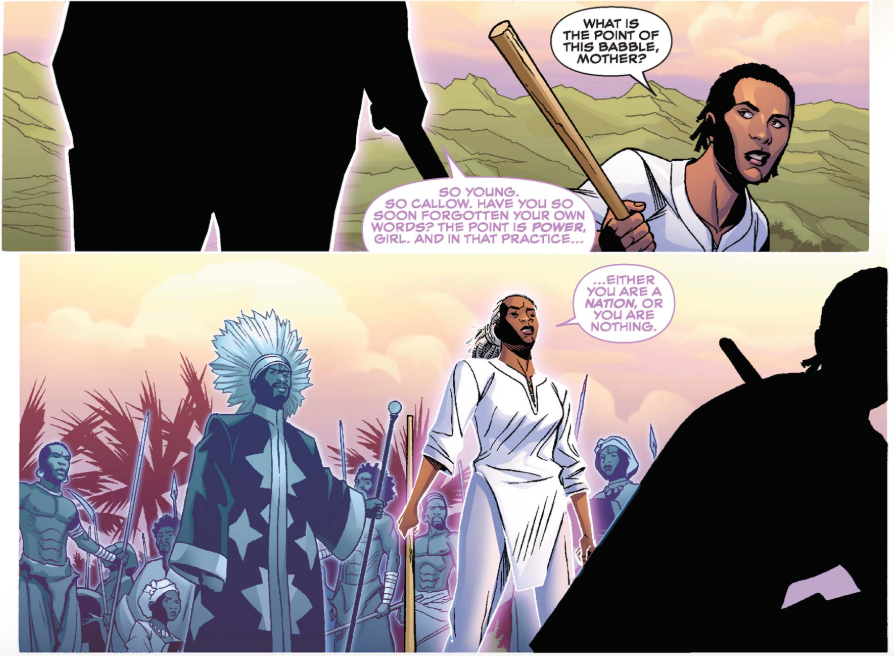
Following the story, Shuri asks the Griot “the point of this babble,” to which the Griot tells her, “So young, so callous, have you so soon forgotten your own words? The point is power girl. And in that practice, either you are a nation or you are nothing.” Adowa, as a nation, protected themselves against the aggression of the strangers. They stood strong as a nation against a force that only sought power and wealth from the conquest of others. The strangers acted immorally, and even if they succeed in conquering the Adowa, they would not have completely conquered them because the nation would stand strong. As Locke puts it, one nation that “unjustly invades another man’s right” through physical prowess can “never come to have the right over the conquered” because the conquered will continue to resist.
What becomes interesting in Black Panther: A Nation Under Our Feet is the fact that even though T’Challa faces a threat from within he must wrestle, even if not overtly in the series, with a history that also enacted violence on others. As Queen Ramonda tells Changamire, we cannot find “a single nation founded on truth and candor” that did not, at some point, engage in the conquest of another.
This is a recurring theme in the series and one I will pick up on, again, in the next post. Until then, what are your thoughts? As usual, let me know in the comments below. Make sure to follow me on Bluesky @silaslapham.bsky.social.

