
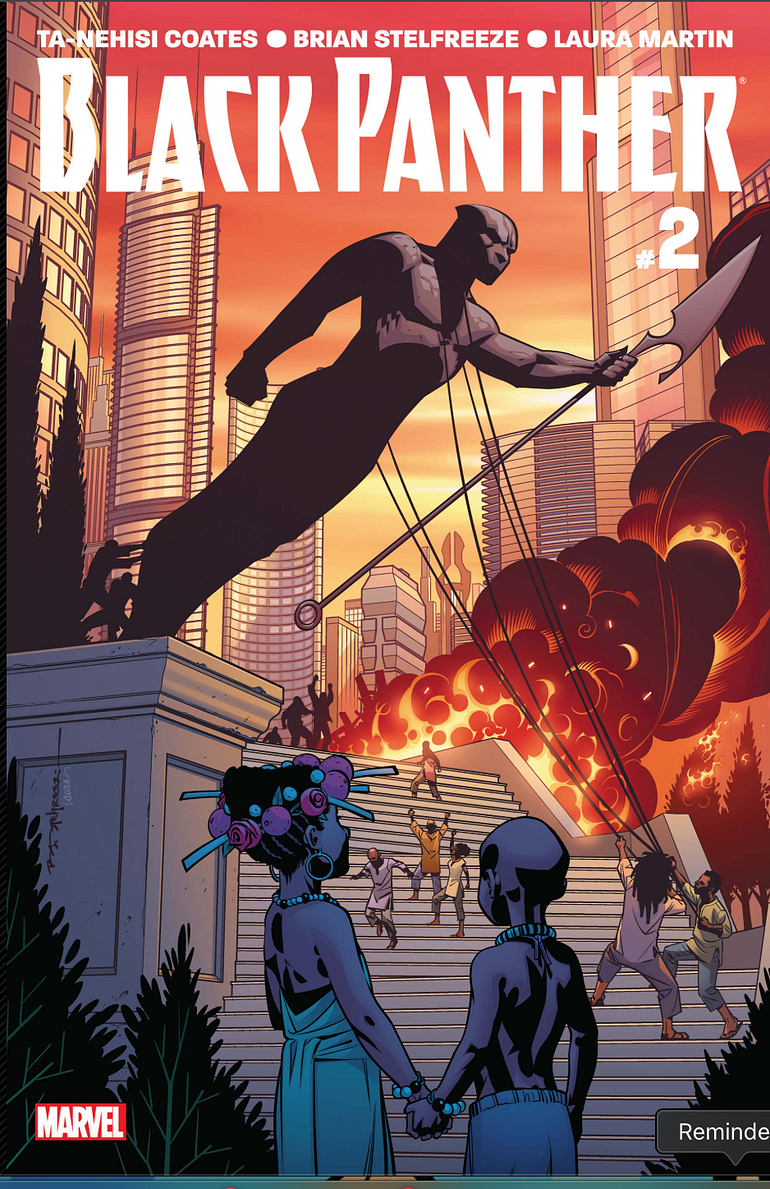
The more I read Ta-Nehisi Coates’ Black Panther: A Nation Under Our Feet, the more I think about what exactly Coates is doing within this narrative. On one hand, as Julian Chambliss and others have remarked, he’s carrying on Don McGregor’s work from the 1970s where McGregor used Wakanda as a backdrop to examine issues of leadership and governance. As well, Coates is expanding upon Christopher Priest’s and Reginald Hudlin’s runs from the late 1990s to the 2000s. Each of these moves away from the internal politics of McGregor’s run to more external threats to Wakanda, coupled with internal threats. What each of these runs have in common, though, is there engagement with revolutionary movements and with governance.
Last post, I started examining this theme in Coates’ run, specifically through Aneka’s condemnation and Queen Ramonda’s comments that even though Aneka “morally” did the right thing she flouted Wakanda’s laws and must be punished. This thread appears in two specific scenes that I want to look at today. The first takes place in issue #2 when Tetu returns to his former teacher’s classroom. Tetu enters as Changamire, a Wakandan philosopher, concludes a lesson. We see him, over the course of five panels walking throughout the class, sitting next to students, as he recites a passage from John Locke’s Two Treatises of Government. Changamire quotes,
The injury and the crime is equal, whether committed by the wearer of a crown or some petty villain.. . . Great robbers punish the little ones to them in their obedience, but the great ones are rewarded with laurels and triumphs because they are too big for the weak hands of justice in this world, and have the power in their possession, which should punish offenders. What is my remedy against the robber, who so broke into my house?
This quote appears in the section of Locke’s treatise entitled “Of Conquest.” Within this section, Locke points out that a nation who conquers another nation can “never come to have a right over the conquered” just as “robbers and pirates” don’t have a right over those they attack. He continues by states that the nation and others can never fully rule those whom they use “unlawful force” to coerce into obedience. This is the section that immediately precedes the quote that Changamire relates, and it calls us back, again, to Ayo and Queen Ramonda’s conversation about Aneka’s condemnation.
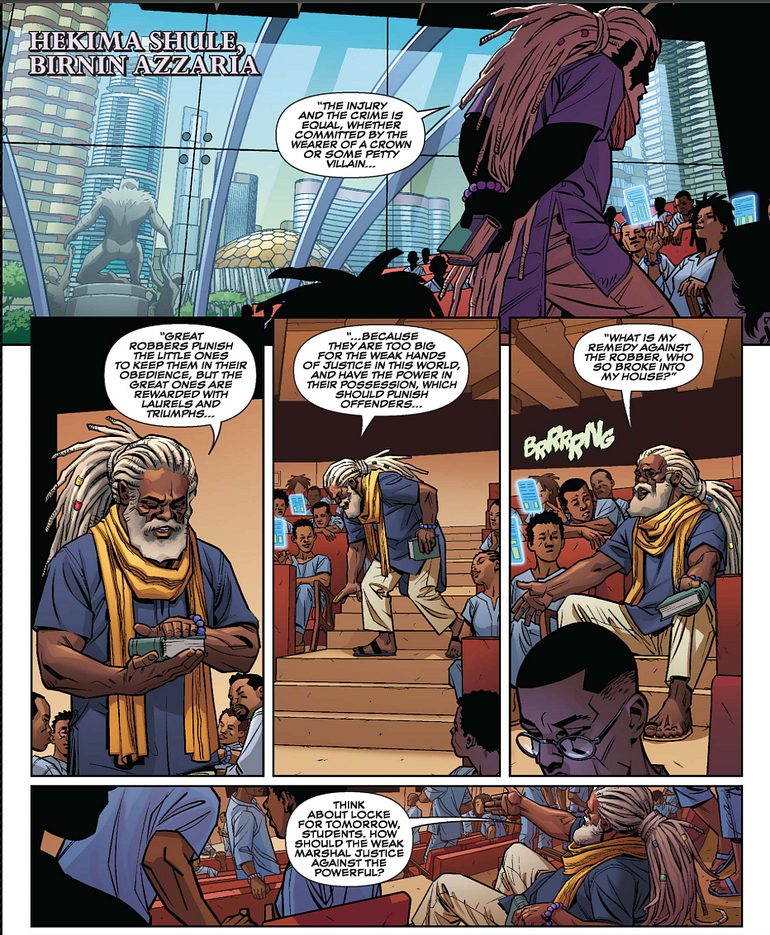
Within the sequence where Changamire quotes Locke, we see him holding the book in his hands as he walks around the classroom. In the first panel, he grasps it behind his back, and in the next, he places it in front of him, looks down at it, and places his left hand on top of it, as if blessing it, treating it with reverence. This moment stands out because it is also when he states that “great robbers punish little ones” to maintain their power, and through that punishment, they receive glory. Changamire is contemplative here, thinking about Locke’s words not just for the class but for himself.
He ends the class by having the students think about one final question for the next session: “How should the weak marshal justice against the powerful?” This question lingers as Tetu enters the room and asks his former teacher how one can “do such a thing.” Tetu comes to Changamire seeking his assistance because Changamire influenced Tetu’s thinking about revolution and action against injustice. Changamire views Tetu with suspiscion, especially with the people he now associates with in his revolutionary actions. To this, Tetu simply responds, “What I do, I do for a better country.”
Their conversation moves into questions about thought and action, and whether or not one can exist without the other and vice versa. Changamire knows that Wakanda needs fixing to provide a future for all, but he does not see that future in Tetu’s actions, even though Tetu tells him. “I have founded an order that fights to protect Wakandans while our king slaughters them.” Tetu them challenges his former teacher to answer the question that he posed to his class, and Tetu goads him on by telling him, “But staying here, shut up in thought and abstraction — that is unconscionable. How long will they plunder our people while we stand aside and look?” Tetu questions Changamire’s ideas and his loyalty to them. While Changamire espouses Locke and proclaims that the king and the robber should be treated equally in regard to justice, what does he do to ensure that that actually happens? For Tetu, Changamire shuts himself up in his classroom, with his ideas, unable to truly answer the question, “What is my remedy against the robber, who so broke into my house?”
Tetu and Changamire’s exchange highlights a key tension that Coates explores in the series in relation to action and poltical/philosophical thought. It is one thing to recognize injustice and to espouse a desire to remedy that injustice for a better future. However, what does it say when an individual’s desire stops there? What does it saw when an individual knows these things but refuses to act in any way? I do not necessarily mean when a person refuses to act as a revolutionary like Tetu.
No, I merely mean what happens when someone sees all of this and doesn’t do, what they can, to help alleviate suffering and push for change? Those acts don’t have to be grand. They can be volunteering at local organizations They can be donating to local organizations. They can be supporting, in whatever way possible, those on the front lines pushing for change. They can be speaking out even when you feel afraid to do so because you fear what others might think. They can be conversations with individuals. They can be consciously choosing who or what to support with your time, money, and energy. The point is that, as Locke and Chagamire state, no difference exists between the actions of the king and the robber, but one has the power of the state and empire behind them. So, when that power acts unjustly and immorally, how do we respond? That is Tetu’s ultimate question. What will Changamire do? What will we do?
In the next post I’ll get to the next scene that I want to discuss within Coates’ series that deals with these questions of governance and justice. Until then, what are some of your thoughts? As usual, let me know in the comments below. Make sure to follow me on Bluesky @silaslapham.bsky.social.

