
When I was thinking about my Who is the Black Panther? syllabus, I debated on which runs to include. I knew I could only do two runs, if that, and I knew that I wanted to include Don McGregor’s Jungle Action run because of its thematic focus and also because of Billy Graham’s and Rich Buckler’s amazing artwork. As well, I debated about whether or not to include Christopher Priest’s 1998 run, simply because I find it extremly engaging and important from a publication standpoint. However, I didn’t choose Priest’s run; rather, I went with Ta-Nehisi Coates’ 2016 run, partly because I wanted to end with Ryan Coogler’s 2018 film, and Coates’ run correlates, really well, with Coogler’s record-breaking movie.
I’m glad I made this choice because Coates’ run thematically connects with McGregor’s 1970s run because each deals with issues of governance and leadership. In each run, some fifty years apart, T’Challa deals with internal threats to the throne and his leadership. Even though he strives, in every sense, to be a compassionate leader, putting his people at the forefront of his actions, he doesn’t always succeed in being able to provide his people with the things they need. The most insightful moment in McGregor’s run on T’Challa’s self-doubt as a leader comes in issue #15 when Salamander K’Ruel captures him and ties him to a cactus.
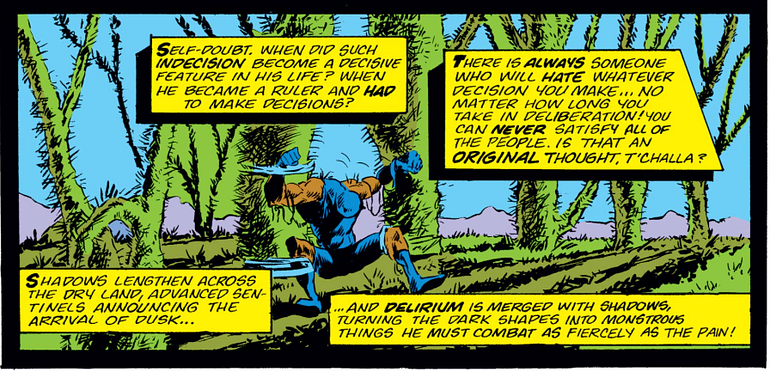
As he struggles to escape, the narrator peers into T’Challa’s psyche, giving us insight into the struggles he endures as the one who sits on the Wakandan throne. The narrator asks, “Self-doubt, when did such indecision feature in his life? When he became a ruler and had to make decisons? There is always someone who will hate whatever decision you make . . . no matter how long you take in deliberation! You can never satisfy all the people.” This moment epitomizes so much of what a thoughtful leader endures when making deicions that will impact those around them. No matter how long the individuals deliberates, some will not be satisfied, even if the decision ultimately benefits them and makes their lives better.
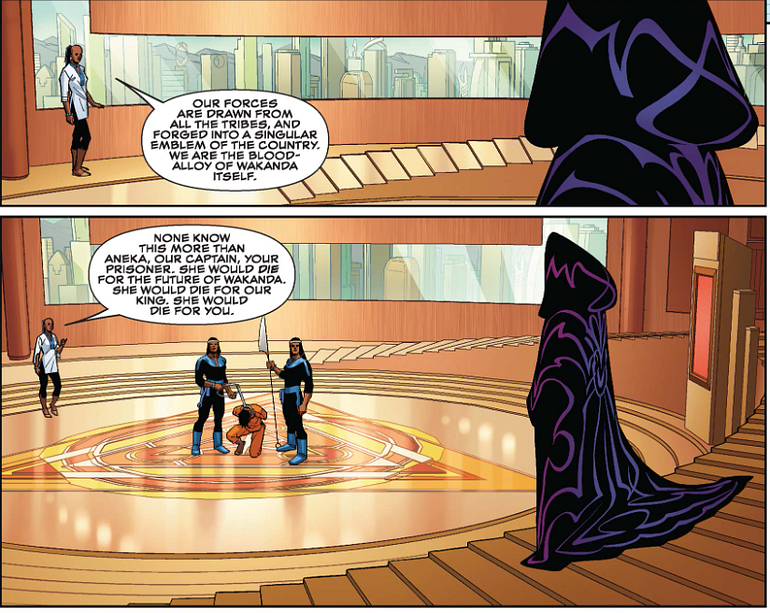
Coates deals with a similar theme in his run, but while McGregor firmly keeps T’Challa on the throne, thus solidifying him as a monarch, Coates has the rebels challenge T’Challa to move away from a monarchy towards a democracy where each individual has a voice and a choice in their decisions. This tension between a benevolent ruler in T’Challa and the call of the people for their voices to be heard lie at the core of Coates’ Black Panther, and it they come to the forefront in the very first issue when Ayo pleads for Aneka’s life.
Even though Aneka is a Dora Milaje and, as Ayo says, thus embodies “the nation,” she has been condemned to die because she went outside the “law” and murdered a chieftain who had been abusing women. Ayo tells Queen Ramonda, “The chieftains outrages upon the girls of his village were known. Yet his lechery was unopposed. Aneka spoke to him as fathers and brothers should have spoken long before. And when she was not heeded, she did as the honor of Wakandan fathers and brothers always demanded.” Before she even killed the chieftain, Aneka spoke with him, as the men in his life should have, about his abuse of the girls and women in his village, but he did not listen. At this, Aneka enacted justice against the man, executing him for his crimes, and thus condemning herself to death.
While Ayo pleads to Queen Ramonda for Aneka’s life. the queen listens, intently. Ayon begs the queen, Spare her, mother. Spare her the bastard sanction of men whose honor is ostentation, whose justice is deceit.” Ayo points out that the chieftain flouted his wealth and power, his ability to escape justice for his actions. Due to his wealth and his gender, the powers that be failed to act and punish him for his abuse, and since the powers did not act, Aneka did. To Ayo’s pleas, Ramonda says, “No.” She goes on to tell Ayon, “You have said it yourself: villainy overwhelms us. And your answer to this villainy is to turn the upholders of Waknadan law into its flouters.” The queen essentially tells Ayo that since her and Aneka, as part of the Dora Milaje, must uphold Wakandan law, Aneka’s actions do nothing but flout it, making them above the law just as the chieftain ostentatiousness and deceitfulness.
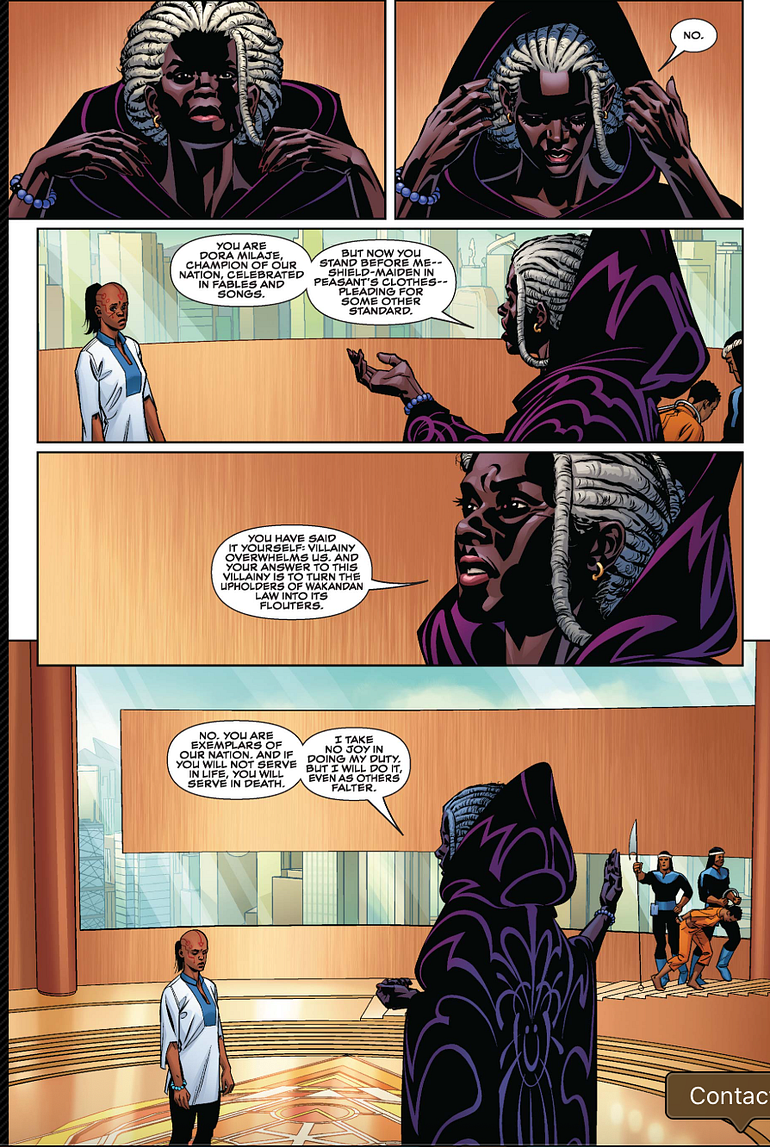
Queen Ramonda agrees that the chieftain’s actions were wrong, but she also thinks that Aneka’s actions, no matter how justified, crossed a line. This moment makes me think, specifically, of Henry David Thoreau’s and Martin Luther King, Jr.’s discussions of just and unjust laws. In “Resistance to Civil Government” (1848), Thoreau asks, “Unjust laws exist: shall we be content to obey them, or shall we endeavor to amend them, and obey them until we have succeeded, or shall we transgress them at once?” In answer to his his query, Thoreau states that individuals who live under unjust laws typically “think that they ought to wait until they have persuaded the majority to alter them” because the change would be worse than the law itself. Rather, they should advocate to chnage the law, to show the powerful that the people don’t adhere to it.
Likewise, in his “Letter from Birmingham Jail,” which he wrote from prison for protesting during the 1963 Birmingham campaign, King points out that two types of law exist: “just and unjust.” He notes that if the law is just one should obey it because we have “a legal” as wee as “a moral responsibility” to do as such. However, when it comes to “unjust laws,” individuals have “a moreal responsibility to disobey” them because they harm others. He goes on to give the example of unjust laws in Nazi Germany and unjust laws supporting segregation and discrimination.
Both Thoreau and King point out that when a law harms individuals and protects the powerful, it must be challenged and individuals have a moral obligation not to obey the law. With Aneka, we do not get the Wakandan law, but we do get that she came forward to confront the chieftain when the powerful men refused to do so. She spoke to him, giving him the chance to change and admit his crimes, but he refused, so she protected the girls and the women by eliminating him. This thread continues throught Coates’ Black Panther and we see it most forcefully in Changamire’s lecture in issue #2 which I’ll write about next post.
Until then, what are some of your thoughts? As usual, let me know in the comments below. Make sure to follow me on Bluesky @silaslapham.bsky.social.

