
Speaking about writing Black Panther for Marvel back in 2016, Ta-Nehisi Coates, when asked about the challenges of writing comics, responded by saying, “It’s a very backwards — in my mind — process of writing. I mean, it’s the process of writing screenplays, of writing comic books, but it’s nmot the process of writing journalism.” Writing comics requires one to think about multiple aspects of the text at every given moment and how they work on the page. The writer and illustrator, working together, must layout the images, handle the pacing, and place the text within the images to move the story forward. It’s a medium, that like journalism or the essay, requires practice and work.
During my Who is the Black Panther? course, I showed students the interview with Coates and his comments about writing comics as oppossed to writing essays. I mentioned to them that even though I am not asking them to write a comic in this course I have had students create comics scripts or full-fledged comics in various classes, and that process has been very rewarding for the students because it gets them to think about the ways that different mediums work when conveying information and telling stories. Even though we had broken down various panels and pages from Black Panther’s appearances in Jungle Action, I took Coates’ statement and had student think about two specific moments from issues #1 and #1 of his Black Panther run.
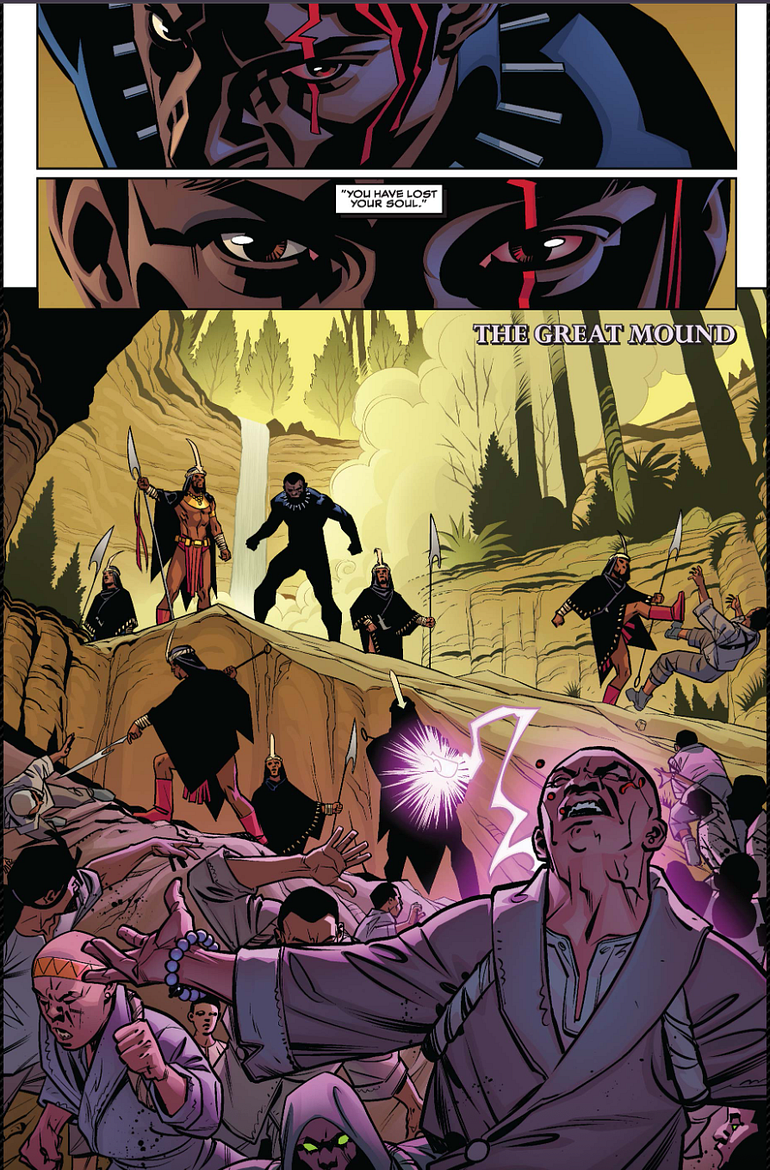
The first sequence appears at the very beginning of issue #1, on the second page. It is a three panel page with T’Challa’s face, zooming in on his eyes, in two horizontal panels at the top and a larger splash panel at the bottom showing Wakandan soliders, under the control of Zenzi, attacking Wakandan citizens at the Great Mound. Over the second panel, which focuses on T’Challa’s eyes, he states, “You have lost your soul.” The page depicts T’Challa, as a ruler who wants to help the miners, witnessing his soldiers attacking the miners, as he stares on in as the massacre occurs.
At the end of the trade paperback edition of Black Panther: A Nation Under Our Feet, there is a brief page entitled “process and development” which has Coates’ direction for this page and also Brian Stelfreeze’s process from his initial sketch to the finished product. When talking about this, I drew the students’ attention to Coates description because he adds things that they would not necessarily have thought of when just looking at the page and reading the text. Coates writes,
PANEL 1
Big splash page. Zoom out and see several members of the Wakandan army firing wildly into a crowd of charging miners. T’CHALLA kneels, wounded, amidst the chaos. The sense should be that the soldiers have lost control of themselves. We want to allude to the Boston Massacre. This is the onset of a revolution — soldiers firing into a peaceful crowd.
V/O CAPTION
“You have lost your soul.”
Looking at this part of the script, I pointed out two things to the students. The first is that in the script Coates says that T’Challa “kneels, wounded,” but in the final page, he stands in an elevated position, looking down at the attack. This moment shows the move from initial thought to final product, an act of revising and changing that occurs in any creative process, this time in the collaboration between the writer and the illustrator.
The other point that I drew the students’ attention to was Coates comment about the scene alluding to the Boston Massacre. The image doesn’t look, in any way, to me like the painting and images we have seen of the Boston Massacre, including Paul Revere’s 1770 engraving. Those images show the massacre from the side, and in the Black Panther page, we see the soldiers shooting in the background towards the miners in the foreground. Visually, it doesn’t match up, at least with what many would find as a point of reference for teh Boston Massacre. Thematically, though, it does because just as the British soldiers, as representatives of the state’s power, shot the colonists, thus sparking the rebelling, the Wakandan soldiers, as representatives of the state’s power, shot the miners. I pointed this out to students to highlight how creators craft stories and the myriad of influences that go into the production of a text or project.
The next sequence takes place in issue #2 as T’Challa attacks one of Zenzi’s compounds in the Nigandan border region. As T’Challa attacks the guards, he thinks about what his mentor, his uncle S’Yan, told him about being a ruler. S’Yan said, “Power lies not in what a king does, but in what his subjects believe he might do.” Thinking about this, T’Challa understands that a king’s power resides not in might but in the myths and mystique surrounding the king, in what the king could do if he so desired to do it. With “[e]very act of might,” T’Challa thinks. the king’s power decreases because it “diminished his mystique.”
Over a six-panel page, we see a good representation of what Coates mentions when asked about writing comics. We see the juxtaposition of words and images, and the ways that each work together to convey meaning and movement. In order to make this work, Coates had to think about what would appear on the page, or at least a rough idea, broken down into multiple panels over the course of one encounter with one of Zenzi’s men on one page.
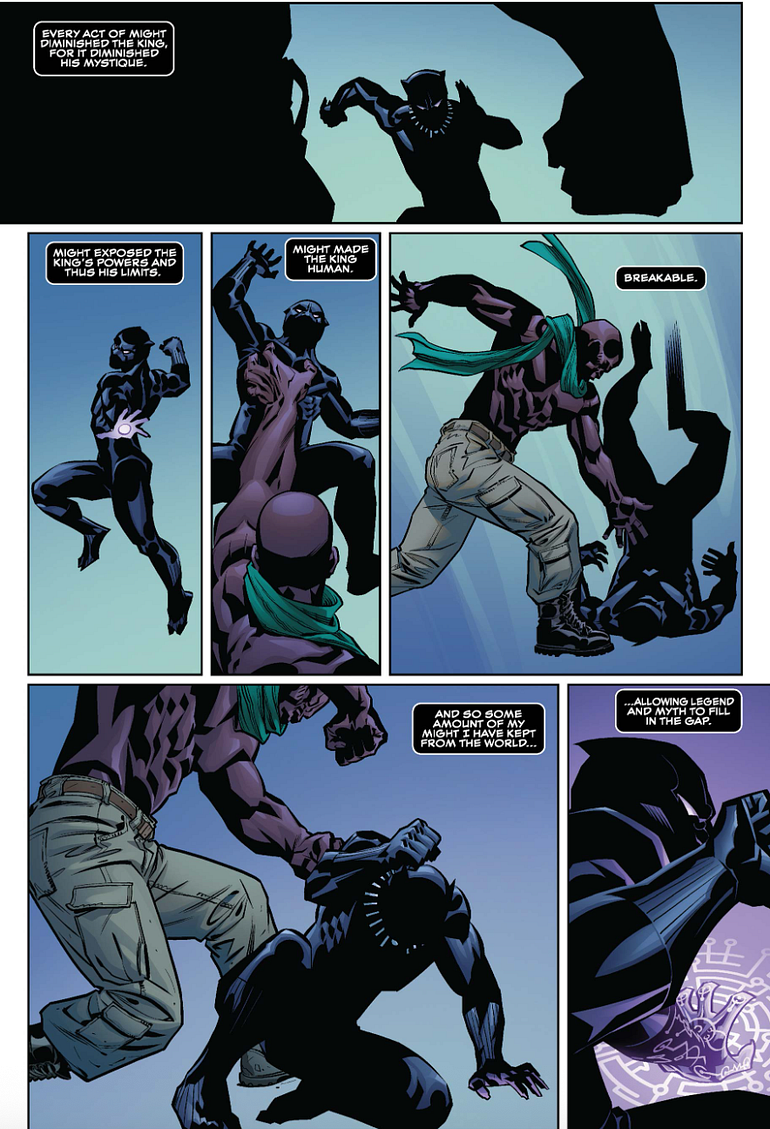
The thrust of the sequence starts in the middle three panels. In the first, we see T’Challa, mid-jump, headed towards us as he prepares to punch. He thinks, “Might exposed the king’s powers and thus his limits.” Here, we see a visual representation of T’Challa’s might, his physical power, but remember that he says might does not a ruler make. The next panel sees T’Challa failing as the soldier grabs him by the neck. Here, T’Challa thinks, “Might made the king human.” When the king shows his might, he loses his mystique and becomes a mere mortal. The final image in the middle shows the soldier slamming T’Challa to the ground as T’Challa thinks, “Breakable.” When he becomes mortal, he can be broken. This sequence shows the ways that words and images work together, and Coates had to think, consciously, of crafting it in this manner.
The final two panels carry along the same path. In the first, we see T’Challa with his hand to his face shielding himself from the soldier’s blows, as he thinks, “And so some amount of my might I have kept from the world . . .” The final panel shows T’Challa charging up his suit as he finishes his thought: “. . . allowing the legend and myth to fill in the gap.” T’Challa, over the course of these five panels, has highlighted S’Yan’s advice and shown the ways that might and mystique function for a king.
The entire sequence shows the process of writing comics. It shows that in order for the story to convey an understable meaning to the reader the images and text must work in unison, playing off one another. To do this, the writer has to think about the images as they write the script because if they don’t think about the images in relation to the text, it could lead to a convoluted mess.
There are, of course, countless other pages and series I could use to highlight all of this, but these are fresh in my head because I’m teaching them right now. What are some of your favorite sequences? As usual, let me know in the comments below. Make sure to follow me on Bluesky @silaslapham.bsky.social.

