
Last January, I picked up the G.I. Joe Compendium Volume 1, which contains the first fifty issues of the series from March 1982 to May 1986. As a kid, I didn’t collect comics, but when I saw a G.I. Joe comic or a Transformers comic on the rack at a grocery store, I’d pick it up. The compendium has been the first time I’ve read these comics in order, and as I read, I couldn’t help but think about our current moment, from Stalker talking about everyone having a right to their own voice and choices in a democracy to the interrogation of the rise of fascism through Cobra Commander and his populist rhetoric. While all of this stood out, one seemingly innocuous panel, from issue #32, “The Mountain!”, really caught my attention.
The panel shows the Soft Master, one of the ninja masters who taught Snake-Eyes and Storm Shadow, assisting Sprit and Airborne after a confrontation with Destro and Firefly in the Sierra Nevada mountains. As the Soft Master patches up Airborne’s leg, the wounded Joe asks him why he returned Destro’s and Firefly’s guns, especially after they tried to kill Airborne, Spirit, and the Soft Master. The Soft Master tells Airborne that the guns only have two bullets, then he proclaims, “Guns do not covet your wealth, seek revenge or justify their actions with righteousness. Fear not the weapon, but the man who wields it.” The Soft Master’s words seem very reminiscent of the claim, “Guns don’t kill people, people kill people.” While individuals can kill others with other weapons, guns have a lethality far greater than say a knife, and while guns are merely tools, requiring an agent to implement them, it is, as the Soft Master puts it, “the man who wields it” that one should fear because the man who wields it turns it upon their fellow citizens.
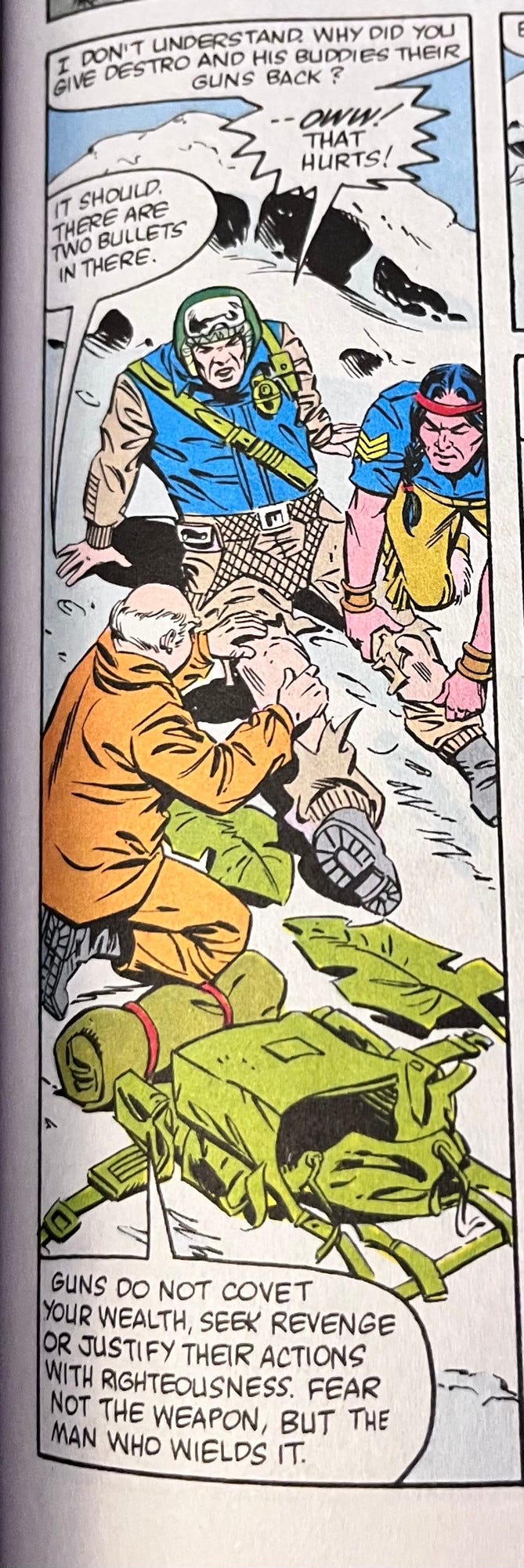
The Soft Master is not wrong, of course, that the “man who wields it” enacts the violence, nor is his wrong that guns do not covet money, look for revenge, or use righteousness to justify their actions. People do these things. The issue, though, arises with the access to guns, the access to weapons that, in the case of mass shootings, homicides, and other incidents, exist for the sole purpose of maiming and killings individuals, not animals for sustenance or protecting one’s homestead. We see this is the research. According to Everytown for Gun Safety, in discussing the claim that “Guns don’t kill people, people kill people,” “People with guns kill people, and more efficiently than people without guns. The US gun death rate is 13 times that of other high-income countries.”
Looking at the panel with the Soft Master from 1985, my mind immediately went to the opening of Pornsak Pichetshote and Javier Rodriguez’s Dead Boy Detectives #4 from 2023. The issue focuses on Jai Sirkul, one of the Thai ghosts that appears under mysterious circumstances in Los Angeles. At the beginning of the issue, he details the stereotypes of Thailand and the fact that the “hospitals are better than America’s and cheaper.” Jai’s parents moved back to Thailand when she was young, but later they told her they were moving back to American because that was where she was born. Jai is reluctant, pushing back against her parents and telling us that even though Thailand isn’t perfect people there “are trying to change things” while people in the United States have given up, specifically in regard to regulating one’s access to guns.
As a ghost and looking at herself in the bathroom mirror at a hospital, points out that when individuals care they seek to change things for the better. She asks, “Cuz what else do you do when you care?” America has given up, she proclaims. “They teaching fucking drills on what to do when shooting sprees start,” Jai thinks, before asking, “And what do the adults do?” Do they listen? No. Do they change anything? No. Instead, she says, they “just talk talk talk about how ‘Everything’s so complicated’” while kids die at the hands of those who wield the guns, just like Jai when a boy at her school shot her because she told him she was not interested in him.
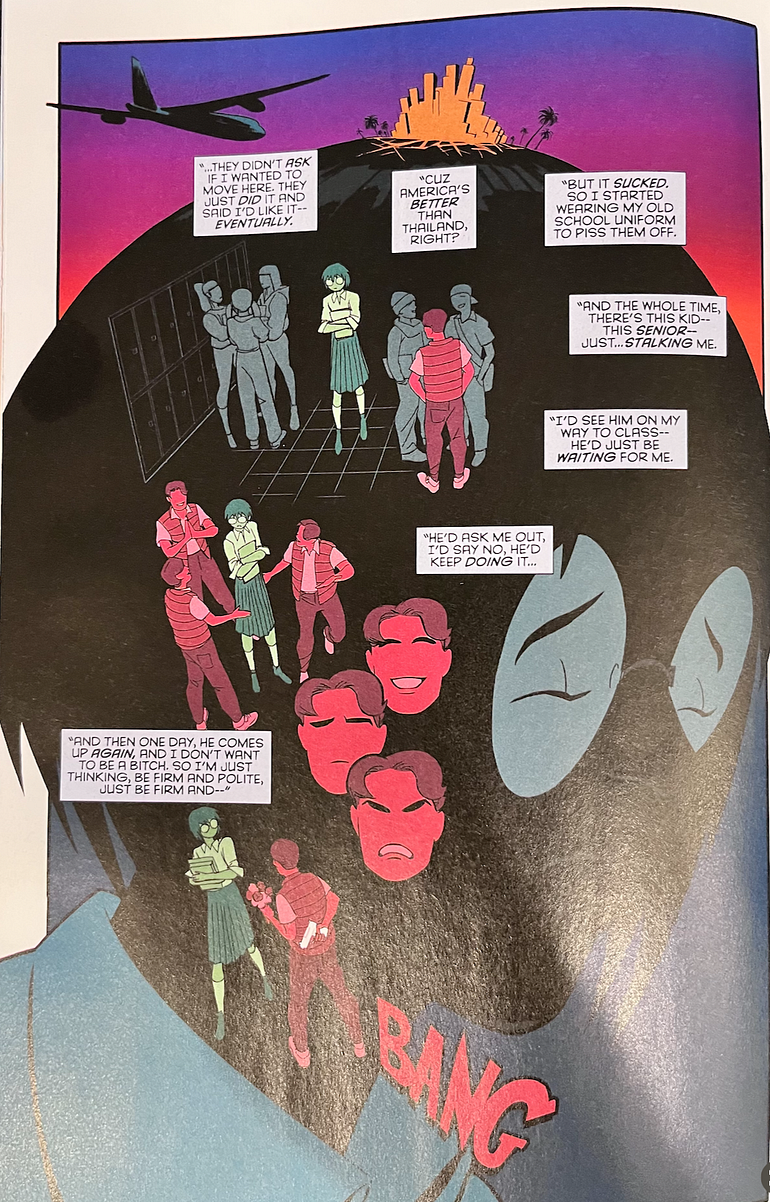
The page depicting the boy shooting Jai is powerful. Rodriguez shows her head, in shilouette, with a plane flying towards Los Angeles, illuminated by the sun, at the top and images of Jai in school, feeling lonely, getting teased, and the final image at the bottom of the boy, with flowers in one hand and a gun behind his back, getting ready to shoot her when she rebuffs his advances. She then tells those with her, “He’d never have gotten that gun in Bangkok. But here, everyone just gives up. Adults . . . they give up.” She reiterates that individuals, instead of pushing for change to protect those they love, simply give up, refusing to speak out and merely accepting the violence of those who wield the guns as inevitable when, in actuality, it’s not inevitable at all.
The next panel shows a closeup of Jai’s face as a tear streams down her right cheek. She tells everyone how she told her parents and teachers about the boy, but no one listened. Rather, they blamed her, telling her she “Was being dramatic,” thinking they knew better than she did even though she was the one who the boy stalked. They did this, Jai says, “because they don’t want to admit they’ve stopped trying.” If they have to admit that they stopped trying, they would have to admit that none of this is inevitable and that things could change, but that would require hard work. Jai’s statements counter the “thoughts and prayers” sentiments, the hollow words that people always resort to when mass shootings occur, as if thoughts and prayers will change the access individuals have to firearms and them wielding those firearms to cause harm. Thoughts and prayers don’t account for the 500 million civilian-owned guns, basically 1.5 firearms for every citizen in the United States, owned by citizens. The United States, as well, accounts for roughly 46% of the civilian-owned firearms in the world.
All of this makes me think about Maynard James Keenan’s lyrics from A Perfect Circle’s “TalkTalk.” Keenan sings, “Sit and talk like Jesus, Try walkin’ like Jesus” because thoughts and prayers don’t work. He continues, “Don’t be the problem, be the soultion.” Push for change instead of accepting something that we should not accept. Should our kids have to do active shooter drills? Should we, whenever we go anywhere like the movies, church, or a mall, have to plan our escape route if someone enters and starts shooting? Should there be a $3 billion industry around active shooter preparedness? Zackary Canepari and Jessica Dimmock’s Thoughts and Prayers tackles that final question, and middle school siblings Quinn and Kannon Davis’ comments in the documentary are gut wrenching. They, like Jai, ask why we don’t change anything. As well, during one moment, Quinn talks about having a “go-bag” containing survival items on her at all times, and this revelation shocks her brother Kannon who begins to cry because he did not know the level of fear she experiences on a daily basis. Quinn says, like Jai, that people care more about their guns than their kids, and she tells us, “People don’t listen to kids.”
I grew up with guns. I play first person shooters. I have no issue with guns. I have issue with a society that does not regulate guns because we have seen, countless times, the fact that what easy access to firearms leads to in our society. We see the emotional toll it takes on everyone, most notably our children. Is this what we want? Is this what we want our children to endure everyday? Is this the mark of a civilized society that provides access to “life, liberty, and the pursuit of happiness” for all of its citizens?

