
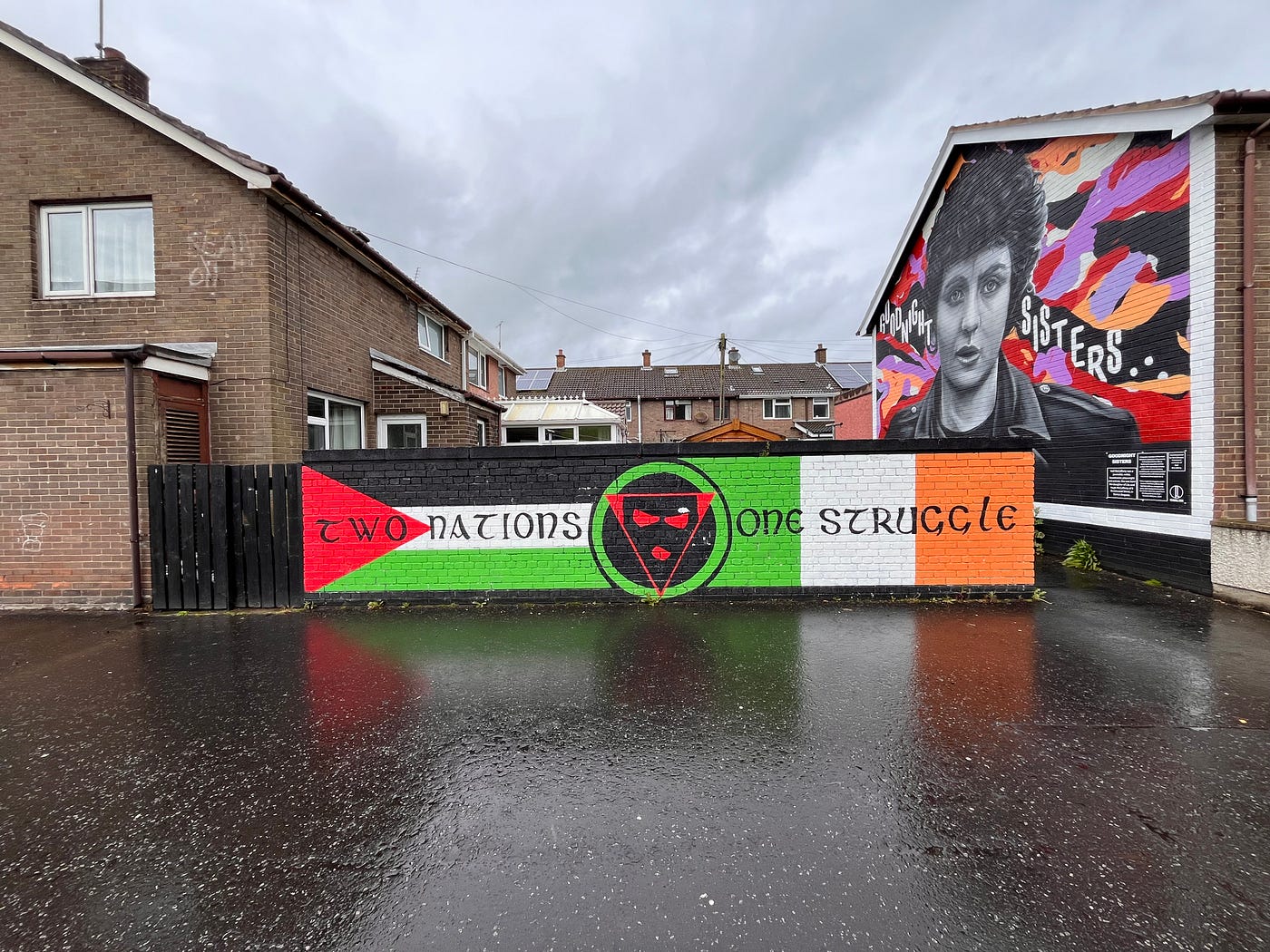
When preparing students for our trip to Belfast, I told them to pay close attention to the murals, graffiti, stickers, and the language that they would encounter during our walks through the cities. Specifically, I told them to pay particular attention to the ways that republicans present solidarity with global struggles around the world, specifically with the Palestinian struggle. So, before we even arrived in Belfast, students primed themselves to be on the lookout for these connections, even though they did not totally understand why republicans would express such solidarity with other groups across the globe.
One student, at the end of the trip, noted that they noticed all of the murals and language, but the student still could not totally comprehend the connections, basically saying that they thought the connections were not warranted because each group experienced different and disparate traumatic events. I pointed out to the student that the republicans did not claim a one to one comparison between their struggle against the British government and the Palestinian struggle. Rather, I highlighted for the student that the republicans, through their own experiences of living under a colonial system that sought to suppress their identity and existence, understood the Palestinian struggle against a colonial system that sought to do the same to them. As well, I pointed the student to one of the lecture we attended on Anna Burns’ Milkman where the lecturer referred to Michael Rothberg’s multidirectional memory, where “different histories of extreme violence confront each other in the public sphere.”
Thinking about the long history of struggles in Ireland and in Palestine, it is no surprise that we see solidarity between these two movements for freedom. Both existed under British colonial control, with Palestine moving, in 1948, to Israeli settler colonialism which we see through the displacement of hundreds of thousands of Palestinians in 1948 during the Nakba and today in the expansion of settlements into Gaza and the West Bank. We see it through the plantation system in Ireland that began in the 1600s with Ulster Scots arriving to the island and setting up plantations that limited the opportunities of Irish inhabitants, and this became exacerbated, of course, with the denominational dimensions when Catholics were suppressed at the polls and in the workplace.
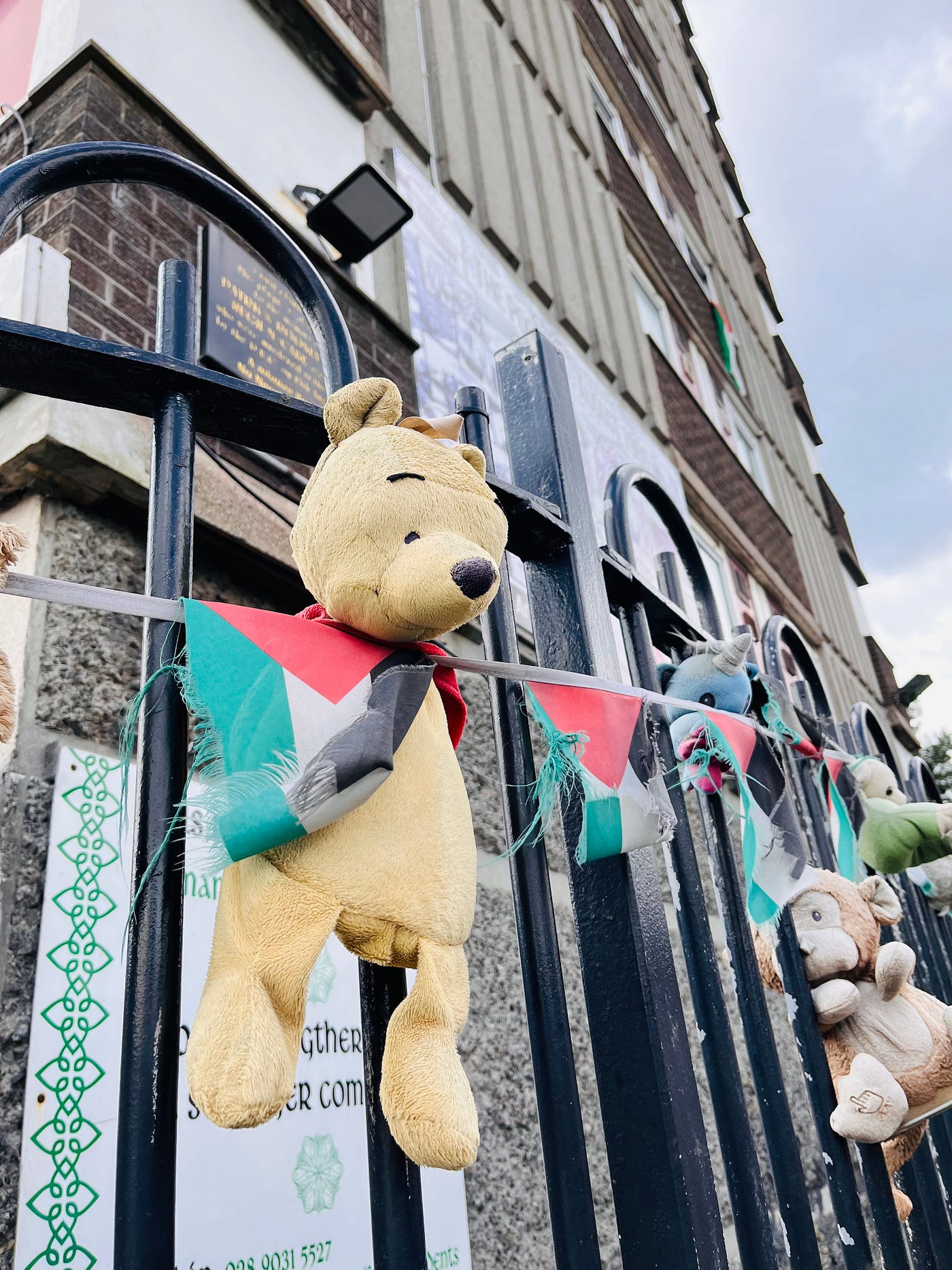
With all of this in mind, it came as no shock when our Falls Road tour guide James, a republican, began the story of the Troubles by stating that Britian colonized Ireland and treated the island as a colony. By doing this, James pointed out that the republican fight took place not against individuals with different religious beliefs but against a government that sought to oppress them. During James’ tour, we stopped at the Palestinian Wall on Divis Street, a mural which directly shows solidarity between the republican and Palestinian struggles, from the murder of children to the political resistance of hunger strikes taken up by individuals such as Bobby Sands in 1981 and Khader Adnan in 2023. Outside of Divis Towers where, in 1969, the Royal Ulster Contuabulary murdered Patrick Rooney, a nine-year-old, in his bed, individuals had put up stuffed animals and Palestinian flags on the fence, again linking the two communities and struggles together in solidarity for another, and highlighting the more than 50,000 children killed or injured since the start of Israeli Military operations in Gaza following the Hamas attacks in October 2023.
One cannot, of course, equate these atrocities based on numbers since the 70,000 Palestinians killed in Gaza since 2023 far surpasses the 3,720 and 47,500 people injured during the Troubles. However, we do not need to think about these connections in that manner. This should not be a comparison that would lead us to a competition of suffering. It’s not a trauma olympics. The purpose of thinking about the Troubles in relation to Palestine stems from the fact that we cannot think about events our ourselves in isolation. Everything, on some level, connects to something else. Everything contains echoes of past atrocities and warns us against future atrocities, but when we think about them in isolation, we become blind. We become numb. We say, “That’s them. That’s not us and will never be us.” It causes us to focus on the speck in our neighbor’s eye while ignoring the plank within our own eye.
I am not sure if the students noticed our interaction with Billy McVeigh in Derry as we got ready to go the Free Derry Museum. Right outside the museum, one can see a mural of McVeigh, 17 at the time, standing defiantly in front of a British Saracen during the 1971 Battle of the Bogside. We encountered McVeigh outside the museum, and he talked to us some, pointing the mural and telling us a little about its history. As well, he asked us if we wanted to take a picture with him in front of the mural, and we said we would like to do just that. When we took the picture, he raised his fist defiantly and said three phrases: “Free Palestine. Down with the king. End genocide.” These three phrases summed up so much of what we saw as we walked through Belfast, Derry, and elsewhere. The phrases pointed to the universal struggle from freedom and the claiming of one’s own identity and life removed from colonial and imperial systems that seek to squash those freedoms and identity. The three phrases encapsulated the ways that once one realizes the struggles the others, once one opens up to the world and views it from outside oneself, then solidarity spreads outward, linking people and their struggles together, uniting them across the globe. The republican movement took cues, in the 1960s from the Civil Right Movement in the United States which took their cues from Mahatma Gandhi and his philosophy of Satyagraha in the early 1900s against British colonial rule in India. With those threads, one should not be amazed at republicans looking across to Gaza and seeing connections, in forming bridges and standing in solidarity with Palestinians.
I can see how it became hard for a student to see all of this. It takes time for us to learn to see beyond ourselves and to see the ways that everything we see around us connects to everything else. It takes time to form these links because these links don’t exist as straight binaries with one side or the other. They exist as webs, with a multitude of interconnecting threads that we must tie together in order to make sense of it. We also know that these links of solidarity anger some because once individuals realize their shared struggle, they become stronger. One need only look at the case against Mo Chara from Kneecap on this front. One need only look at a magazine I picked up in Belfast entitled The Olive Tree to see these links. I plan to, in the near future, write some about this magazine, which contains pieces from both Irish and Palestinian writers and muralists, drawing these connections even tighter, in the future.
For now, what are some of your thoughts? As usual, let me know in the comments below. Make sure to follow me on Bluesky @silaslapham.bsky.social.

