
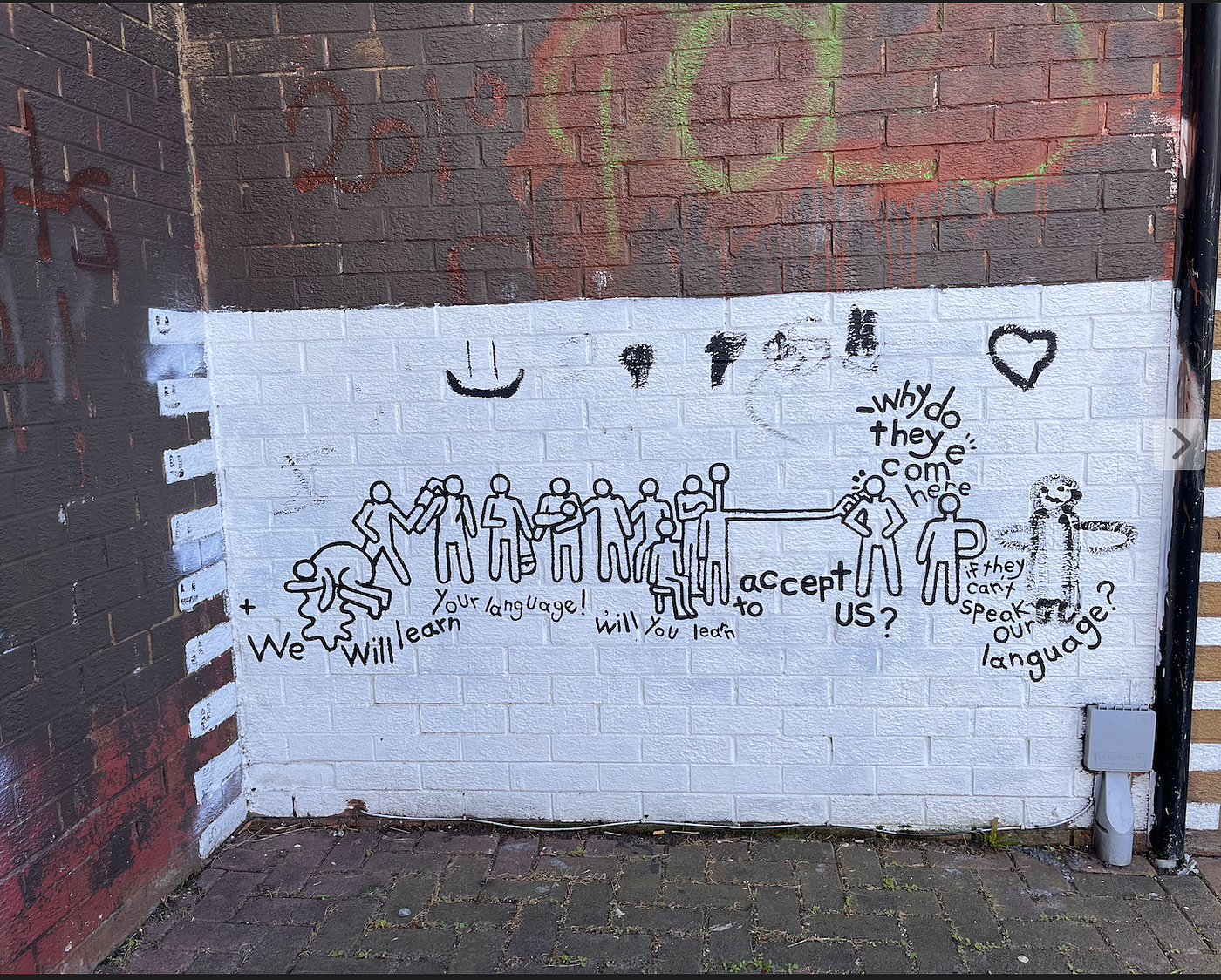
Throughout Louise Kennedy’s Trespasses, language plays an important role in the ways that it defines individuals and creates divisions even where similarities exist. During a session with Michel Agnew and his friends, Cushla teaches them Irish. One of Michael’s friends, Victor, goads Cushla into teaching him the Irish words that would denigrate her as a Catholic, Irish speaker. He tells her, “There are lots of words I like to know in Irish” then proceeds to ask her to translate “propaganda,” “internment,” and “terrorist.” Victor asks her to translate these words because he views Cushla and nationalists, even though she isn’t one, as violent antagonists that use froce to enact their will. He sees himself, of course, as an upright Protestant whose culture and livelihood are under threat from Catholics and nationalists.
Following this interaction, as Michael and Cushla leave, they get into an argument about Victor’s prodding and Cuslha tells him, “Interesting list of words though. Words associated with my lot. Catholics. Nationalists. Republicans. Whatever you call us.” Michael tells her he made Victor stop, but Cushla, still furious, counters by telling him, “It’s awkward enough sitting there like the token Taig without you shaping up to biff your friend.” Michael gets offended at Cushla’s use of the derogatory Taig, and she tells him he has no right to get offended because it’s “honest,” and she asks him if he would prefer “RC? Fenian? Mick?” all equally derogatory terms.
This scene, and others in Kennedy’s novel, drive home what I experienced during our time in Belfast, especially following the tour with a republican and a loyalist. During our time at Divis Towers, Falls Road, and the Clonad, the republican, whom I will call James, never spoke using vicious labels to identify loyalists. Rather, he used language aimed at the British state, proclaiming them a colonizing and occupying force, at various points. This framing carried over to the murals throughout the republican areas. The murals commemorated victims of the violence, but they also framed everything in a much broader, global context, specifically, at this moment, in connection with Palestine. (I will explore this aspect some in future posts.) As well, language in spaces such as the Free Derry Museum which details the events of Bloody Sunday, present The Troubles within this context, connecting the struggle both to the Civil Rights Movement in the United States and to global struggles.
However, the loyalist narrative does exactly what Victor does when he pushes Cushla to translate those words. Our loyalist guide, who I will call William, began his section of the tour on Shankill Road by stating a few things. When talking about the history of the 1960s, he said that the civil rights activists were Marxists and Communists, or at least that’s what people said, but he continued by stating that republicans were terrorists, repeating that word and others multiple times. This type of language carried over to countless murals and memorials. At the Bayardo Pub Memorial, the plague reads, “In memory of five innocent protestants slaughtered here by a republic murder gang on 13th August 1975.” The attack was atrocious, with the IRA murdering five people and injuring over fifty. However, even when I heard of similar attacks by loyalists on republicans, I did not see language such as this.
Within the memorial, which had numerous sections, the narrative continued to use language such as “terrorist” and “murder gang,” and even presented panels showing ISIS terrorists attacks in London and Paris, positioning the IRA and ISIS together. Now, while terrorism is the use of violence for political means and both groups fit this definition, the use of such of language perpetuates violence. When a child walks past that image, sees that comparison, that child will see someone, the same age as themselves who lives on the other side of the Peace Wall, as a terrorist, as someone to be afraid of and to hate. What does this do? It leaves the wounds open, never allowing them to heal.
I know that some will say that I can’t make such generalizations about all of this based on a tour and walking around Belfast, yet I would say that visiting sites such as the Siege Musuem in Derry, where I picked up a pamphlet entitled “Londonderry’s Protestant Exodus” and looking at the panels on the Bayardo Pub Memorial about the La Mon restaurant bombing where the IRA killed 12 and injured 30 drove home the ways that language and images work to create anger and fear within communities. On the latter, the memorial shows an image of one of the victim’s burned body and describes the attack in violent language, but what it omits is just as important. It admits that the attackers tried to warn the restaurant so it could be evacuated, seeking to cause commercial damage and yes fear, but not necessarily the loss of life.
Over the next few weeks, I plan to delve into all of this some more, but for now I want to finish with an excerpt from John Conroy’s Belfast Diary, which was published in 1987, almost forty years ago, and written during The Troubles. When talking about the republican and loyalist bonfires, Conroy details the language he hears at each gathering. He states that the “Catholic fires are a show of defiance and solidarity and remembrance of abuses past,” while the Protestant bonfires stoke anger and fear. He saw grafitti that read “Fuck the Queen,” an attack on the state, but he never saw the same vitriol against the community that he saw in loyalist graffit, some of which read “All Taigs are Targets” or “Kill All Taigs.” He also never heard a Catholic priest attack Protestantism, but he heard Protestant pastors continually denounced Catholicism. He points out that these things cause loyalists “to think the future boils down to ‘squash the Catholics before they squash you.’” While on the other side, “Catholics . . . perceive the conflict as political.”
We know that language becomes a weapon to maim and detsory. We know that the words we use and the rhetorical frameworks we deploy have an impact on the ways that we perceive the world around us. When one side continually uses loaded language to define their opponent, then one cannot be shocked when that language continues to perpetuate the violence that one proclaims to want to stop. We see this everywhere, including in the United States. When, oh when, will we learn our lesson?
What are some of your thoughts? As usual, let me know in the comments below. Make sure to follow me on Bluesky @silaslapham.bsky.social.

