
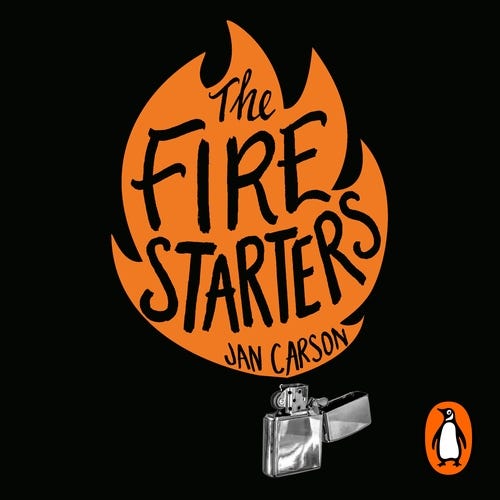
Whenever I travel, I always visit local bookstores. Even if I don’t purchase a book, I do this because I want to see what books they have available and I also want to see what books I may add to my to be read pile. During our study travel trip to Belfast, I must have walked into around fifteen bookstores, ranging from new books stores such as No Alibis to used bookstores such as Keats & Chapman. No matter what store I went into, I looked at the Irish section to add more books centered in Ireland and Belfast to my reading list. This led me to purchasing three books by Irish writers while on the trip: Anna Burns’ Mostly Hero at Little Acorns Bookstore in Derry, Wendy Erskine’s The Benefactors at No Alibis, and Jan Carson’s The Fire Starters at The Secret Bookshop in Carrickfergus.
I started Carson’s novel while still in Belfast, and I finished it when I returned home. This made it more relatable than novels such as Burns’ Milkman and Louise Kennedy’s Trespasses which I read in preparation for the trip. It made it more relatable because I had spent two weeks walking the spaces in the novel, knowing where the streets and stores that the characters passed by during the narrative. At one point, Sammy Agnew sits across from the Build A Bear in Victoria Square, and the day before I read that section, I strolled right by that exact Build A Bear. The knowledge of these spaces added to my enjoyment and understanding of The Fire Starters, but I am still an outsider, as the novel foregrounds from the outset a reiterates throughout the novel, a fact that warrants examination.
The Fire Starters changes perspective over the course of the novel, and at some points, Belfast itself takes on a narrative presence, referring to itself as a collective “we.” The city itself acts as a character, becoming a sort of enigma that seeks to move forward from its history but can’t. Belfast proclaims, as it introduces itself, “This is Belfast. This is not Belfast.” The Belfast that teh community knows, of course, is not the Belfast that the tourists, mostly Americans, visit. These tourists “believe themselves brave for coming to this city, or at the very least, open-minded,” but Belfast tells us that it has “scant respect for these people” because they come in to see the Troubles, the history of violence etched into the walls and the bullet holes that remain in the sides of buildings.
For these tourists, the people of Belfast put them in “black beetle taxis and drive them round and round teh ring road” while they serve up a breakfast of “fried eggs and bacon,” proclaiming it a “taste of local cuisine.” The city does this because it relies on the tourism, the money brought in from people who stare and gawk at its past. The city tells us, “We dance for them and their foreign money. We are also prepared to cry if this is expected. We wonder what our grandparents would say to all this clamour, all this proving talk.” It becomes an act, a dog and pony show to survive and function. When the tall fires start, though, the tourism begins to dry up because people become reminded of the Troubles, of the past, and they stay away, leading the local officials to think about ways to get the all-important tourism money back into the local economy.
The Belfast tourists see, the Belfast I saw, is not the true Belfast. A tourist, no matter how hard we try, can ever see the true space. Even though I started to referring to places in Belfast as my own, as if they were places I always visited when I needed groceries or other items, they were never truly “mine” because I entered for two weeks then left, returning to my home across the Atlantic, far removed from the day-to-day life of Belfast. However, this does not mean that I cannot glean things about Belfast. As the city tells us, one can learn about the Troubles and Belfast through Wikipedia, academic articles, and elsewhere, and they can also learn “a kind of history [that] may be acquired from talking to locals. Piecing together will be a painstaking process, similar to forging one jigsaw puzzle from two, or perhaps twenty.” Talking with people, engaging with people, leads one to further knowledge, transforming one from a tourist to a traveller.
Still, though, one will not fully understand Belfast. It is both Belfast and not Belfast. It is both the past and the present. It is both what one sees and what one doesn’t see. It both the place for bachleor and bachelorette parties and the place where unhoused people beg for money beside the Tesco Express. It’s a place, like every place, that defies simple definition. Belfast is more than the Troubles, and Belfast is the Troubles, a word that does not, as Belfast tells us, fully describe what happened between 1969 and 1998. “The Troubles is/was,” the city informs us, “many individual evils caught up together.” They existed and they continue to exist, seeping through the streets. We see this in Sammy Agnew’s past, as he attacked republicans and Catholics and as he fears that he has passed these hates and violent actions onto his some Michael. We see this in the revelery surrounding the July 11 bonfires. We see this is the ways the Tall Fires take hold of the city and its community.
Carson’s novel lays bare that one can never truly know a place because that place contains multitudes that weave their ways throughout its corridors. I know things about places I have lived, but even I don’t know everything about these places. I learn things every day. I learn about new places. I learn about nex streets. I learn about new stores. How does that relate to me when I merely visit a place? Can I fully comprehend it? No. I can only scrape the surface, if that, wherever I travel. I can attempt to immerse myself into the place, but I will forever be apart from it. Does that mean that I cannot, in some manner, understand the place? No. I can understand it, and I can bring my own experiences to bear on what I see in that place. But, I will never be a part of that place.
Carson’s The Fire Starters really drives home the fact that one, especially if one is not from a place, can fully understand it. If I read this novel without knowing the background of the Troubles or even further back to the Battle of the Boyne or the Easter Rising of 1916 or the Eleventh Night Bonfires or of Orangeman’s Day, I would be able to enjoy the novel, yes, but I would not understand all of its complexities. Reading the novel within the context of the study travel course and after spending multiple days in Belfast helped me to understand it, but I am still an American tourist who swooped in, snapped my pictures, spent my money, then left on a jet plane back to my own postage stamp of land.
What are some of your thoughts? As usual, let me know in the comments below. Make sure to follow me on Bluesky @silaslapham.bsky.social.

