When we lived in Bergen, Norway, I would occasionally go to the KODE Art Museums to see pieces by Edvard Munch and other Norwegian artists. During one of those visits, I encountered the work of Nikolai Astrup, a modernist painter from Kalvåg. Walking through the galleries, I came upon his 1920 painting entitled Marsmorgen (March Morning). This work stopped me because it depicts a tree, with human-like characteristics, reaching its branches to the sky, as if stretching from a long winter slumber. The tree’s features remind me, in many ways, of Groot from Guardians of the Galaxy, but there is much more to the image. Through the tree, we see the cylces of the seasons and rebirth. We see a new beginning.
Along with Marsmorgen I also saw Jonsokbål (Midsummer Night), a painting depicting the midsummer bonfires on the fjords in Norway. Like Marsmorgen this image grabbed me with its colors and its dream-like feel, as the fire from the bonfire rises in the middle of the canvas, curling its ways up to the heavens, as merrymakers dance around it and the mountains enclose them. Each of these images attracted me partly because of their subject matter but also because they have a distinctively modernist aesthetic. While I like painting that relies on verisimilitude, such as classical realism and naturalism, I am more draw to modernist works and impressionism that depicts reality but also distorts it in certain ways, relaying, in many ways, how I sometimes perceive the world, like when we look at designs on a wall and see certain images or when we look at clouds and see certain shapes.
Paris, of course, has offered me a great opportunity to discover artists like Astrup that I would have never possibly discovered if I had not seen them in a gallery, and on a recent trip to Le Musée de l’Orangerie, I did just that. Amongst Claude Monet’s Water Lilies cycle and works by Pablo Picasso, Paul Gauguin, Henri Rousseau, and others, I came across the work of Chaïm Soutine. The first piece I encountered from Soutine was Le Petit Pâtissier (The Little Pastry Chef). This portrait, while making me stop to look at it, really didn’t move me in any way, even though it is one of Soutine’s most recognizable works. Even though I like portraits now and then, I really enjoy landscapes, so it wasn’t until I started coming across Soutine’s payasge paintings that I really started to pay attention and enjoy his work more.
Upon seeing Soutine’s Arbre Couché (Fallen Tree) I instantly thought about Astrup’s Jonsokbål because the tree, which takes up the majority of the image, reminds me of the fire in Astrup’s painting. The way that the braches and leaves swirl, causing our eye to to move from the trunk to the top in a sort of semi-circular manner due to the tree leaning, creates a feeling of movement and to me wonder. At the base of the tree, on the bottom right of the canvas, a woman appears to be sitting on a bench. I would like to imagine her reading since her head appears to be gazing downward at her lap. She looks like the lone figure in the image, apart from those living behind the walls of the buildings in the background. The woman, who is not the focal point of the piece, causes me to think about myself sitting either along the Seine or in Jardin du Luxembourg reading, engrossed in a text, as nature envelopes me and life seems to stand still.
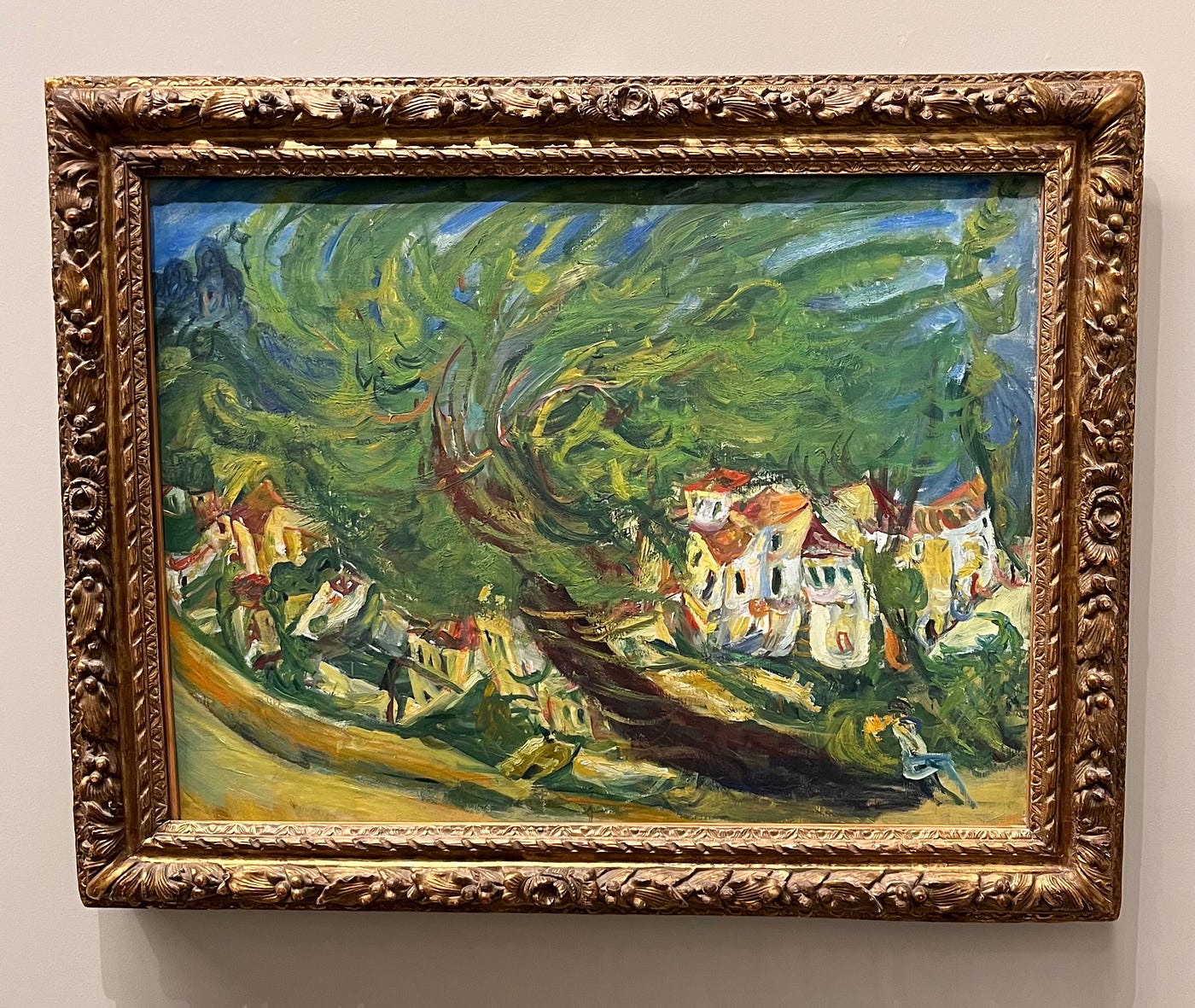
Soutine’s Arbre Couché, through its color and form, has a dream-like quality, as if seeing this image not through our physical eyes but through our mind. The circular nature, set in motion by the tree, causes us to view the image as a loop, moving from the base of the tree all the way around the image. This feeling of movement and disorientation of reality appears in another piece from Soutine, Les Maisons (The Houses). Here, wavy maisons lean to the left of the canvas, and darker colors, apart from the white of the walls and the clouds, pervade the image. Like Arbre Couché, Les Maisons drew me in with its familiarity of houses but also with the ways that Soutine, through painting, distorts that familiarity. It is a piece that looks at the world, as a photograph would, and manipulates it, as a photograph could, creating within us a new feeling, one that, for me, resides between wonderment and distress. I feel the latter due to the color pallette and the ways that the maisons lean to the side, as if ready to fall over and break apart once they hit the earth.

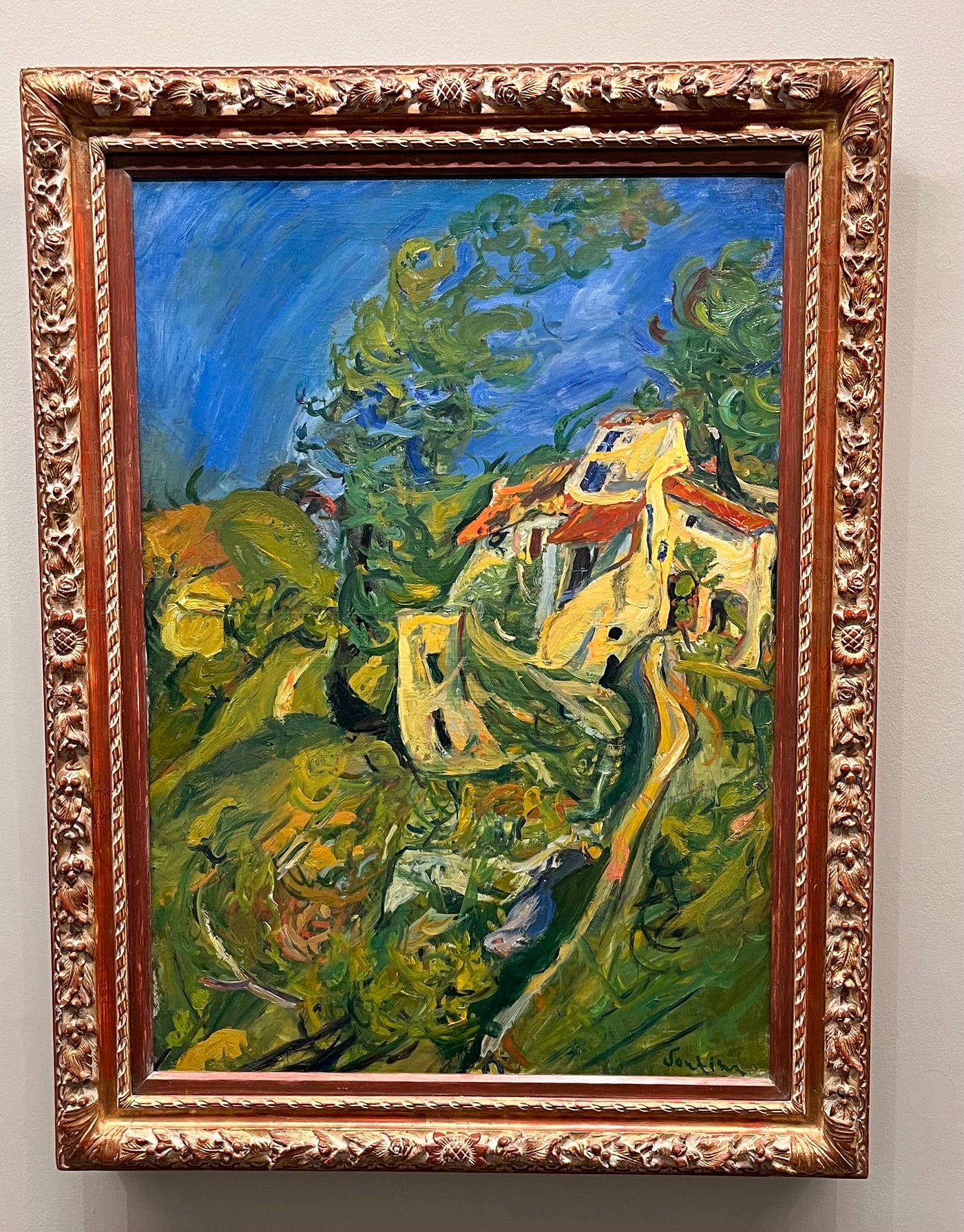
The final piece that I enjoyed was Paysage (Landscape). In many ways, Paysage reminds me of Vincent Van Gogh’s landscapes, which does not come as a shock since many call Van Gogh the “father of expressionism,” he style that Soutine worked within. This image, with its vibrant colors and again, with its circular movements, feels whimsical in a way. It oscillates back in forth like the waves we see on the horizon on a hot summer day, distorting our perception what sits in front of us. It shows a tree, in the center, with its branches curling up to the right, where our eye descends to the roofs of the houses, down the path from the houses, and back up the right side of the image, returning to the tree. Again, it feels cyclical, causing us to move ourselves around the scene. The feeling of abstraction yet familiarity also draw me into this piece since I know wha a landscape looks like and I can make out the various pieces but as well the waviness disorients me.
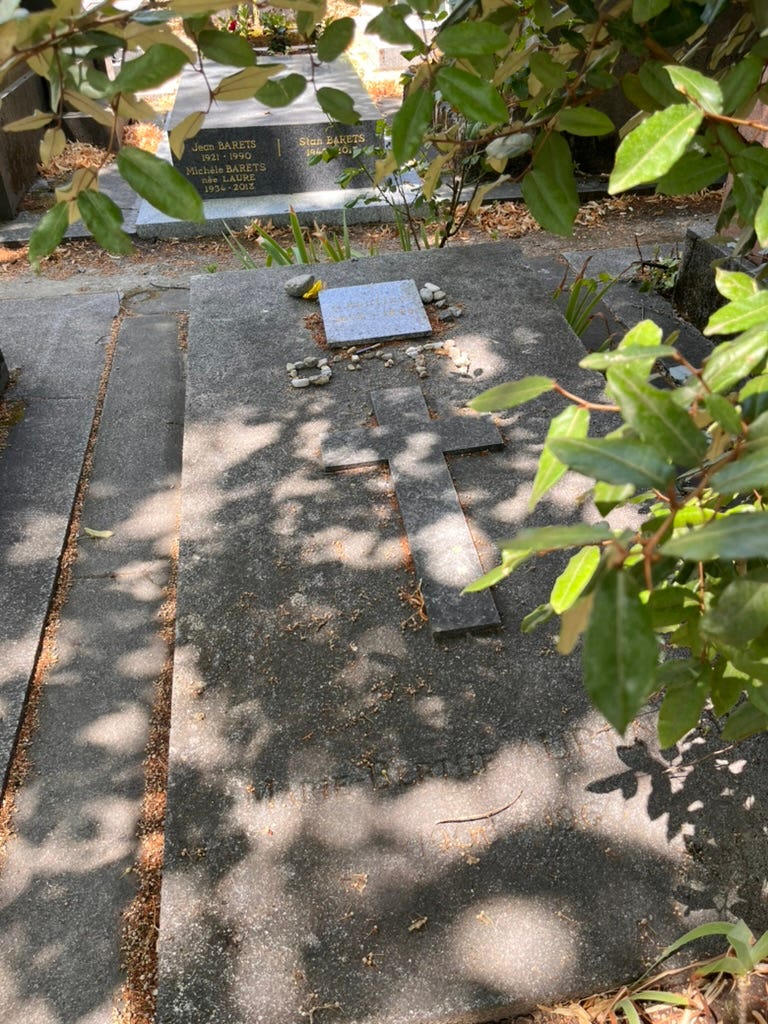
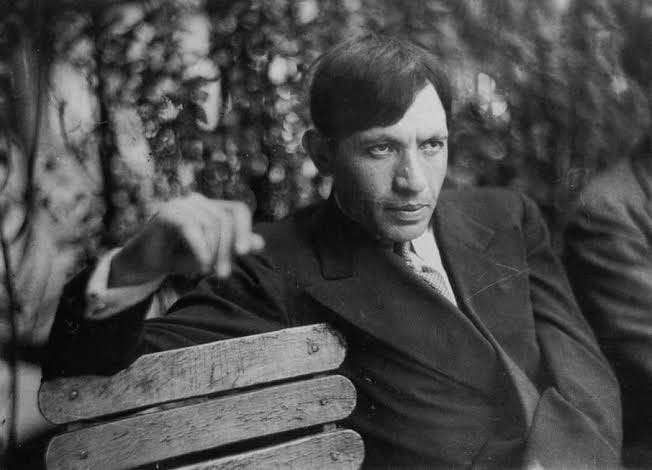
Before going to Le Musée de l’Orangerie, I had never heard of Soutine, but after seeing his works I did a brief dive into him and found out he was Jewish and was born in Belarus. As well, I discovered he is buried at Cimetière du Montparnasse, a place I have strolled through before. In 1943, while hiding from the Nazis in forests, Soutine started bleeding badly from a stomach ulcer. On August 9, he dies from a perforated ulcer. Two days later, he was interred in the cemtery. Scared of what might happen to them if seen Soutine’s funeral, many friends and contemporaries stayed away; however, a few, including Pablo Picasso, Jean Cocteau, and Max Jacob, showed up to see their friend and contemporary laid to rest. The day after discovering Soutine’s work, I travelled to Cimetière du Montparnasse to pay my respects to an artist who, only a few days before, I had never heard about. This is the power of art, to move us and to inspire us, to cause us to see and think about the world differently. This is what Soutine, Astrup, and others have done for me at various points.
Who are some artists whom you have discovered that inspire you? As usual, let me know in the comments below. Make sure to follow me on Bluesky @silaslapham.bsky.social.