I visited Paris for the first time back in the spring of 2019. During that trip, I only had, basically, a day and a half to wander around the city. I went to the Auguste Rodin museum, the Musée d’Orsay, and Cimetière du Montparnasse. As well, I walked to various sites where I knew that expatriate writers such as James Baldwin and Richard Wright gathered and wrote. That trek took me to Café de Flore and Les Deux Magots, two cafés right next to each other on Boulevard Saint-Germain. On a cold and rainy March day, I came to Les Deux Magots, walked inside, and sat down to have a coffee and snack. I sat alone, thinking about the people who had been there before, from Baldwin and Wright to Ernest Hemingway to Simone de Beauvoir and Jean-Paul Sartre to Albert Camus and Pablo Picasso.
Almost seven years later, I am living right off of Boulevard Saint-Germain, so I walk down the street almost every day. In the course of one of my recent walks, as I went to check out some new markets to see where I could find food and other items, I made my way down to Les Deux Magots. As I approached, I noticed a church right across the street from the café. I didn’t see the church on my first visit, but granted I wasn’t really paying attention to much at that time; I was just trying to navigate my way around an unfamiliar city. This time, though, I knew where I was, becoming somewhat familiar now with the neighborhood, and the church caught my attention. Unfortunately, I couldn’t enter the church when I initially saw it, but I cam back the next day to visit.
L’Église Saint-Germain-des-Prés is that church, and it is the oldest existing church in Paris. Founded as a Benedictine abbey in 558 by Childebert I, the church has been destroyed over the years and has undergone various additions and changes over its 1,468 year history. What we see today, and what Baldwin would have seen, comes from this long history and from the restoration effort that took place in the early 1800s after the church became a church again following the French Revolution. When Baldwin arrived in 1948, right off of the boat from New York, he went to Les Deux Magots, to the second floor, and met with Wright and the editors of Zero magazine, who would publish his essay “Everybody’ Protest Novel,” an essay that Wright vehemently disagreed with. They would have sat, looking out on Place St.-Germain-des-Prés and l’Église St.-Germain-des-Prés.
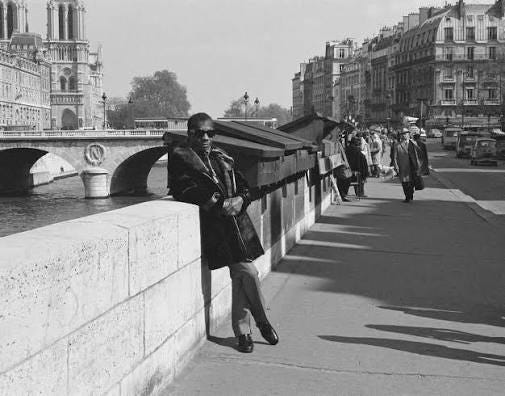
Thinking about Baldwin and Wright sitting at a table looking out at the church makes me wonder whether or not either one of them entered into the doors of l’Église St.-Germain-des-Prés and sat there, looking around them at what Christianity had constructed. I think about this the same way I thought about Baldwin in St. Paul de Vence in 2023. There, I walked around the village, and I entered the Chapelle des Pénitents Blancs where I sat down and read Baldwin’s “The New Lost Generation,” an essay he wrote in 1961, thirteen years after his initial arrival in France. I envisioned Baldwin, after writing in the morning, taking a stroll to clear his head. He would look at the Alps and then at the the Mediterranean. He would stop in a shop. He would chat with others he saw on his walk. He may have even entered the chapel, sat down, and thought things through.
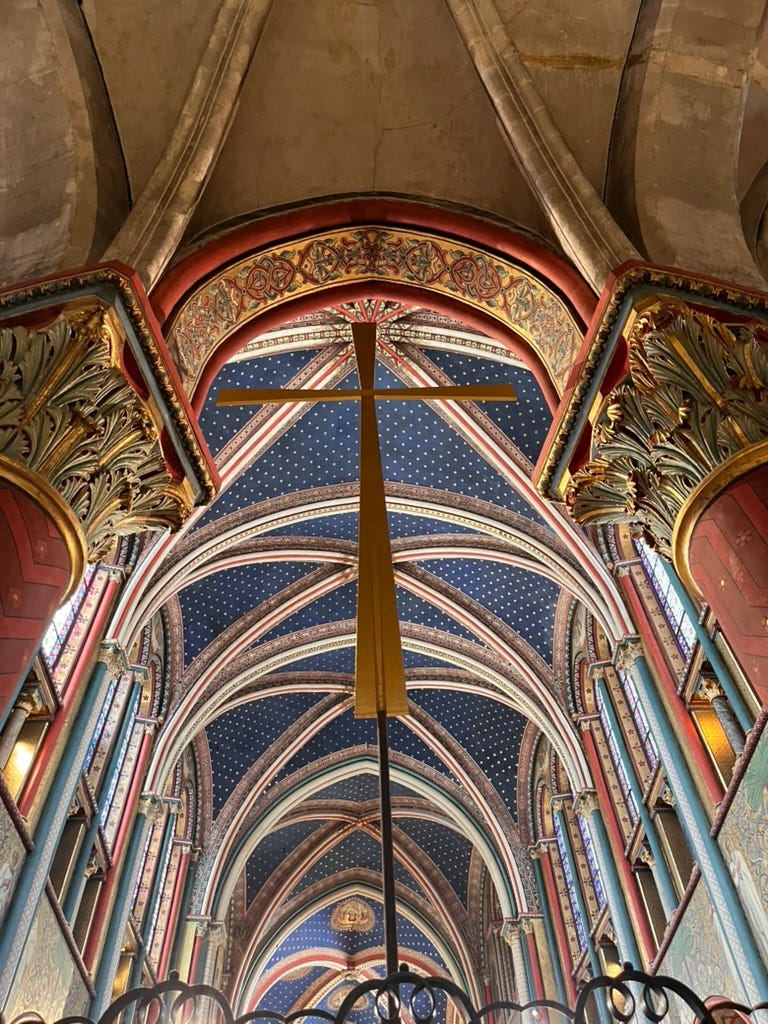
These are the things I envisioned, as well, when I sat down in l’Église St.-Germain-des-Prés. Did Baldwin, frustrated with Richard Wright, walk into the doors of the church? Did Baldwin gaze up at the royal blue ceiling dotted with stars? Did he sit in a pew and think? I can only imagine Baldwin doing this. I can imagine him looking at the depictions from the Bible and the saints, the white European Jesus and white European christians, noting that the constructed image facing him in no way resembled reality. I can imagine him sitting there thinking about his own novel in progress, Go Tell It On the Mountain, and how Christianity, specifically European Christianity, oppressed him and those he loved. I can imagine him sitting there and thinking that the god worshipped in that church had no place for him.
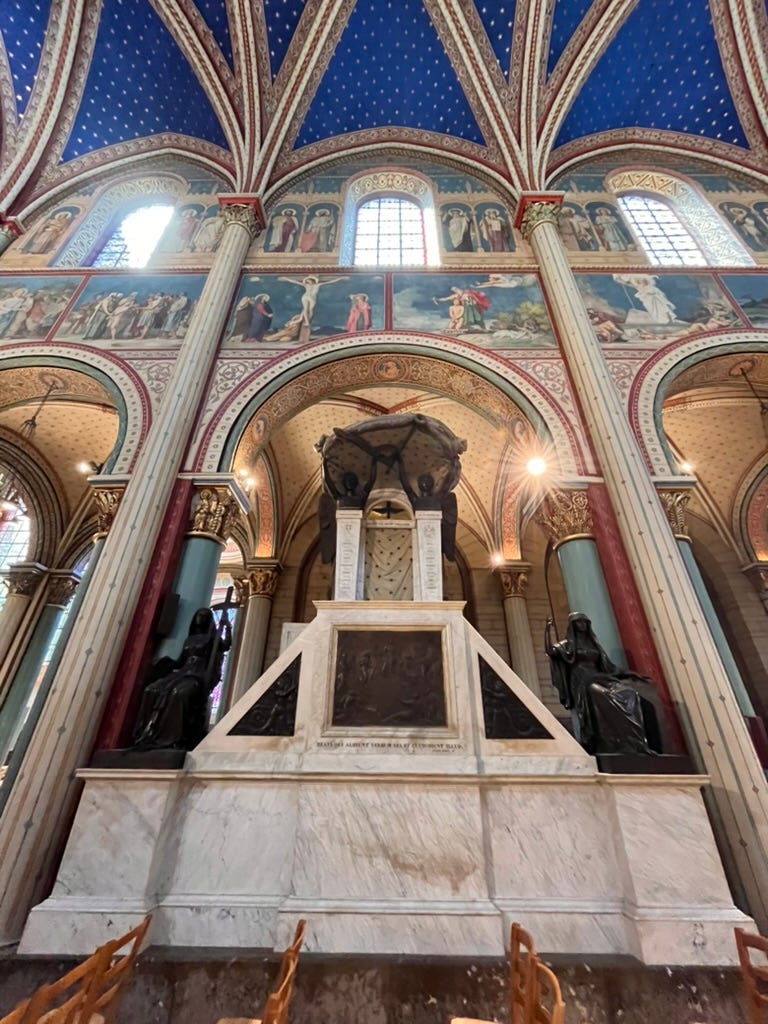
If, almost eighty years before I entered l’Église St.-Germain-des-Prés, Baldwin sat in the same place, I think of him looking at the white Jesus crucified about the pulpit, of the white disciples, of all of the white individuals, and thinking about the ways that Christianity, through its symbols and imagery, has been used to suppress him and many others. I think of Baldwin in 1963, as he walked past the charred remains of St. Mary’s Cathedral in San Francisco, as his guide tells him that the Catholic church, to rebuild the cathedral, had already raised fifteen million dollars, sarcastically proclaiming. “Some people know how to make it.” I envision Baldwin, fourteen years before Mississippi governor and Baptist Sunday School teacher Ross Barnett said, “The Good Lord was the original segregationist. He put the Black man in Africa. . . . He made us white because he wanted us white, and He intended that we should stay that way,” looking in disgust at the Christianity Barnett, segregationists, and colonizers espoused.
Looking beside me in l’Église St.-Germain-des-Prés, I see Baldwin interrogating the Christianity he sees before him. I see him thinking, as Lillian Smith put it in 1943, “Ever since the first white Christian enslaved the first black man the conscience of America has been hurting.” I see him thinking this and expanding it to the world. I see him expanding it to the church in France where he sits in contemplation. I see Baldwin laying the groundwork for so much of his work to come, so much of his interrogation of the interlocking chains of white supremacy and religion. I see him, if he sat there, formulating these ideas.
I see Baldwin thinking about the disease that a warped Christianity has wrought on whites. I see him thinking, as he said in 1963 outside of St. Mary’s, “I don’t even think they’re Christians. And I know they’re not because I know . . . I was raised Christian. My daddy and my momma were very religious. And they knew that white Christians were not Christians because of the way they treated Black people. And the Christian church in this country has never, in my experience as far as I know, been Christian. . . . The record proves . . . the Christian church is bankrupt.”
I do not know if Baldwin graced the doors of l’Église St.-Germain-des-Prés. I do not know what he thought if he walked inside. I do not know how being in that space may have impacted him. I do feel, though, that while the grandeur of the space may have impacted him, it also revolted him. I do know that he would have viewed the church as he did the cathedral at Chartres, as a space that, as he writes in 1953’s “A Stranger in the Village,” “says something to the people of this village which it cannot say to me; but it is important to understand that this cathedral says something to me which it cannot say to them.” While the villagers look up at the windows, at the spires, and gaze towards heaven, Baldwin thinks about the terrifying well in the crypt where they threw heretics because unlike the white villagers, who never think about the devil when they look at the cathedral, he does because he has “been identified with the devil.” The cathedral says something to the villagers that it does not say to him, and this is how I see Baldwin sitting next to me as we star at the stars in l’Église St.-Germain-des-Prés. I see him hoping to change the myths that have infected and oppressed so many people.
What are your thoughts, as usual, let me know in the comments below. Make sure to follow me on Bluesky @silaslapham.bsky.social.