
During my time in Paris so far, I’ve been trying to go to a lot of the free museums and memorials. This past week, I went to the Mémorial de la Shoah and to the Maison Européenne de la Photographie (MEP), which I thought was free based on information I found, but it actually costs €13. At each of these museums, I became intrigued by some of the photographs that they housed. While the MEP primarily focuses on photography, the Mémorial de la Shoah focuses on remembering the victims of the Holocaust. Currently, that museum has an exhibit on Simone Veil entitled Simone Veil. Mes sœurs et moi. This exhibit, curated by photographer and filmmaker David Teboul, tells the story of Jacob family, from Simone’s childhood in Nice to the Holocaust and to her activism.
As I walked through each of the museums, I found myself drawn to the numerous instances where photographers, during the early twentieth century, turned the camera upon themselves in various ways, specifically the ways that the photographers used the medium of photography to refract the ways that we view them and the photograph itself. In the Veil exhibit, I saw photographs from Veil’s brother, Jean Jacob. Born in 1925, he wanted to study photography, and he even started working at Emka Photo in 1942; however, the anti-semitic laws of the occupation shut the studio down. In 1944, the Nazis deported Jean, along with his three sisters and parents. The family was separated, and Jean and his father left on Convoy 73, never to be seen again. Jean was 19 at the time.
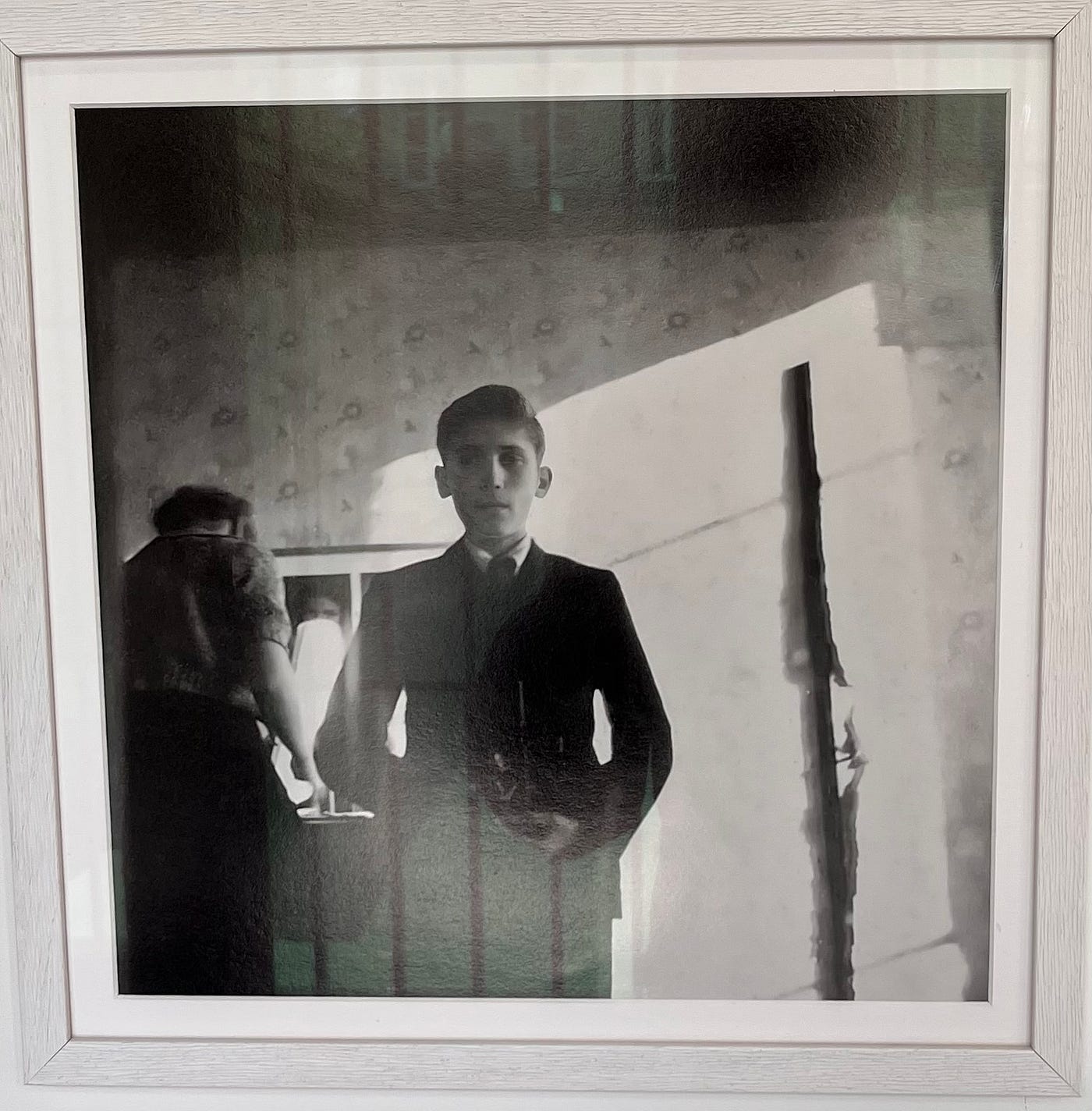
The exhibit contains a few of Jean’s photos, mostly landscapes covered in snow and people skiing. However, one photo shows Jean himself, staring at what I assume is a mirror, with the camera at his waist. It is a self-portrait. I did not see a date for this photograph, but it looks like Jean would be possibly be in his early teens. Jean stares at his reflection, and we see a woman over his right shoulder. I assume the woman is his mother, but I am not sure. He head tilts down, and in front of her we see the eyes of what appear to be one of his sisters in a photograph. Of this image, Simone, speaking with her sister Denise, says, “Il a l’air triste, mais il avait souvent cet air.” (“He has a sad air about him, but he always had that air.”) Jean does appear sad, but he also appears stoic, staring purposefully ahead.
Jean’s self-portrait haunts me because it shows him twice removed from our view. Photographs, while depicting reality, remove us from it, and this self-portrait, removes us again because what Jean depicts here is not himself but his reflection. It is him, but it is not him. As well, Jean died at the hands of the Nazis, and his death, along with the suffering of his family and millions of others, appears in his stare. Even though, depending on when he took the photograph, he may not have know about everything happening across the border in Germany, his future was tied to it. Jean’s reflection remains in the mirror, staring at us across time and space, reminding us, as the images of his sisters and him at the beach, eating, and living life do, of the atrocities he and so many others endured.
At the MEP, I saw more self-portraits, including Claude Cahun’s Autoportrait avec miroir (1928). While we don’t see the mirror in Jean’s self-portrait, we purposefully see it in Cahun’s self-portrait. Cahun’s photograph stands out to me because of Cahun’s importance as a surrealist artist and writer, but also because of her androgynousness and her gender fluidity. Born Lucy Renée Mathilde Schwob, she adopted the pseudonym Claude Cahun in 1914. On her gender identity, she wrote in Aveux non Avenus, “Masculine? Feminine? It depends on the situation. Neuter is the only gender that always suits me.”
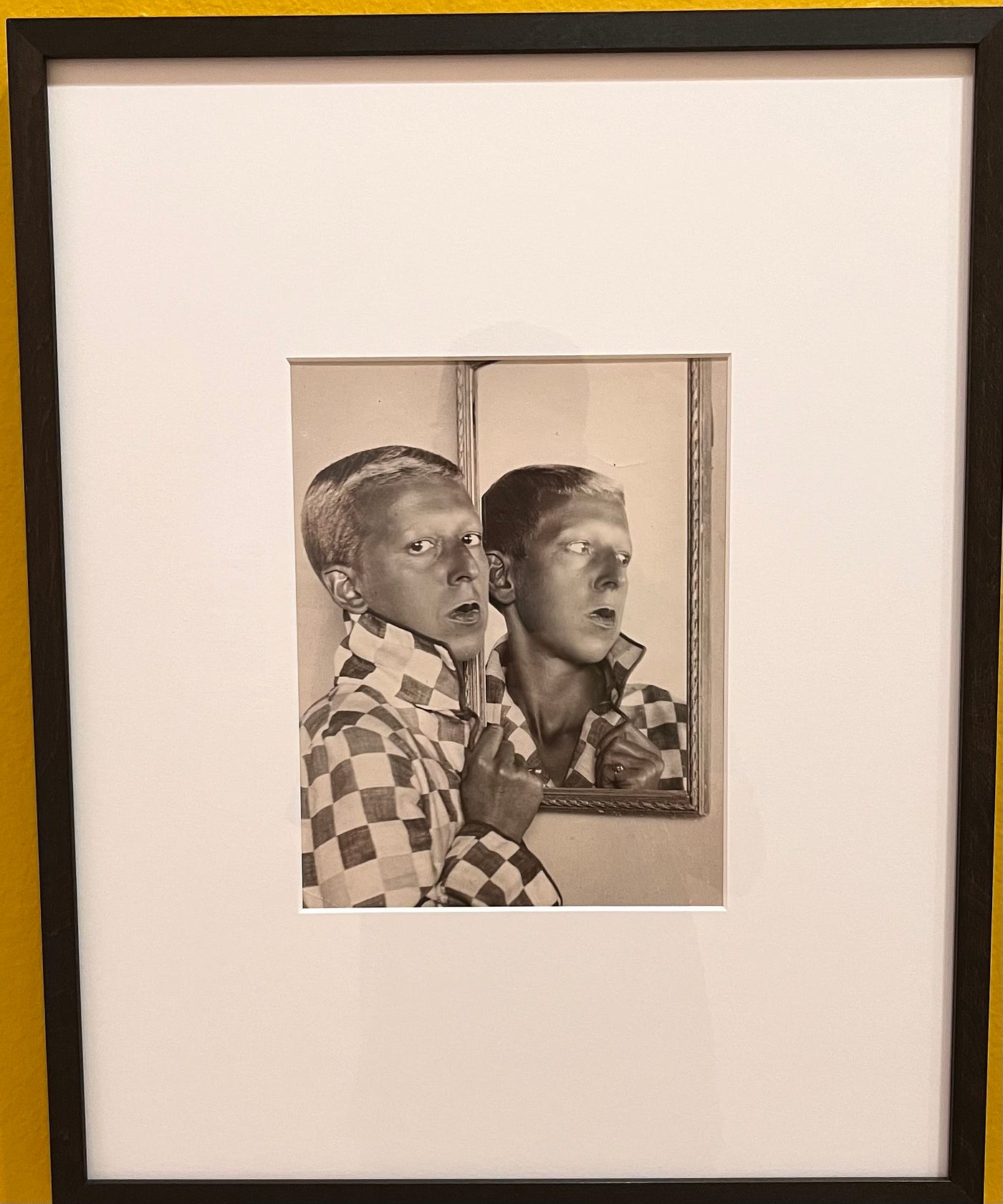
When I first saw Cahun’s self-portrait, I thought, based on her name and the image, she was a man. I did not know anything about Cahun or her life. (I want to learn more.) Finding out more about Cahun impacts my understanding of the photograph. In the self-portrait, Cahun, on the left side of the image, looks at us, the viewer, as her right hand holds the color on her shirt. The mirror is on the right side of the photo, and due to Cahun’s pose, the reflection shows her looking away from us, towards something backwards and outside of the image. This positioning causes some disorientation and fluidity because like Jean’s self-portrait, we see reflections of the subject, removing us even more from the subject. Add on top of this Cahun’s gender fluidity, the self-portrait depicts that fluidity because each subject, Cahun herself and her reflection, are Cahun and yet not Cahun, just like Jean.
The final photographer that caught my attention was Kasimir Zgorecki, a Polish photographer, born in Germany, who moved to France. What struck me about Zgorecki’s work was the fact that he used his camera to stage tableaus with himself at the center. He would pose as characters from works of literature. He would pose as members of various professions. He would pose and snap. Of these self-portraits, Autoportrait en peintre (ca. 1925) drew me in. Here, Zgorecki, dressed as a painter with a brush and palette in his hands, paints himself on a canvas. Neither the actual Zgorecki or the self-portrait painting, look at the viewer. Each looks at the other, removing us as the viewer from the gaze.
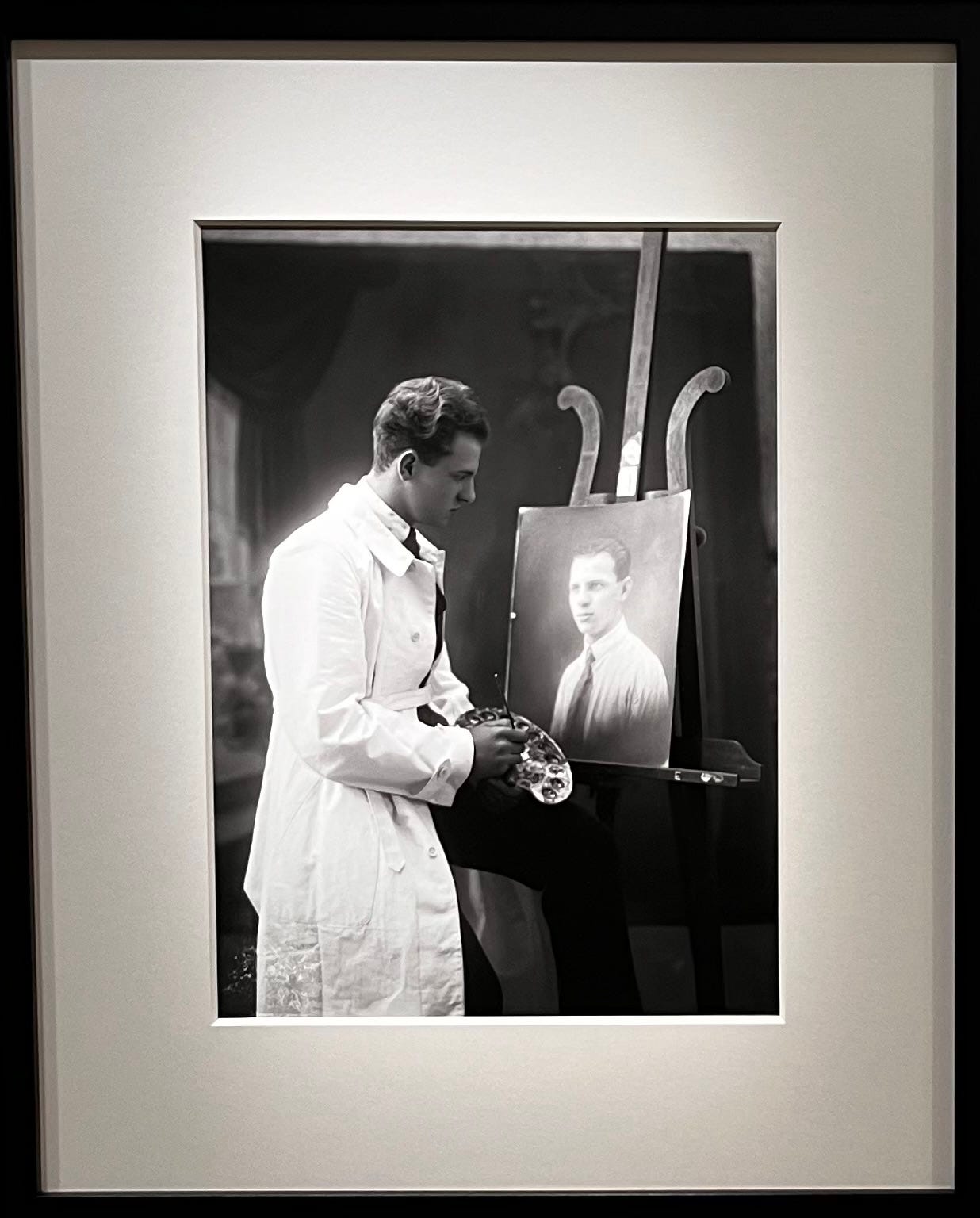
Like the Jean’s and Claude’s self-portraits, this one stands out because it depicts Zgorecki twice-removed from us. Unlike the others, though, it adds the fact that we exist as voyuers in the tableau, as if we are intruding on Zgorecki in the act of painting himself. Zgorecki’s self-protrait fascinates me because it plays on the unreality of photography. It is a, as the exhibit points out, a simulacrum, a representation of reality but not reality. All photography serves as a simulacrum because while the photograph shows reality it obfuscates reality through the gaze of the photographer then through the gaze of the viewer. Each of the self-portraits I’ve written about here do that, and that is why each of these, in their own ways, stand out to me.
One thing, that I do not know how to address right now, just struck me as I finish up this post. I took pictures of each of these images myself, and thus I have become the photographer within these circuits, joing Jean, Claude, and Kasimir in the act of creation. What are your thoughts, as usual, let me know in the comments below. Make sure to follow me on Bluesky @silaslapham.bsky.social.

