
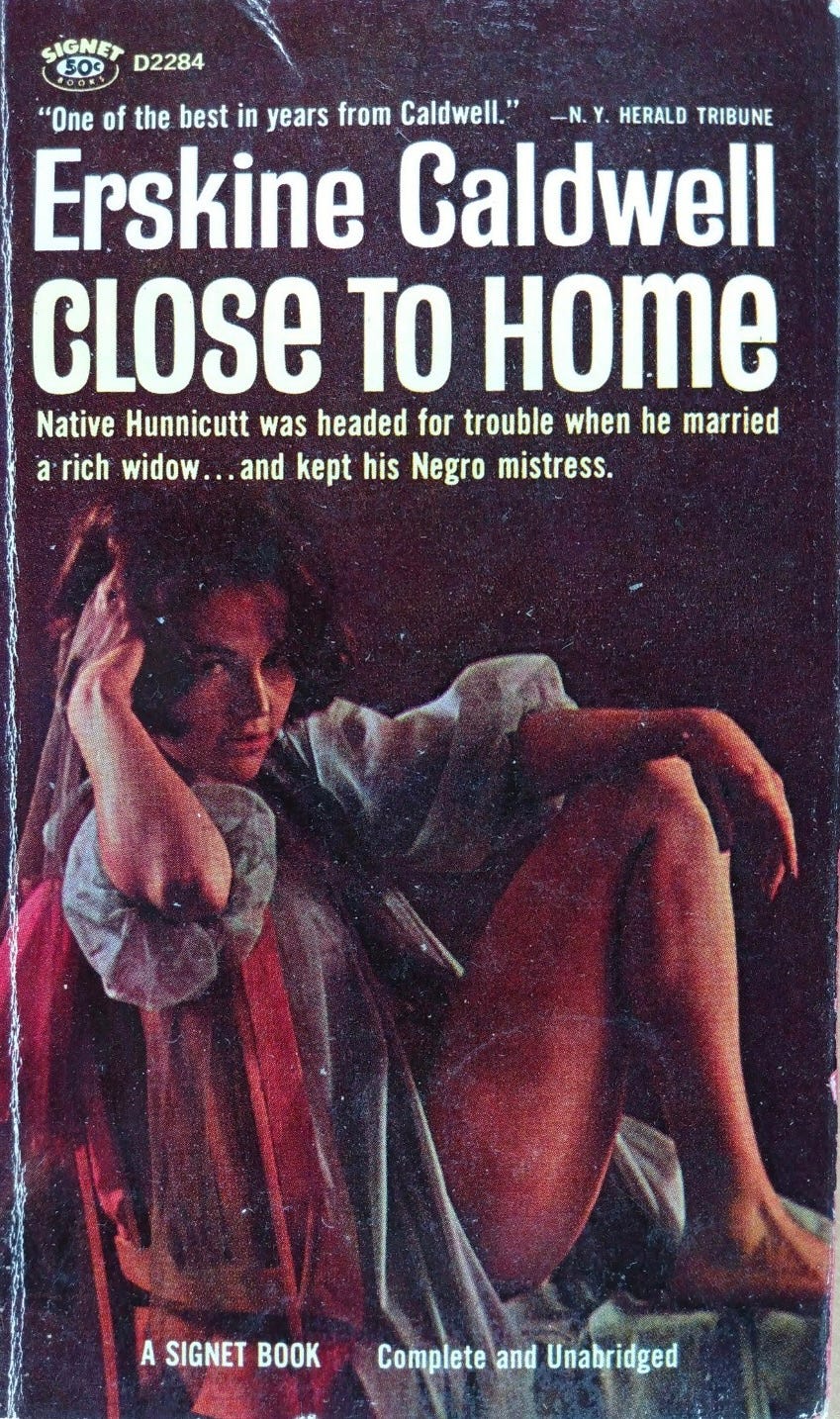
One of the things that frustrates me about living in Paris for a set amount of time is that I can’t buy all of the books that I want to buy. For example, I’ve been to most of the English language bookshops multiple times, just looking around, and buying very little. I did pick up James Baldwin’s No Name in the Street at Shakespeare and Company, Jan-Werner Müller’s Democracy Rules at The Red Wheelbarrow, and Kamel Daoud’s The Meursault Investigation at Smith & Son. The doesn’t include the few comics I’ve also aquired. I don’t plan to return with all of these books; in fact, I plan to either donate them or leave them with people here. One of the books that I intend to leave, even though I want to teach it at some point, is Erskine Caldwell’s Close to Home.
When I went into San Francisco Book Company, I immediately found a copy of William Melvin Kelley’s A Drop of Patience, a novel I had also seen at the Red Wheelbarrow. I contemplated buying the copy, since it was €9 cheaper, but I as I looked around, and specifically as I went to the pocketbook section, I started finding other books that caught my attention. Plus, they were only €5 each. There, I picked up a copy of Frank Yerby’s Benton’s Row, which I plan to reread and leave here, and Caldwell’s novel. When I started looking at Caldwell’s novels, the pulpy cover of Close to Home, plus the brief, tantilizing description of the narrative on the back of the book caught my attention. In fact, the words “RACE-MIXING,” plastered largely across the back grabbed me. I’ve known about Caldwell for a while, and I know about his connections to Lillian Smith and his progressivism.
When I started reading Close to Home, I noticed a lot of similiarities between it and novels such as Lillian Smith’s Strange Fruit and Ernest Gaines’ Of Love and Dust. Apart from the apparent connection that each novel deals with interracial intimacy, I also noticed that each, at various points, provides various viewpoints of teh community, not just the view points of teh main characters. Each writer does this in a different manner, with Smith, specifically near the end of the novel, devoting a chapter to the different reactions of community members to Henry’s lynching and with Gaines slipping seamlessly in and out of Jim Kelley’s narrative perspective into the perspectives of others in the quarters. Caldwell also provides community perspectives, but unlike Smith and Gaines, he does so, in almost every chapter, with parentheticals. Sometimes we don’t know who the community member is; we just get an impression. Other times we know it is a character. This technique really intrigues me, and as I think about how to teach Caldwell’s novel, I am thinking about the ways to discuss how authors bring in community perspectives to the narrative.
Another thing that stood out to me was how developed Caldwell makes Josene. I have serious issues with Smith’s depiction of Nonnie in Strange Fruit, especially compared to the other Black characters in that novel, but I was impressed at Caldwell’s depiction of Josene. While it is by no means perfect, he gives her agency and a rounded identity, unlike Smith does with Nonnie. Gaines does the same with Pauline in Of Love and Dust, and this provides another avenue of discussion within a course where I would teach Caldwell, Smith, and Gaines together, along with Alice Childress and others, examining texts on interracial intimacy.
For all of the good I saw in Close to Home, I also saw a lot that gave me pause. Namely, Clyde Hefflin’s murder of Harvey. It’s a graphic scene, and it is filled with symbolic imagery, especially if we think about it in relation to James Baldwin’s “Going to Meet the Man” or Ralph Ellison’s “A Party Down at the Square,” but ultimately it comes across as a gratuitous act of violence, even though within the context of the story and time period we can see it happening. Yet, it feels, in relation to the rest of the novel’s pace and tone, as too much, landing like a voyueristic act of violence instead of an aspect of the plot.
Likewise, I did not like the way that Caldwell concluded the novel, wrapping things up without things changing. Something like Gaines’ Of Love and Dust makes sense, where the vioelnce in the novel does not upset the status quo and Jim leaves the plantation. However, I am left at the end of Close to Home, even though we also see nothing changing, feeling let down because for all of his posturing, Native remains, upholding the culture that killed Harvey and caused Josene to leave town with her daughter Ellen. He even goes back to the woman who caused all of this violence. Again, while I get the fact that the culture will not change overnight or in the span of few days over the course of the novel, Native’s decision really feels like Caldwell couldn’t think of anything better for him to do in response to all that transpired.
Even with its faults, I want to teach Close to Home. I have been thinking, for years now, about a course that focuses on interracial initimacy and Loving. After reading Close to Home and thinking about it in relation to some of the other texts I have already thought about for that course, I think I want to actually teach it soon. Right now, I want to do Caldwell, Gaines, Smith, Alice Childress’ The Wedding Band, Octavia Butler’s Kindred, and Frank Yerby’s Speak Now. I want to do a course wherewe read both Black and white writers who examine interracial intimacy, in different time periods, and how they approach it through their writing. I think that this list gives us a good cross section of that.
Who would you add to this list? As usual, let me know in the comments below. Make sure to follow me on Bluesky @silaslapham.bsky.social.

