
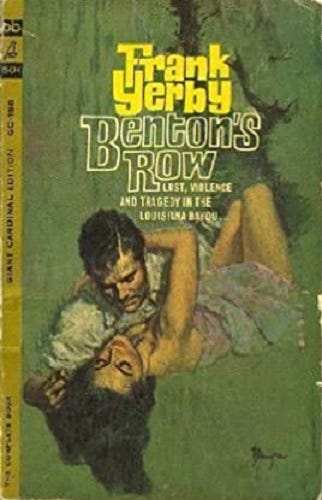
Whenever I go to a used bookstore, I always check to see if they have any books by Frank Yerby, mainly because I research his work and I also collect any book I can find by him. Inevitably, no matter where I find one of Yerby’s novels, it is always one of his “costume novels,” his historical novels, typically set in the antebellum South. On the surface, most of these appear to uphold the Lost Cause mythology of the South and the confederacy as they follow poor white men amassing their fortunes and then losing their fortunes through the enslavement and exploitation of others. Throw a heavy dose of sex and patriarchy into that mix and you have a recipe, in the mid-twentieth century, for literary success. However, as I’ve pointed out throughout my work, Yerby’s novels are anything but apologetic Lost Cause dribble. In fact, at every turn, Yerby subverts the mythological past espoused by the Lost Cause narrative.
When I went to San Francisco Company, I looked through the paperback section, picking up, as I mentioned last post, Erskine Caldwell’s Close to Home, and I also spied a copy of Yerby’s 1954 novel Benton’s Row, a book of which I have a couple of copies at home. Seeing it there, for only €5, I picked it up, planning to read it during my stay in Paris and leave it somewhere or with someone when I leave. I took the novel with me as I headed out to Rock en Seine, knowing that I would have time, either on the metro or at the festival, to pull it out and read a chapter or two. I hadn’t read Benton’s Row in a while, and while I remembered the key plot points, I really started picking up on the way that Yerby, from the outset, confronts the myth of the Lost Cause.
Tom Benton embodies the myth, and the opening page lays bare that his memory is just that, a myth. The novel opens with “Tom Benton, the an, himself,” riding out of Texas into Louisiana, and “of the myths and legends already enshrouding his past,” he becomes a flesh and blood man. However, after his death, and leading into the start of the twentieth century, he becomes much more. The narrator continues,
So it was that after his death, perhaps even before, he was to slide back again into myth and legend, his stature augmented in the minds of his progeny to that of a flok hero, more, even into demigod, princely in valor, sagelike in wisdom, strong beyond the possibility of mere humanity, fair with that commanding male beauty attributed alwats to the offspring of dim, ancestral gods.
Tom Benton becomes mythological, rising to the staure of one birthed from the gods themselves and a demigod himself. Yet, in the very next paragraph, the narrator undercuts this deification by stating, “He, the man himself, was none of these things.” He bought into the stories people told about him, even those that would arise after his death, but he di dnot embody them. Concluding this section, the narrator links the stories about Tom Benton to the South itself, stating that he was “the very type-form of the South, a region about which more lies have been solemnly told and believed than any other comporable section of earth.”
Following a flood where Tom and Sarah’s house gets destroyed, the community arrives and helps them rebuild the structure. Again, Yerby dismantles the myth of the aristocratic South where every white person, no matter their standing, seemed to own a palatial plantation home. When Sarah goes to New Orleans to shop, she sees “one of teh neo-Grecian great houses the very richest planters were building.” She sees this and wants her own home to be the same, but, the narrator continues, the site of this house perpetuated “one of the dearest-held and mist undying of all Southern legends — that planters lived like this, grandly, in the huge, chaste temples of domesticity; but legend it was, and near myth, and world remain no more.” The narrator points out that those houses represented a miniscule number of planters, perhaps a thousand or half of that for amongst the region’s eight million inhabitants.
When Tom Benton seeks to acquire a piece of riverfront property from Davin Henderson, Yerby again points out the mythmaking at work when deifying individuals like Tom Benton and mythologizing the South. Henderson, a Virginia planter and aristocat who moved to the frontier because he was “crowded out of lands” in Virginia, failed to succeed in Louisiana because, as the narrator states, the frontier was not “for gentleman.” No, those who succeeded on the frontier were “horsetraders, sharp dealers, hard, violent me, thieves. In short, it was made for Tom Benton, and men like him.” Men like Tom Benton would grab wealth and power by any means neccessary. We see this from the outset when he takes Reverend Bob Tyler’s land and wife right out from under him, leaving the Revernd to deny his faith and ultimately end his life.
Men like Tom Benton “pile up money gouged out, stolen, gained by chicanery, by fraud, by force, and at the bottom from the sweat of black men’s faces, to the tune of the whiplash, and in the cabins, the sorrow songs.” In essence, they aquire everything through violent means, not through the supposed “gentelmanly” means that the lost Cause myth places upon Southern “aristocrats.” That moniker, the narrator intones, would have to wait until Tom Benton and men like him died and the community began to formulate the myths of their existence. The narrator states,
It would be left for their descendnets then to whitewas them into gentlemen, invest them with the polish they never had, make affairs of honor of their drunken brawls, and bloom their unpainted pine and cypress cottages, with saddles, ploughs, drying corn, the impedimenta of rural living cluttering up veranda, the galleries — into white Grecian manions, silver in the moonlight, serene under the magnolia trees.
The myth would obfuscate reality, turning it into something it was not, something that one could wield to justify their own actions and violence. Tom Benton would become a myth, a demigod, and all of his violence would become whitewashed, creating of this past a gentleman of the South.
With Yerby, I always wonder how many of the readers actually picked up on his subversion and the ways that he confronts his white readers head on, even amidst the violent and tawdry narrative. I’ve written about Southern womanhood in Benton’s Row and other novels. This aspect is something that Rediscovering Frank Yerby seeks to adress, and it is something that makes me wonder, when I find a Yerby novel in an antique store, no matter where that might be, whether or not the reader actually picked up what Yerby put down.
What are your thoughts? As usual, let me know in the comments below. Make sure to follow me on Bluesky @silaslapham.bsky.social.

