
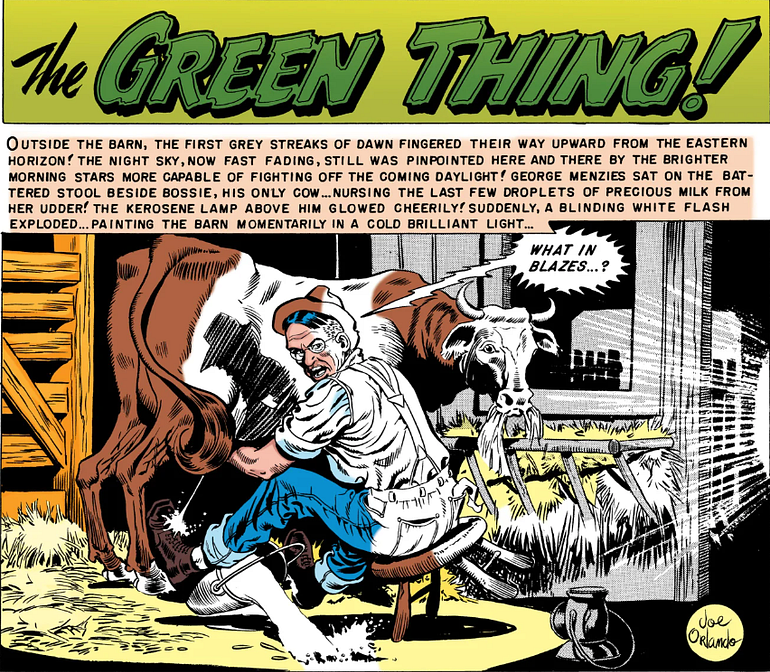
I have always enjoyed reading EC Comics from the 1950s because William Gaines and the crew didn’t shy away from broaching topics such as antisemitism, racism, sexism, and more. Even in stories that seemingly, on the surface, seem to have nothing whatsoever to do with these issues, they expose these issues, specifically the social constructions of race. They do this in horror stories such as Al Feldstein’s “A Little Stranger” and explicitly in stories such as Joe Orlando and Al Feldstein’s “Judgment Day.” On the surface, Joe Orlando, Bill Gaines, and Al Feldstein’s “The Green Thing!” from Weird Fantasy #16 doesn’t appear to deal with race. It looks just like a typical alien invasion story where a spacecraft crashes near a farm and starts killing anything that it infects. Yet, when we look closer, it’s an interrogation, like “A Little Stranger,” of racist thought and the social constructions of race.
“The Green Thing!” appeared at the end of 1952, two years after the Red Cross stopped segregating blood donations, two years before Brown v. Board of Education, and 15 years before Loving v. Virginia. At its core, “The Green Thing!” deals with the racist idea of contaminated blood or bodily fluids. This idea was used to argue against interracial intimacy, and it was used to segregate blood supplies. Nobel Peace Prize winner Bernard Lown talks about experiencing the latter during his time as a medical student at John Hopkins University in the mid-1940s. During medical school, Lown worked in the blood bank, and there he “confronted a conflict of values.” The blood bank segregated white blood donors from Black blood donors, even though, as Lown puts it, the “apartheid in blood had no scientific basis.”
Lown goes on to talk about whey the blood bank had a larger stock of “Black” blood than “white” blood. He says this difference came about, in part, through medical malpractice when, as personnel saw the amount of “Black” blood getting low they would shoot up a patient with morphine, tell the family the patient took a turn, then draw blood from the patient, without their knowledge. Lown didn’t participate in this act; instead, he subverted the “apartheid in blood” by turning the “C,” which stood for “colored,” on vials to a “W” for “white.” He did this for a while, conducting his own act of subterfuge.
When a colonel from Georgia came in, needing blood because he was going to have prostate surgery, he spoke to another student, John, about his “pedigree” and told John he’d pay him $50 a pint for his blood. The colonel did this because, as he said, being “in damn Yankee country” he didn’t want to, as Lown puts puts it, “get polluted mongrel blood or, worse still, “n***** blood.” John looked like he couldn’t risk giving too much blood, and Lown convinced him to just give the colonel some of the “Black” blood with the appended “W” on the vial. The colonel said he had never felt better after the operation and blood, and he was none the wiser.
However, the colonel asked for more blood because it was so good. Thus, John did the same thing, another time. Since John spoke a lot, he commented on the act, talking about “how he ad outsmarted the ‘Southern cracker’” and made some money off of him. This got Lown in trouble, and Dr. Alfred Blalock, the chairman of the Department of Surgery, called him into his office. Blalock, also from Georgia, told Lown, “Neva in the long history of infamy had such an immoral act been committed by someone aspiring to be a docta.” Blalock moved to get Lown expelled, but higher administration stopped that, even agreeing with Lown but telling him that change comes slowly. It would be another ten years, Lown, points out, before John Hopkins ended the “apartheid in blood.”
Lown details the racist thought behind contaminated blood, a thought we can see looking back to enslavement to Hitler and his comments about Jews and non-Aryans during the Holocaust. “The Green Thing!”, with its veneer of a typical alien invasion story, directly confronts these racist thoughts, pointing out their absurdity and the violent impacts of such thinking, impacts that lead to murder and death. After the ship crashes near the Mezies’ farm, an amorphous green being starts slithering towards the property, eventually “infecting” their dog. Once inside the dog, the thing causes the dog to lunge towards Kenny, at which point Kenny’s father George shoots it dead. The green thing departs the dead dog, and the dog becomes “[a] reddish mass of ooze” on the barn floor.
Next, the the green thing “infects” a horse in the barn, and the horse begins to buck and rear up. Like he did with the dog, George shoots the horse, causing the green thing to seek out another host. In both of these instances, the green thing, while causing a violent reaction within the animals, can be seen as trying to escape an attack from those it comes into contact with, reacting in a defensive, not an offensive, manner. Thus, the green thing looks for escape from harm, not to cause harm.
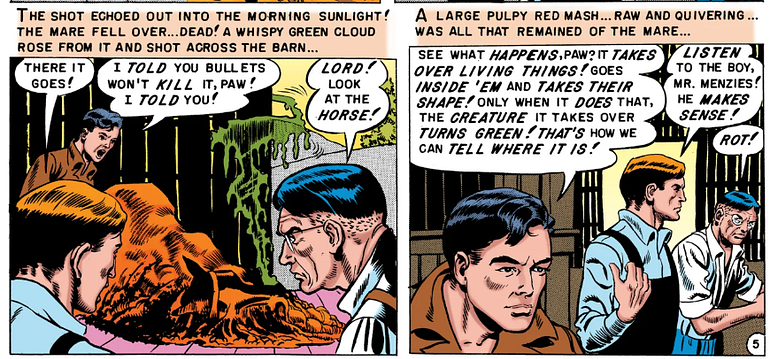
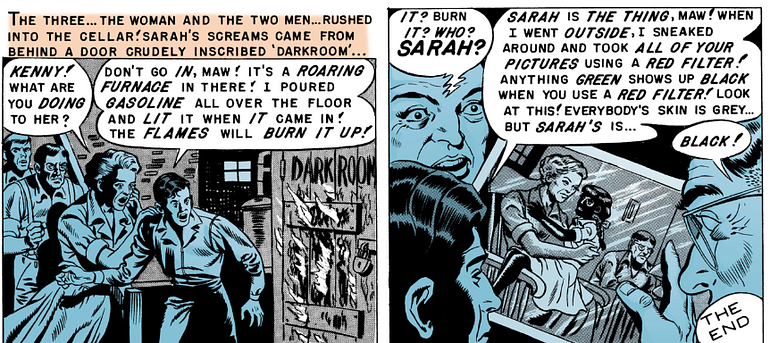
After departing the mare’s corpse, the green thing realizes that the humans can detect the being it “infects” because they can see the being turn green. Thus, the green thing causes everyone to become color blind, making them unable to detect its presence. However, Kenny realizes that he can use his camera and a red filter to take pictures because anything with that filter would cause anything green to show up as black to them. This technique allows Kenny to showw that Sarah, his young sister, is the green thing. She shows up as “black” in the photograph, and this realization causes Kenny to kill his sister by trapping her in the dark room and setting fire to it.
The reveal at the end of the story, with Sarah showing up as “black” in the final panel, drives home the undercurrent of racial contamination that the story exposes. In that panel, Kenny shows his family the picture and says, “Sarah is the thing, maw!” Notice. Kenny doesn’t say that the thing has entered Sarah or that the thing as contaminated Sarah. No, he says, that Sarah is the thing, a definitive statement that suggests she has been the thing all along, bringing the green thing to them and causing all of the chaos. Yet, she has not, over the course of the story, done anything to harm anyone, always reacting as the rest of the family does, fearful of what the amorphous mass will do to them.
Again, what makes “The Green Thing!” interesting stems from the ways that it, like “A Little Stranger” does with horror, uses science fiction to interrogate racist ideas. Thinking about EC Comics ethos, especially in relation to its preachies and more realistic stories, this makes complete sense. As well, “The Green Thing!” appeared in Weird Fantasy #16, two issues before the monumental “Judgment Day!” We need to think about stories such “The Green Thing!” in a broader sense, for what Gaines, Feldstein, and Orlando do with genre to expose the issues of our reality.
What are your thoughts? As usual, let me know in the comments below. Make sure to follow me on Bluesky @silaslapham.bsky.social.
 Interminable Rambling